UX strategy is the plan for how a product works for the people using it. Product strategy is the plan for what the product does and who it is for. When both support the same business goal, design improves real metrics such as adoption, retention, and revenue. A shared UX strategy framework makes that link clear.
Introduction
Most products don’t fail because they look bad. They fail because they solve the wrong problem. The screens look clean, sign-ups stall, and someone in a meeting asks why the numbers haven’t changed.
YUJ Designs helps businesses align UX design with product strategy so every design decision supports a clear business goal. Instead of treating them as separate efforts, we bring them together to create products that are intuitive for users and effective for businesses.
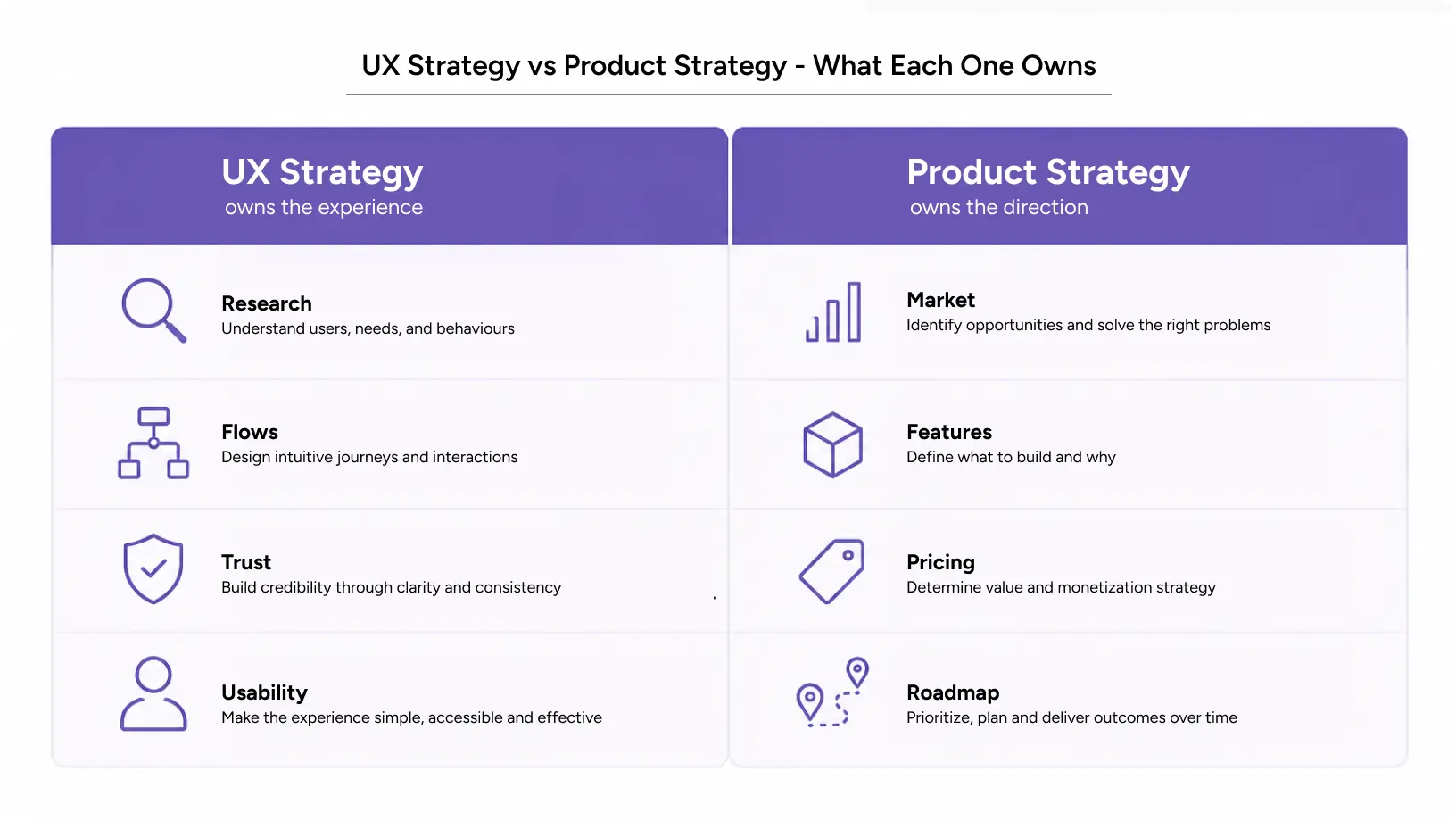
A good UX strategy focuses on how people experience and interact with a product, while a product strategy defines what to build, who it’s for, and the business goals it should achieve.
This guide keeps it simple. You will see how the two differ and where they meet. You will also see how an enterprise UX strategy ties each design choice to a business result.
Understanding UX Strategy and Product Strategy
A UX design strategy is your plan for how a product feels and flows, and how it builds trust. It covers research, structure, and the reasons behind each choice. It answers one plain question. How do we make this useful for the person using the product?
Product strategy is a level above. It sets the market, the customer, the price, and the features to build. The UX vs product strategy difference is right here. One owns the experience. The other owns the direction.
Take a bank fixing its lending app. Product strategy decides to target small business owners. The UX strategy decides how those owners apply, upload documents, and check their status without frustration. Both must agree. If they do not, the app ships quickly and still loses users.
Types of UX Strategy
Not every UX design strategy looks the same. The right one depends on how mature the product is and how large the team is.
- Foundational UX strategy: For new products with no research yet. You start by defining users, their jobs, and the core flows.
- Optimization UX strategy: For live products. You fix drop-off, reduce friction, and improve conversion using data you already have.
- Enterprise UX strategy: For large, complex systems with many user roles and older tools. Here, depth matters more than speed.
- Digital product strategy: A wider plan that combines UX, technology, and market direction in one view.
Use the foundational one when you are starting. Use optimization when growth slows. Use an enterprise UX strategy when the work spans many systems and teams.
UX Strategy Framework
A good UX strategy framework follows a few simple rules. Each one keeps design accountable.
Every choice should trace back to a real user need and a business metric. Research matters more than opinion. And the plan should live somewhere your whole team can see it and question it. A digital product strategy without these rules becomes a list of guesses.
Also Read: Building AI-Native Products at Scale: UX Patterns for Teams Moving Beyond the Minimum Viable Product
Why UX Strategy Matters in UX Design
When UX strategy and product strategy do not match, the business suffers. Features ship, but few people adopt them. Support tickets increase. Sales hears the same complaint for months. A clear UX transformation closes this gap. It also changes how the team makes decisions, not only how the product looks.
Impact on User Experience
A solid UX design strategy improves the parts of a product people feel day to day. It reduces mental effort, so users do more with less thinking. It widens access, so more people can succeed. And it builds the trust that makes someone rely on the product for real work.
This matters more for complex tools, not less. Enterprise users often have to use a system every day. A bad experience there does not annoy one person. It slows the whole company.
Impact on Business Metrics
A digital product strategy that takes UX seriously improves the numbers leaders track. Engagement rises when tasks feel worth doing. Conversion rises when friction drops at the key steps. Retention holds because the product stays worth using.
The data supports this. McKinsey studied 300 companies over five years. The top quartile for design grew revenue 32% faster than their peers. Their shareholder returns ran 56% higher. That result held across banking, consumer goods, and medical technology.
We see the same pattern at Yuj Designs. On DataMate, a banking product, we restructured how information was grouped and accessed. The redesign cut the clicks and time needed to finish tasks by up to 20%. That also lowered the cost of training new users. When we combine an enterprise UX strategy with a clear UX strategy roadmap and named goals, adoption follows.
Common Mistakes to Avoid
Teams tend to make the same few errors.
- Design as decoration: Polishing screens before the problem is clear. It looks good and fixes nothing.
- Strategy that stays on paper: A UX strategy roadmap nobody reads or updates is not a real plan.
- UX and product working apart: Two teams, two goals, one confused product. That is the common UX vs product strategy mistake.
How to Apply UX Strategy
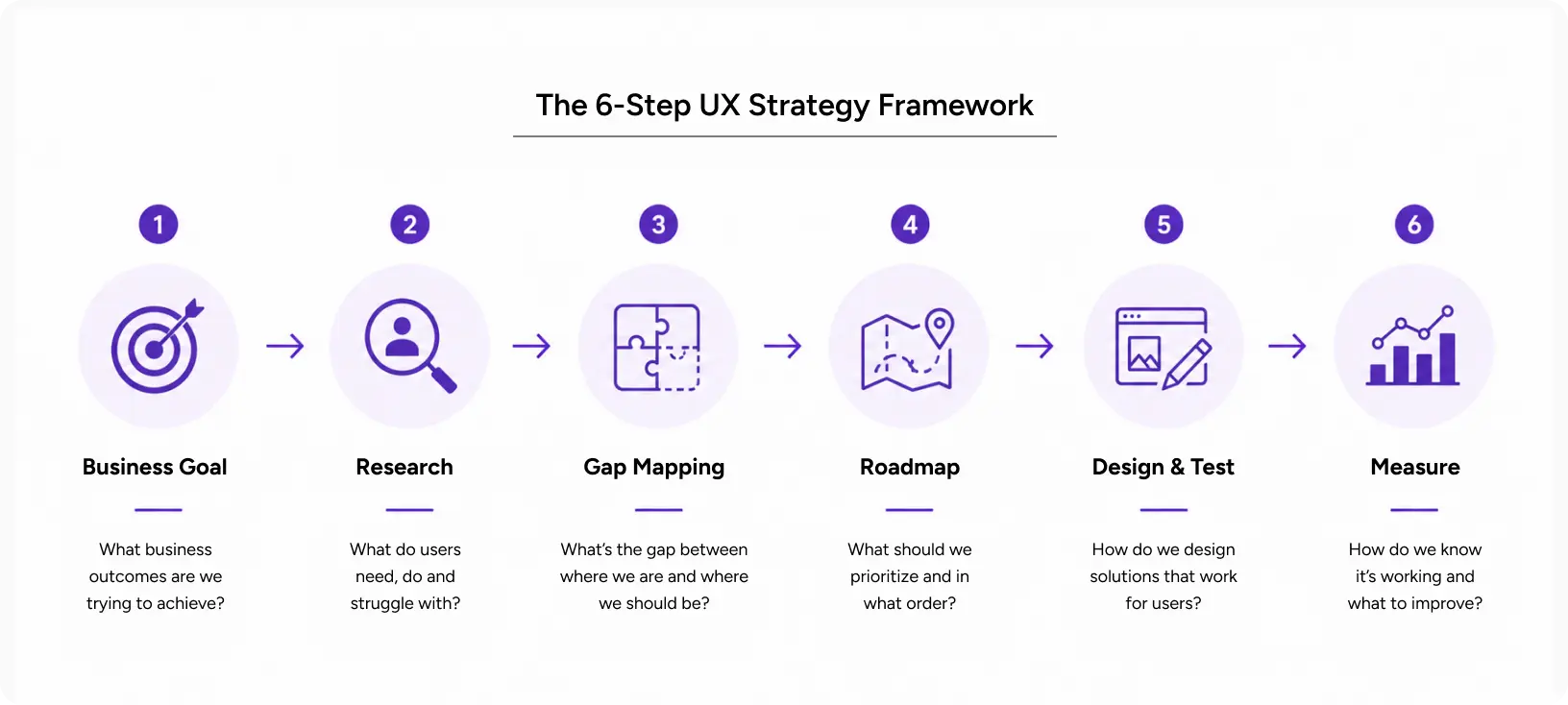
Aligning design with business goals is a process, not a one-time workshop. Done well, it results in a UX transformation you can measure. Here is the UX strategy framework Yuj Designs uses with product teams, step by step.
Step-by-Step Workflow
- Start with the business goal. Name the outcome that matters: revenue, adoption, retention, or cost. Write it down first.
- Research the user. Run interviews, usability tests, and a review of your analytics. Let evidence decide the debate.
- Map the gaps. Compare what users need against what the product does today.
- Build the roadmap. Order the work by impact, not by who speaks loudest. This is your UX strategy roadmap.
- Design and test. Move from rough ideas to prototypes to flows you have checked with real users.
- Measure and adjust. Track the metrics from step one. Then refine.
This is where a UX design strategy and product strategy meet. The roadmap becomes the shared agreement between both teams.
Pro Tips from Designers
A few habits save months. Tie every UX strategy roadmap item to one metric, or remove it. Keep the plan somewhere your product team checks each week. Treat a UX transformation as a change in how you decide, not only how you design. And review your enterprise UX strategy each quarter, because the market keeps changing.
One more point. Do not confuse being busy with making progress. A team can run studies, ship features, and still miss the goal if the digital product strategy never named that goal in the first place.
Tools & Resources
You do not need expensive software. Figma handles design and prototyping. Maze and Dovetail cover research and testing. GA4 and Hotjar show where users leave. A simple shared document can hold the UX strategy framework and roadmap, so everyone works from the same source.
Also Read: Wireframing vs Prototyping in UX: When to Use Which and How to Test Both
Real-World Applications
A UX strategy proves its value through results, not slides. Here is one example from Yuj Designs’ work in the US.
Case Study: UX Strategy at Boca West Club
When Boca West Club came to Yuj Designs, the real problem was event registration, not visual design. Older members had to click through screen after screen to book an event. Admins could not manage the portal without constant workarounds. We started with the product question. Which outcomes mattered most? Then we built the UX design strategy around them.
Yuj Designs rebuilt five connected products: the website, member portal, web app, native app, and admin app. They now share one layout, grouped tasks, high-contrast text, and fewer clicks for older users. The UX transformation produced clear business results: more conversions, better member retention and satisfaction, lower admin cost, and stronger cross-marketing.
Read More: Boca West Club Case Study
Conclusion
The UX vs product strategy debate has a simple answer. They are not rivals. Product strategy decides the direction. UX strategy decides how people move through the product. When both support the same business goal, design becomes a source of growth instead of a cost.
The teams that succeed treat this as one system. They name the outcome, support decisions with research, and keep a current UX strategy roadmap that product and design both share. A digital product strategy built this way keeps design and the business aligned. That is what separates a UX transformation that increases revenue from a redesign that only looks new.
A strong enterprise UX strategy is not about more screens. It is about the right screens, built for the person using them and the business paying for them. Decide the UX vs product strategy question early, and every later decision becomes easier. That is the work worth doing, and it is the work Yuj Designs is built around.

FAQs