A design thinking workshop is a structured session where a team solves a real product problem through empathy, ideation, and testing. It puts designers, engineers, and business stakeholders in one room to understand users, frame the right problem, and prototype solutions. Done well, it turns vague product complaints into clear, testable design decisions.
Introduction
Picture a product team stuck on the same complaint for months. Users keep leaving, and nobody knows why. Engineering blames the design, the design blames the requirements, and everyone has an opinion, but there is no shared evidence.
A design thinking workshop breaks that loop. It’s a focused session where the team stops guessing and starts working from what users really do. Instead of debating in yet another meeting, people observe real behavior, agree on the actual problem, and collaborate on solutions.
Most teams aren’t short on ideas. They’re short on a clear problem. They build fast, ship features, and still miss the point. A good session closes that gap. It’s where design thinking and UX research meet, so decisions rest on facts instead of the loudest voice in the room.
At YUJ Designs, we’ve run these sessions for enterprise products in banking, healthcare, automotive, and supply chain, out of both Pune and our Sunnyvale office in the USA. This guide walks through how to run one that solves a real product problem, not one that just fills a whiteboard with sticky notes.
You can discover what a session involves, why it matters for user experience, and a step-by-step method you can use next week.
What Is a Design Thinking Workshop?
A design thinking workshop is a guided working session. The team uses it to solve one specific product problem, and it starts with the user rather than the solution. The goal is simple: understand the person, define the real problem, then test ideas quickly.
Design thinking itself runs through five stages: empathize, define, ideate, prototype, and test. A session compresses those stages into a room, a day, or a full week of shared work, and it swaps long email threads for decisions made face-to-face.
What matters most is solving a real problem. Plenty of sessions solve pretend problems, because they start from a feature someone already wants to build. A strong session starts earlier, with evidence about where users struggle.
Key Characteristics
A good session needs a clear owner, a defined problem, and the right people in the room, meaning someone who understands users, someone who can build, and someone who owns the business outcome. Miss any of the three and the room drifts.
It’s also time-boxed, because constraints force decisions. A loose meeting with no clock produces discussion. A tight one produces prototypes.
Choosing the Right Type of Workshop
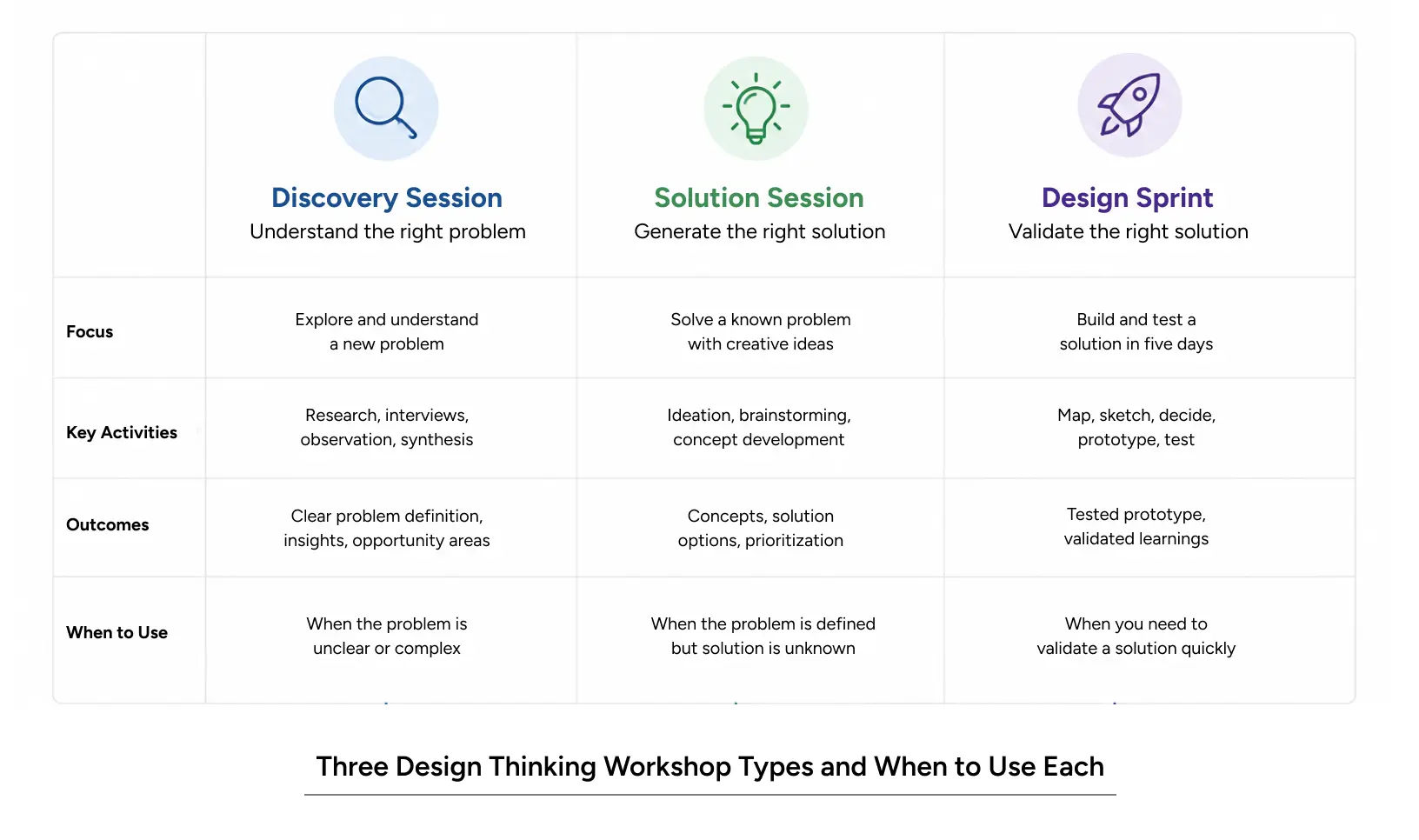
Not every session looks the same. Three design thinking examples show up again and again in practice.
A discovery session helps a team get its head around a new problem space, and it leans hard on user research and empathy in design thinking. A solution session takes a problem you already understand and generates concepts. A design sprint runs the whole method in five days and ends with a tested prototype.
Pick the type based on how much you already know. If you don’t understand the user yet, run discovery first, because solutions built on thin research just fail faster. These design thinking examples share one rule: research comes before ideas.
The best design thinking examples never treat the session as something separate from daily work. They wire design thinking and UX research together, so the insights you gain in the room feed straight into what you design next.
Also Read: Ethnographic Research in UX: How to Understand Users in Their Real Context
The Five Stages, and Where the Double Diamond Fits
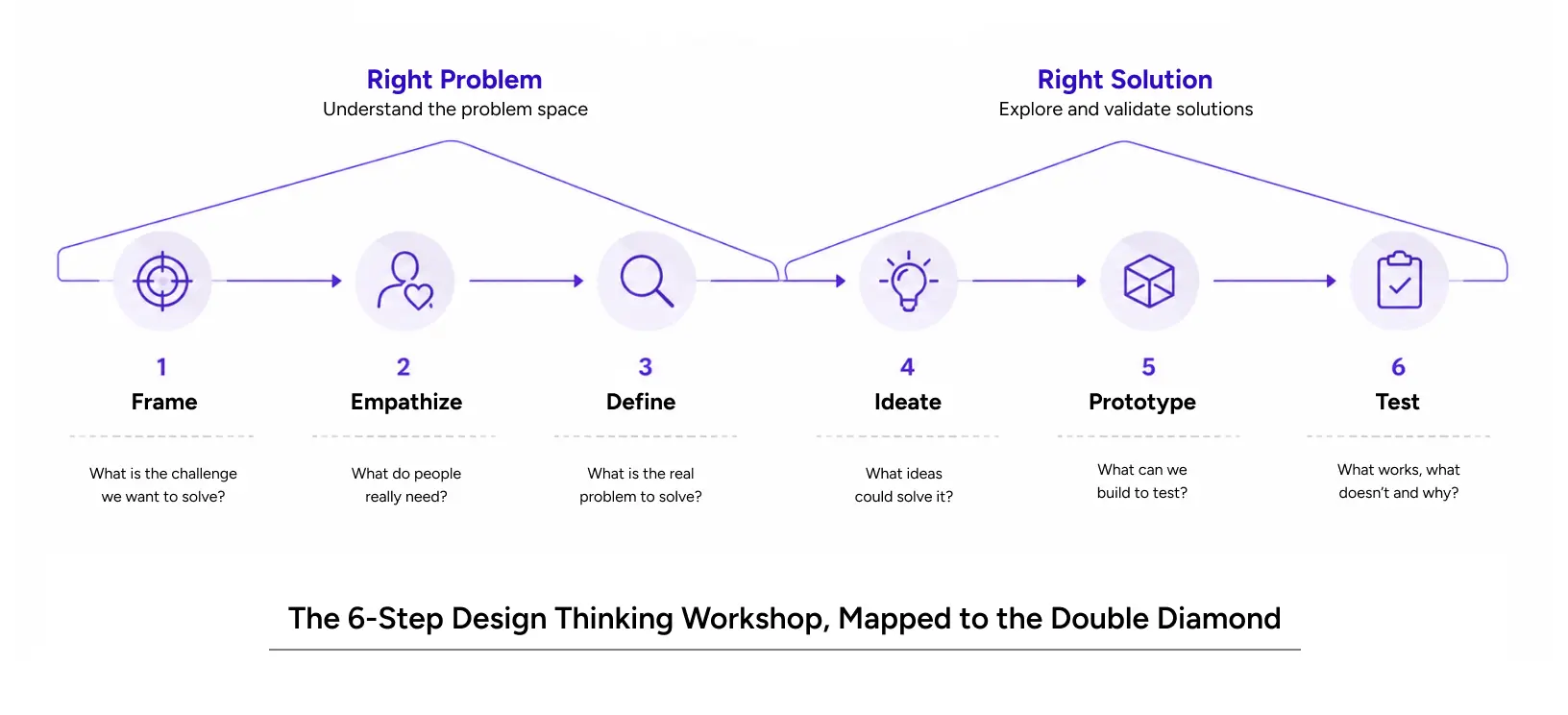
The five stages give you the actions. The double diamond design framework gives you the shape. The first two stages live in the first diamond, where you find the right problem. The last three live in the second, where you find the right solution. The model comes from the UK Design Council, and each diamond opens wide to explore, then narrows to a decision.
Stage 1: Understand the User
Start by researching how users actually behave, through interviews, observation, and support tickets. You’re building a real picture of the person, not guessing at one. This is the front edge of the first diamond.
Stage 2: Define
Turn all those observations into one clear problem the team agrees to solve. This closes the first diamond. It’s where empathy and design thinking do their most useful work, because you commit to the one problem worth solving instead of ten vague ones.
Stage 3: Ideate
Now open the second diamond. Generate a wide range of solutions fast, and don’t judge them yet. At this point, quantity matters more than polish.
Stage 4: Prototype
Take the strongest idea and make it real enough to test. A clickable Figma screen works, and so does a rough paper flow. It only has to be good enough for a user to react to.
Stage 5: Test
Put the prototype in front of real users and watch where they struggle. Their reactions narrow you down to one solution. The double diamond design approach keeps teams from leaping this far before they understand the problem.
Core Principles
Three principles hold the whole thing up. Start with the user, every time. Make ideas visible early, through sketches and rough prototypes. And test with real people before you spend a single hour of engineering time.
They’re simple to say and hard to live by. Teams under pressure cut research and testing first, which is exactly when the double diamond design discipline earns its keep, keeping everyone honest about the problem they’re really solving.
Why It Matters in UX Design?
A workshop isn’t a team-building exercise. It’s a way to make better product decisions. This is where design thinking and UX work pay off in numbers you can measure, and where empathy and design thinking stop being buzzwords and start shaping the product.
Impact on User Experience
When you build empathy in design thinking, you design for how people behave in the real world. You cut confusion, remove unnecessary steps, and lower the effort a task takes, so users finish what they came to do.
Good design thinking UX practice helps accessibility too. Watch real users, and you quickly see who gets stuck: the person on a slow connection, the first-timer, the expert in a hurry. You design for all of them, not just the ideal case.
Impact on Business Metrics
The business case is direct. Clearer experiences lift task completion, which lifts conversion. They cut support tickets, which cuts cost. They bring users back, which improves retention.
The numbers back this up. McKinsey studied 300 companies over five years and found the most design-led firms grew revenue 32% faster and delivered 56% higher total returns to shareholders than their peers (McKinsey, The Business Value of Design). Our own work follows the same pattern: the StubHub redesign lifted conversion by 4.4% and overall sales by 10.6%.
This is the link between design thinking and UX that leadership cares about. A session that solves a real problem moves a number that matters. Drop-off falls, adoption climbs, and revenue follows. Strong design thinking UX work pays for itself.
Common Mistakes to Avoid
The biggest mistake is skipping research. A session with no user evidence is just a group of people guessing confidently, so do the empathy work first, because empathy and design thinking are what separate insight from opinion.
The second mistake is leaving without making a decision. Ideas alone aren’t enough. A good design sprint ends with a clear direction and a prototype, not just a whiteboard full of sticky notes.
The third is inviting the wrong people. If nobody in the room can decide or build, you’ll just need a second meeting to get anything done.
How to Run a Design Thinking Workshop, Step by Step
Here’s the method we use at YUJ Designs on real enterprise projects. It fits into a single focused day, or a five-day sprint when the problem is bigger. Adjust the timing, but keep the order.
Step 1: Frame the Problem
Before anything else, write one problem statement, and base it on research rather than opinion. Get this wrong, and everything else becomes more difficult, so it’s worth the time.
Step 2: Build Empathy
Open with user evidence, whether that’s research, session recordings, or support tickets. The room has to feel the problem, not just hear a summary of it. This is empathy in design thinking in action, and it sets the tone for the day.
Real quotes and real behavior carry the weight here. Numbers tell you what’s happening; stories tell you why. You want both.
Step 3: Define the Real Problem
Now narrow. Turn all those observations into one clear problem that the team agrees to solve. This is the close of the first diamond, and you don’t move on until everyone can say the problem in a single sentence.
Step 4: Ideate
Generate solutions fast, and sketch instead of debating. Hand everyone paper and a marker. Quiet people tend to put ideas on paper they’d never say out loud in an argument.
Step 5: Prototype
Take the strongest concept and make it real enough to test. A clickable Figma prototype works. So does a paper flow. It only has to be good enough for a user to react to.
Step 6: Test
Put the prototype in front of real users and watch where they hesitate. Every hesitation is your next task. Testing is what turns a confident guess into evidence.
Pro Tips from YUJ Designs
Keep the group small. Too many people can slow the session down. A neutral facilitator helps everyone stay focused and keeps the discussion on track.
Close with owners and dates. A brilliant idea with no owner is dead by Friday, so write down who’s doing what next.
Tools and Resources
For remote sessions, we use FigJam or Miro for the shared board and Figma for prototypes. In person, paper and sticky notes still beat any app. Either way, the tool matters far less than the method.
Also Read: UX Audit Services: What’s Actually Included and When Your Product Needs One
Five Questions Every Design Thinking Workshop Must Answer
Plenty of teams run a session, cover a wall in sticky notes, and change nothing. Before you book a room, work through the five questions we use at YUJ Designs. The honest answers separate a workshop that ships decisions from one that only feels productive.
1. What separates a successful design thinking workshop from a superficial one?
A superficial session skips research and jumps straight to ideas. It feels productive because the room is busy, but energy isn’t evident. You can spot one fast: nobody can point to a real user, every claim opens with “I think” or “users probably,” and the output is a pile of features instead of a defined problem.
A successful session looks different. It opens with proof of how users behave, pulled from interviews, session recordings, or support tickets, and it spends the first half on the problem rather than the solution. People argue about what the user really needs, then settle on one problem worth solving.
The test is simple: at the end, can everyone state the problem in a single sentence? If they can, the session worked. If the room produced ideas but no clearer problem, it was the decoration. In our experience, the sessions that flop almost always cut research to save time.
2. How do you turn workshop outcomes into real product decisions?
The hardest part isn’t the session. It’s the week after. Good ideas die when nobody owns them or ties them to the roadmap; the energy fades, priorities shift, and the notes end up in a folder no one opens.
So we close every session with three things: a chosen direction, a named owner, and a date. Each idea maps to a real product decision, a backlog item, or a test. A vague “we should improve onboarding” turns into “redesign the first-run screen, owned by Priya, tested by the 14th.”
We also write down what the team decided not to build, and why, which stops the same debate from coming back next month. Research has to connect to delivery, or the insight never ships. The workshop is the start of the decision, not the decision itself.
3. What stakeholder groups should be involved, and why?
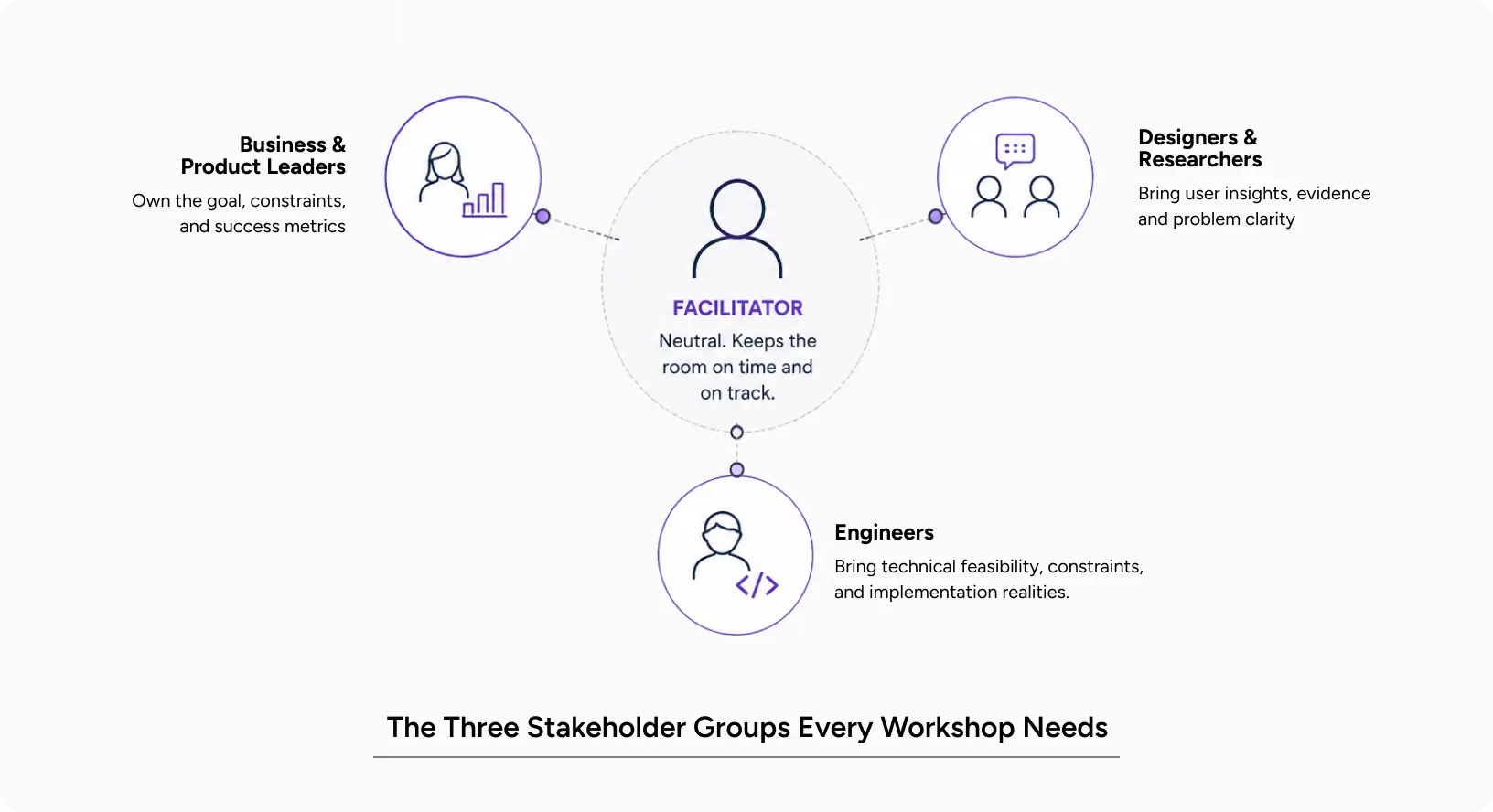
The wrong attendees are the most common reason a session fails. You need three groups in the room, and each has a clear job.
Product and business leaders bring the goal; they know the metric that matters and can approve a direction on the spot. Designers and researchers bring the user evidence and empathy in design thinking that keeps the room anchored to real behavior instead of assumptions. Engineers bring feasibility, flagging what’s cheap, what’s hard, and what simply won’t ship, before the team falls for an idea that can’t be built.
Leave out engineering, and you get ideas that stall in development. Leave out the decision-maker, and you get a second meeting to approve everything. Leave out research, and you design for a user who doesn’t exist.
Keep the core group to six or seven. Any bigger and the session slides into a status meeting. Pull in domain experts, sales, or real users for the parts that need them, then let them get back to work.
4. What common facilitation mistakes reduce a workshop’s effectiveness?
Good facilitation is invisible. Bad facilitation is expensive. A handful of mistakes wreck more sessions than anything else.
The first is letting the loudest person set the direction, because seniority isn’t evidence. A good facilitator protects the quiet voices, often through silent sketching, so the best idea wins rather than the most confident one. The second is skipping the clock; with no time limits, discussion expands to fill the day, and no decision gets made. The third is ending with no test, since a prototype nobody showed to a user is still just a guess.
Smaller traps add up, too. No pre-read burns the first hour. Fifteen people in the room means most of them only watch. Designing before the problem is defined produces confident answers to the wrong question.
The fix is one neutral facilitator with no stake in the result. Their only job is to keep the room honest, on evidence, and on time.
5. Can a workshop lead to real business or product outcomes?
Yes, as long as the process is followed properly. A workshop isn’t decoration. Done right, it moves the numbers leadership tracks: conversion, sales, retention, and support cost.
The chain is direct. A workshop finds the real reason users drop off, the redesign fixes it, and the metric moves. McKinsey found the most design-led companies grew revenue 32% faster than their peers over five years, and that gap starts with decisions made in rooms exactly like these.
The StubHub project below is a clear example. The team ran the same research-first, test-last process, and the redesign lifted both conversion and sales. Here’s how it played out.
Also Read: Wireframing vs Prototyping in UX: When to Use Which and How to Test Both
Real-World Application: The StubHub Marketplace Redesign
Here’s a real example of that process producing meaningful business and product outcomes. It’s one of our design thinking UX projects for a US product.
StubHub is the largest secondary ticket marketplace in the United States, selling tickets for sports, theater, and concerts. The problem was low conversion. The buying flow had confusing labels, weak seat maps, and clumsy event discovery, and plenty of buyers gave up before checkout.
YUJ Designs started with the user. Through user research and a close read of the task flow, we found the real pain points. A complicated search buried new events. A static seat map left buyers with no sense of the actual view.
So we rebuilt the flow. We regrouped the information, cut steps, and designed a dynamic seat map that showed the view, row, and price for every seat. Then we tested it with real buyers before shipping.
Conversion rose 4.4%, overall sales rose 10.6%, and the seat-selection redesign drove a reported USD $117M ROI. It’s one of the clearest design thinking examples we point clients to.
Read More: StubHub UX case study.
Conclusion
A design thinking workshop isn’t about sticky notes or clever ideas. It’s a dependable way to solve a real product problem, starting with the user and ending with a tested solution.
The method works because it forces order. Build empathy first. Define one problem. Generate ideas, prototype, and test. Lean on the double diamond design shape, so your team doesn’t end up solving the wrong thing well.
Connect design thinking and UX research this way, and you stop guessing and start deciding on evidence. The best design thinking examples all end the same way, with a real decision backed by real users. That’s the gap between a session that fills a wall and one that moves a metric.
At YUJ Designs, we ran these sessions for products people rely on every day, for clients in India and the USA. If you want a session that changes what you build next, not just how a meeting feels, we’d be glad to help.

FAQs