
Ethnographic research in UX is a method of studying people in their real environment to learn how they actually behave, work, and make choices. Instead of asking users what they do, designers watch them do it. This reveals honest needs, habits, and context that surveys and interviews often miss.
Introduction
A nurse on a busy night shift uses a hospital app with one hand, in dim lighting, while managing urgent patient care. In an interview, she can describe the challenges she remembers. On the ward, you see the real challenges as they happen, where every second matters and every extra tap or delay affects patient care.
This gap is exactly why ethnographic research exists. People rarely act the way they describe. Users often forget the steps they actually take, overlook the workarounds they’ve developed, and adapt to challenges they no longer notice. When teams design based on what users say rather than what they do, products can fail in ways that affect adoption and business results.
At Yuj Designs, we have watched this pattern across 3,000+ projects. And the strongest insight rarely comes from a script. It comes from watching someone in their own setting, doing their own tasks, on their own terms. That is the heart of ethnography and design.
In this guide, you will learn what ethnographic research means, the main ethnographic research methods, real ethnographic research examples, and how to run this work without a huge budget or timeline.
Understanding Ethnographic Research
Ethnographic research is the practice of studying users inside their natural context. You observe, listen, and take part in their world instead of pulling them into yours. The goal is simple. See the truth of how people live and work, not the polished version they report.
The method comes from anthropology. Researchers once lived inside communities for months to understand culture. UX borrowed the idea and made it faster and sharper. Today, ethnography and design work together to ground product decisions in real human behavior.
Three traits define this approach. First, it happens in context, not in a booth. Second, it favors observation over opinion. Third, it captures the small details, such as sticky notes, side conversations, and shortcuts, that shape real use.
Types and Variations
Several ethnographic research methods fit different needs and timelines.
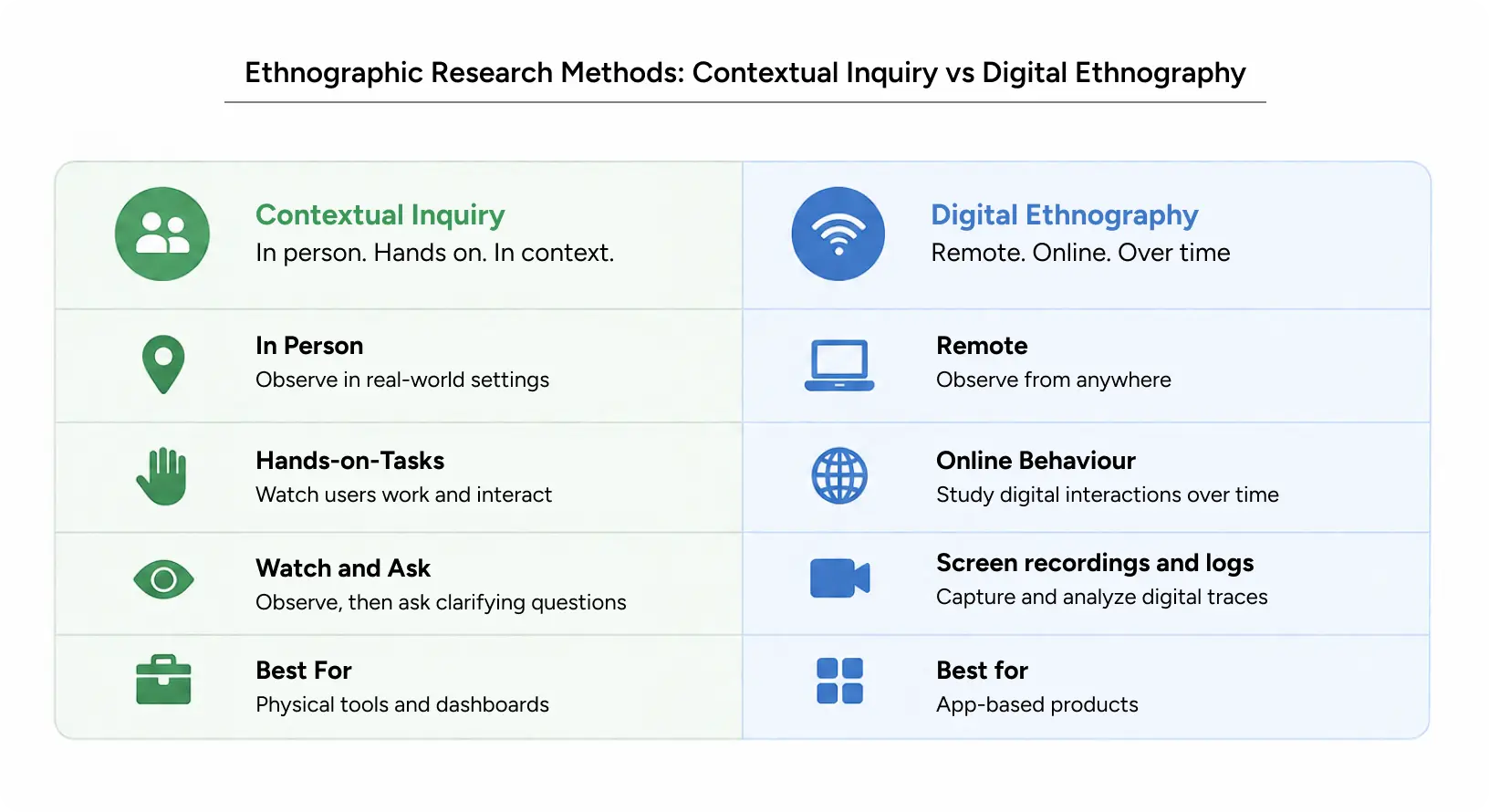
- Contextual inquiry: You watch users do their tasks and ask short questions in the moment. Contextual inquiry blends observation with a light interview, so you learn the “what” and the “why” at once.
- Contextual inquiry UX field studies: A focused form of contextual inquiry UX where you sit beside users at their actual workstation. This works well for complex tools like dashboards, banking systems, and enterprise software.
- Digital ethnography: You study behavior in online spaces. It covers chat logs, app recordings, community forums, and remote sessions. This method suits products where the “environment” is a screen.
- Diary studies: Users record their own actions over days or weeks. This method captures habits that a single visit would miss.
Each type answers a different question. Use hands-on observation for physical tools, and use remote study for screen-based products. Many teams mix both to see the full picture.
Core Principles
Good ethnographic research follows a few rules. Stay curious, not certain. Watch first, then ask. Record what happens, not what you expected. Respect the user’s space and pace. These principles keep your findings honest and easy to act on.
Also Read: E-Commerce UX Design: The Patterns Behind Product Pages and Checkouts That Convert
Why It Matters in UX Design
Ethnographic research matters because context changes everything. A feature that feels smooth in a demo can break in a warehouse, a clinic, or a moving vehicle. When you study real settings, you design for real conditions.
Impact on User Experience
Field insight improves usability in direct ways. You spot the moment a user hesitates. You see the workaround they built to survive a bad flow. You learn which steps add stress and which ones add value.
This reduces cognitive load, since you remove the friction users actually feel. It also improves accessibility, because you observe people in low light, in noise, and in a hurry. Strong contextual inquiry UX work turns these observations into clearer, calmer screens.
Here is a simple example. A team assumed users read every alert in their app. In the field, we saw people swipe alerts away without a glance. The real problem was not the wording. It was the timing and the volume. Only field observation exposed that truth.
Impact on Business Metrics
Better context leads to better numbers. Products built on field studies tend to see higher adoption, as they match real-world habits. Engagement increases when the design aligns with the moment of use. Retention improves when the tool feels made for the person, not the persona.
Trust grows, too. When ethnography and design shape a product, users sense that someone understood their world. That feeling drives loyalty and word of mouth.
Common Mistakes to Avoid
Teams often stumble in the same places. They rely only on interviews and skip observation. They run one contextual inquiry session and treat it as proof. They ignore remote study for online products. They also let bias lead, watching only for what they hoped to find. Avoid these traps, and your ethnographic research methods will pay off.
Putting Ethnographic Research into Practice
You do not need a year in the field. A focused study of a few days can shift a whole roadmap. Here is a practical way to run this research with a small team.
Step-by-Step Workflow
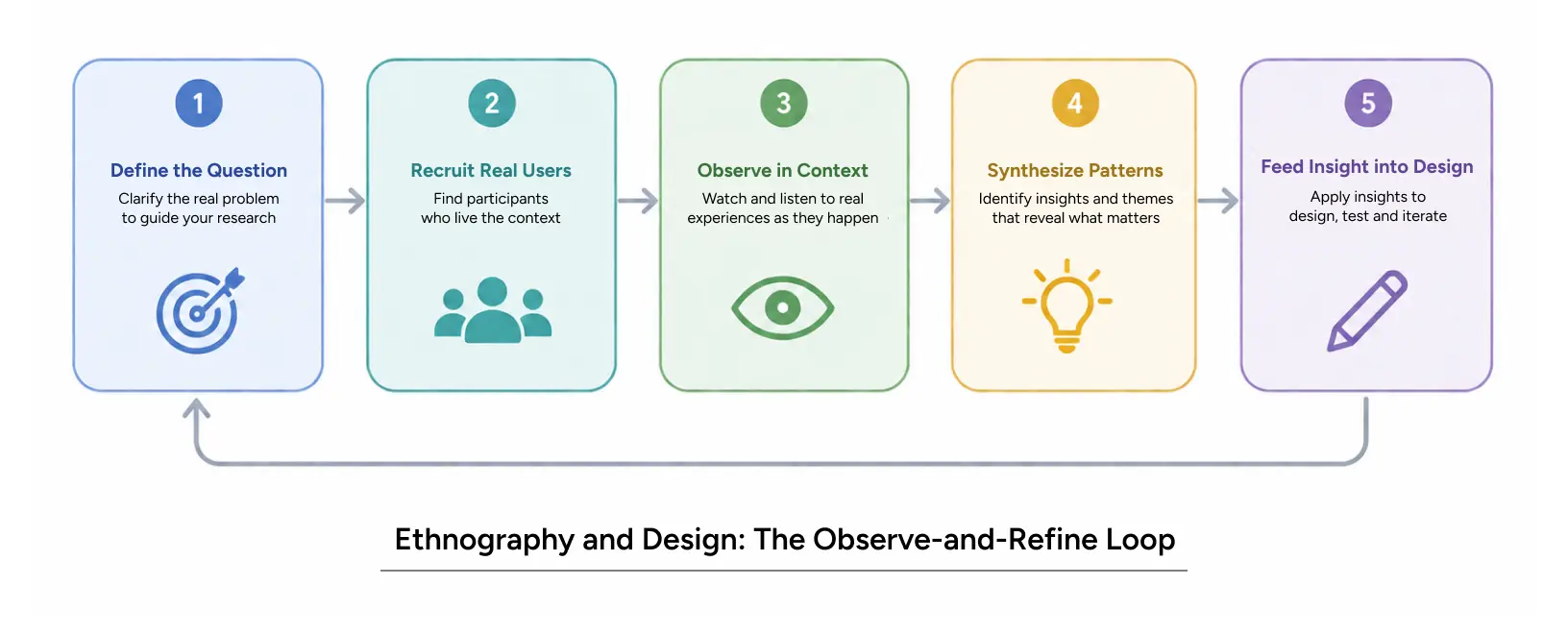
Step 1: Define the question.
Pick one clear behavior you want to understand. A sharp question keeps the study focused. For example, “how do nurses log patient notes during a night shift?” works better than “how do nurses use our app?”
Step 2: Choose your method.
Pick hands-on observation for physical tasks, or remote study for online behavior. Match the method to where the action happens. If people use your product on the go, plan to meet them there.
Step 3: Recruit real users.
Find people who do this task in their daily life. Avoid friends, coworkers, or anyone who wants to please you. You need honest habits, not polite answers.
Step 4: Observe in context.
Visit their space or watch their screen while they work. Let them lead. Stay in the background and resist the urge to guide or fix things in the moment.
Step 5: Ask light questions.
In contextual inquiry UX, ask “why did you do that” without breaking their flow. Keep questions short and open. Follow their actions, and let curiosity, not a script, shape what you ask next.
Step 6: Capture everything.
Note actions, words, tools, and emotions. Record the workarounds, the sighs, and the sticky notes. With permission, use photos or screen recordings so you miss nothing.
Step 7: Synthesize patterns.
Group findings and look for repeated pain points. One odd moment is noise. The same problem across three users is a signal worth acting on.
Step 8: Turn insight into design.
Feed the patterns into your ethnography and design decisions. Tie every design change back to something you saw, so the whole team trusts the reasoning.
Pro Tips From Designers
Give Users Time to Respond
Avoid interrupting or rushing users during a session. Giving them enough time to think and answer often leads to more accurate and detailed feedback.
Record Every Usability Issue
Document every point where users face difficulty, even if it seems minor. Small issues often repeat across users and can reveal larger usability problems.
Review Ethnographic Research Examples for Workarounds
When reviewing ethnographic research examples from previous studies, pay close attention to the workarounds users create. These alternative ways of completing tasks often reveal design issues that need to be addressed.
Keep Your Original Notes
Avoid rewriting or summarizing your notes immediately after the session. Recording observations as they happen helps preserve important details that could be useful during analysis.
Use Two Researchers When Possible
Whenever possible, have two researchers conduct the session. One can lead the discussion while the other observes user behavior, records key findings, and captures details that may otherwise be missed.
Also Read: Why Agentic AI Design Is the Missing Link in Every AI Implementation Strategy
Real-World Applications
Ethnographic research examples show up across web design, mobile apps, and complex enterprise tools. The clearest lessons come from products used under pressure, where context shapes every tap.
Harley Davidson Case Study: A Connected Motorcycle App
Yuj Designs partnered with Harley Davidson to redesign its connected rider app. The old experience felt fragmented, and riders struggled to find the features that mattered after they bought the bike.
We started by understanding riders in their real world. That context shaped three clear personas: the long-haul rider who worries about fuel and service in remote areas, the lifestyle rider who values status over specs, and the community rider who lives for group trips. Each need came from real behavior, not guesswork.
Yuj Designs rebuilt the app around glanceable bike insights, simple servicing, roadside help, and community features. The results were strong: a 20% rise in monthly active users, 51% adoption growth on new cross-sell features, a 30% lift in service bookings, and 30% more referrals.
Conclusion
The full story doesn’t emerge during a feedback session. It unfolds in the user’s everyday environment, where real conditions shape real decisions. Ethnographic research gives teams a front-row view of those moments, transforming assumptions into design backed by evidence.
The methods are within reach for any team. Run a short contextual inquiry, try some digital ethnography, and study a few honest ethnographic research examples. Then let those patterns guide your product. This is how ethnography and design move from theory into real results.
At Yuj Designs, we build products that users feel, not just see. When you understand context, you design for the person behind the screen. That is the difference between a tool people tolerate and one they trust.

FAQs