A UX audit is a structured review of your product against real user behavior and proven usability standards. An auditor maps where people get stuck, confused, or drop off. You get a prioritized list of fixes, ranked by business impact. It is a diagnosis, not a redesign, and it usually takes three to six weeks.
Why is “our UI looks fine” a trap?
A product manager once told his app was fine. The UI looked clean. The brand colors were sharp. But users kept leaving in the first session.
That gap is the whole problem. A pretty screen is not the same as a usable one.
Here is what gets me every time. Teams pour months into visuals, then wonder why conversion sits at 11%. The screen looks good. The experience underneath it is broken.
This is exactly where a good UX audit agency earns its keep. It separates what looks right from what works. And most of the time, the two have very little to do with each other.
In this piece, we will walk through what a real UX design audit includes, the different types, the process Yuj Designs follows, and the signs that your product needs one now. No fluff. Just what we have learned from 25+ years of experience.
What a UX audit actually is?
A UX audit is a diagnostic process. Someone who does this work studies how people move through your product. They find the friction, name it, and tell you what to fix first.
Think of it like a home inspection before you buy. You want to know what is cracked behind the wall, not just whether the paint is nice.
A good UX design audit does three things. It shows you where users struggle. It explains why they struggle. And it ranks the fixes so you know what to tackle on priority.
It does not rebuild your product. That is the common misread. When teams ask us to audit UX design across an app, they sometimes expect new screens back. They get something more useful first: a clear map of what is actually wrong.
The audit UX design process leans on evidence, not taste. We check behavior data, not opinions. We watch real people, not imagined ones. Your loudest stakeholder is not your user.
Types of UX Audit Services and When to Use Each
Not every audit looks the same. The right type depends on the question you are trying to answer.
- Heuristic review. An expert checks your product against known usability principles. Fast, affordable, and good for a first read.
- Usability testing. Real users attempt real tasks while you observe. Slower, but it shows you exactly where people fail.
- Analytics-led review. You read behavioral data to find drop-off points and dead ends. Numbers tell you where; they rarely tell you why.
- Accessibility and technical review. You check compliance, load speed, and screen-reader support. This is where a website UX audit often surfaces problems nobody knew existed.
A full engagement usually blends two or three of these. One method alone gives you a partial answer. When you audit UX design properly, you triangulate: data points to the problem, testing confirms it, and heuristics explain the cause.
Choosing between them is where a seasoned UX audit agency actually helps. The wrong method wastes weeks. The right one pays for the whole project in a single finding.
Also Read: Agentic AI UX: How to Design Interfaces for Autonomous AI Agents
Why a UX audit matters more than a redesign
Redesigns are exciting. They are also risky. You can spend six months rebuilding a product and reproducing the same problems in a nicer font.
A UX audit protects you from that. It tells you what to keep, what to cut, and what to fix, before anyone opens Figma.
The user impact
Small friction adds up fast. A confusing label. A form with too many fields. A button that hides below the fold. Each one costs you a fraction of your users. Together, they bleed you dry.
A UX design audit finds these one by one. It lowers cognitive load. It removes the moments where a tired person, on a slow connection, at 11 pm, decides your product is not worth the effort.
The business impact
This is the part leadership cares about. Drop-off is a revenue problem wearing a UX costume.
We have seen a single fix move trial-to-paid conversion from 11% to 27%. The model did not change. The experience did. That is the kind of return a focused website UX audit can point you toward.
Retention improves. Support costs fall. Sales cycles shorten because the product explains itself. A strong audit UX design effort connects each fix to a number, so you can defend the spend upstairs.
The mistakes to avoid
The biggest one: auditing for looks instead of behavior. If your report talks about aesthetics and never mentions a task-completion rate, walk away.
The second: a giant list with no priorities. Two hundred problems are not a plan. Ten ranked fixes are. Any UX audit company worth hiring gives you the second one.
What is actually included in UX Audit: the step by step process
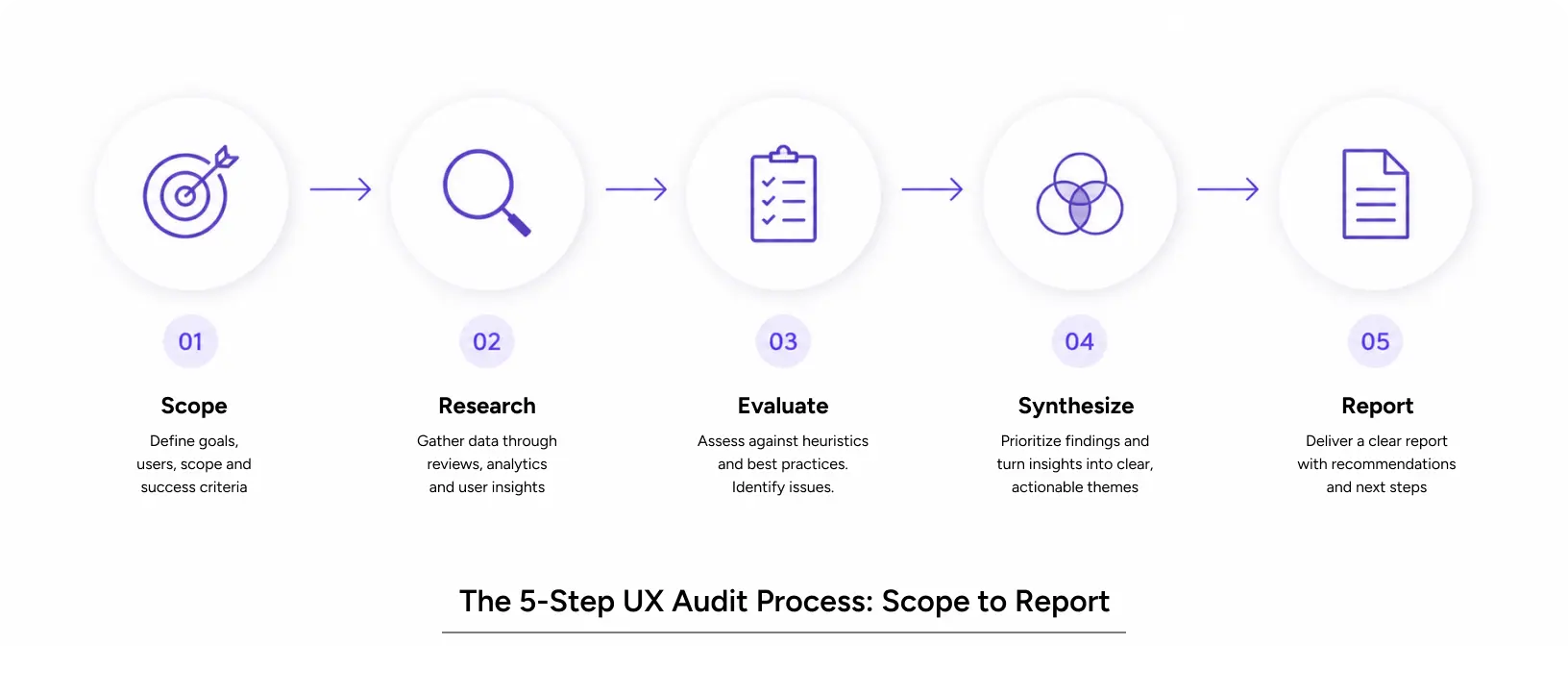
Here is how a real audit UX design engagement runs, start to finish. This is the process we follow at Yuj Designs, refined across hundreds of projects for enterprise clients in the US and India.
Step 1: Scope and goals. We start with your question, not your product. Are you losing users at sign-up? At checkout? A tight scope keeps a UX design audit focused and affordable.
Step 2: Research and data. We pull analytics, session recordings, and support tickets. We read what users already told you. Most teams sit on a goldmine of evidence they never open.
Step 3: Expert evaluation. Senior designers walk through the product against usability heuristics. Where budget allows, we run usability tests with real users. This is the core of any credible UX audit agency.
Step 4: Synthesis. We turn scattered findings into patterns. One broken flow often explains ten symptoms. Good synthesis is what separates a UX audit agency from a checklist tool.
Step 5: The report. You get findings ranked by impact and effort. Each one links to a user problem and a business metric. It reads like a plan, because it is one.
The tools behind this vary. We use Figma for annotation, Maze or UserTesting for research, and analytics platforms like GA4 or Hotjar for behavior. But the tools are the least interesting part. A good UX audit company sells judgment, not a checklist. The judgment is what you are paying for.
A quick pro tip from the team: never audit in a vacuum. Bring one engineer and one product owner into the readout. Fixes ship faster when the people who build them hear the “why” firsthand. This is where good UX audit services stop being a document and start being a change.
Also Read: How to Run Usability Testing: Moderated, Unmoderated and Remote Methods Explained
Signs your product needs a UX audit right now
You do not need to guess. A few signals show up again and again.
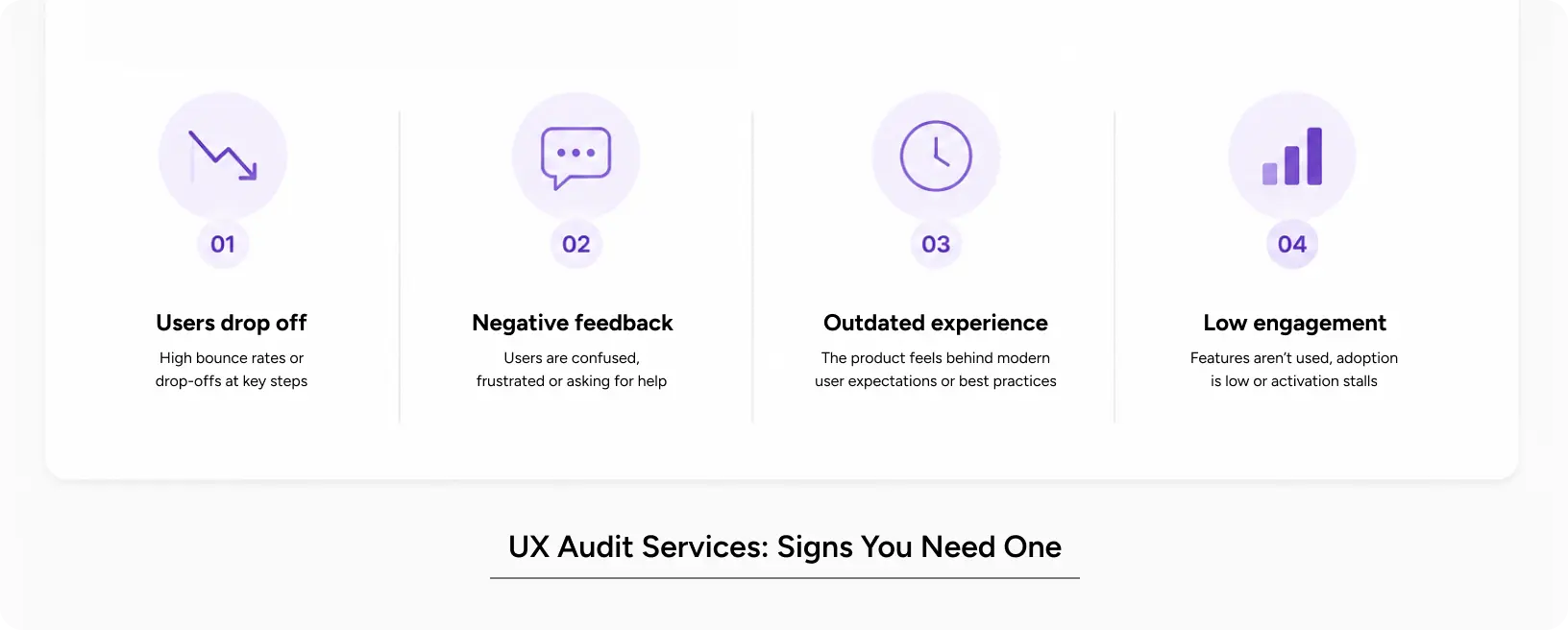
Users churn after the first session. Support tickets repeat the same complaint. A feature you shipped goes unused. Conversion drops after a release, and nobody can say why. Your team argues about design based on opinion, not evidence.
If two or more of these sound familiar, a website UX audit will pay for itself. And if you are about to fund a full redesign, run the audit first. Auditing before rebuilding is the cheapest insurance you can buy.
The best time to commission UX audit services is before the redesign, not after it fails.
Real example: how we audited a US supply chain app
Resilinc, a US-based supply chain risk company, came to Yuj Designs with EventWatch, their mobile app for event and risk management. The app worked, but engagement was thin, and they wanted to grow the user base.
Our review found classic friction. The app showed information with little relevance to users. Key event locations were missing. Current events stayed hidden unless someone tapped “More Stories.” Worst of all, finding which partners were affected took six clicks, with no upfront detail.
Those are exactly the problems a good ux audit company exists to surface. We restructured the information hierarchy and rebuilt EventWatch around a news-style feed, with clear categories for active, forecasted, and general events.
The outcome: higher user adoption, better perceived value, and lower support costs.
Conclusion
A clean interface hides a lot of broken behavior. That gap is quiet, and it is expensive.
A UX audit closes it. It finds where users struggle, explains the cause, and hands you a ranked plan you can act on. It protects you from redesigning the wrong things. And it ties every fix back to a number your leadership already watches.
The teams that win are not the ones with the prettiest screens. They are the ones who know exactly where their users trip, and fix those spots first. A serious UX design audit gets you there faster than any guess. If your product looks good but isn’t performing as it should, it’s time to look beyond the interface.
For over 25 years, YUJ Designs has helped enterprise clients across India and US uncover usability gaps and improve digital experiences from our base in Pune. We design experiences that work as well as they look.

FAQs