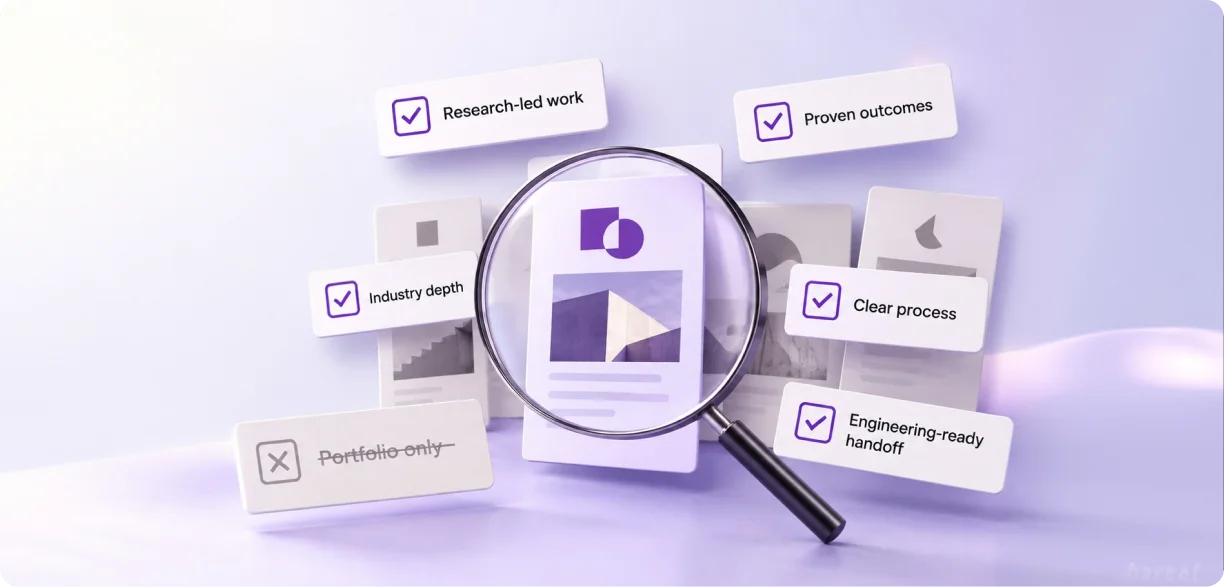
A good digital product design agency does more than make screens look good. Before hiring, check five things: proof of research-led work, outcomes tied to business metrics, depth in your industry, a clear process from discovery to developer handoff, and a team willing to challenge your brief. Evidence matters more than a pretty portfolio.
Introduction
Most product teams don’t hire the wrong partner because they skipped due diligence. They hire the wrong partner because they judged the wrong things.
A polished portfolio shot tells you a team can style a screen. It tells you nothing about whether they can untangle a claims workflow, cut drop-off in onboarding, or help 40 internal users trust a new AI feature. Those are different skills. They are also the skills you are actually paying for.
The stakes are higher than they look. Product engagements often run for months, and the best ones last years. A mismatch early on shows up later as rework, missed deadlines, and features users quietly ignore.
This guide walks through what to evaluate before you sign with a digital product design agency. It covers what these teams do, the criteria that predict good outcomes, the questions to ask on the first call, and the mistakes product leaders make most often. Whether you run a startup in the US or lead a product at an enterprise in India, the checklist works the same way.
It draws on what we’ve learned at Yuj Designs over 25+ years and more than 3,000 global projects, working with product teams at companies like Avis, Otis, Honeywell, and Wayfair.
What Does a Digital Product Design Agency Do?
A product design partner plans, researches, designs, and tests the software people use every day. That includes web apps, mobile apps, enterprise platforms, dashboards, and, more and more, AI-powered tools. The work covers the whole product, not just its surface.
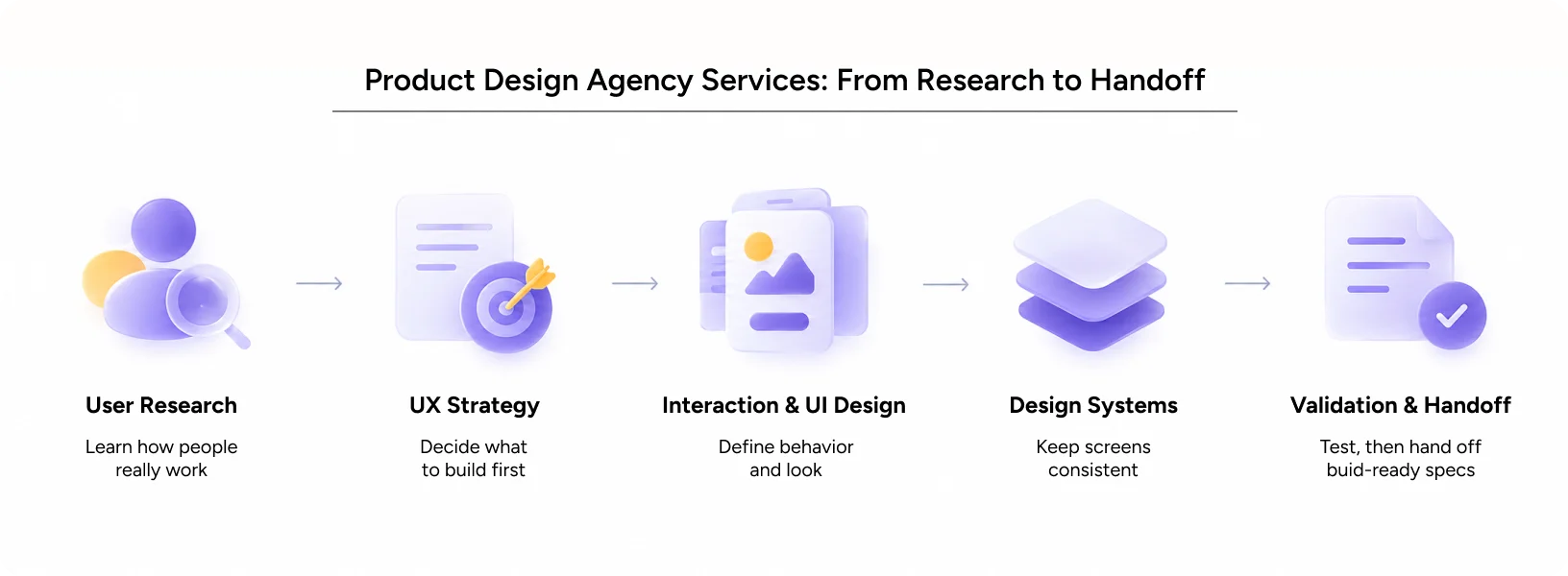
Here is what that scope usually looks like in practice.
User Research
Interviews, field studies, and user testing show how people really work. Good research reveals the gap between what users say and what they actually do. That gap is where most product problems hide.
UX Strategy
UX Strategy decides what the product should do, for whom, and in what order. It connects user needs to business goals. Without it, teams end up designing features nobody asked for.
Interaction and UI Design
This covers flows, wireframes, prototypes, and visual design. Interaction design defines how the product behaves when someone clicks, swipes, or waits. UI design defines how it looks and how easily it reads.
Design Systems
Large products need shared components, patterns, and rules. A design system keeps hundreds of screens consistent. It also helps engineers build faster, because they reuse tested parts instead of starting from scratch.
Usability Testing and Developer Handoff
Designs are tested with real users before anything is built. Engineers then receive specs, annotations, and assets they can build from without guessing.
UX Agency vs. UI Agency: Which Do You Need?
Here’s the distinction that matters. A user interface design agency focuses on how screens look and feel. An experience design agency looks further: at what users are trying to get done, where they get stuck, and how the product fits into their day. The best partners do both. They also know which problem they are solving at any given moment.
If your brief says “make it look modern,” you may only need visual polish. If it says “users won’t adopt the new module,” you need research and strategy first.
Also Read – Mobile App UX Audit: Find the Friction Losing Users
8 Things to Look For in a Digital Product Design Agency
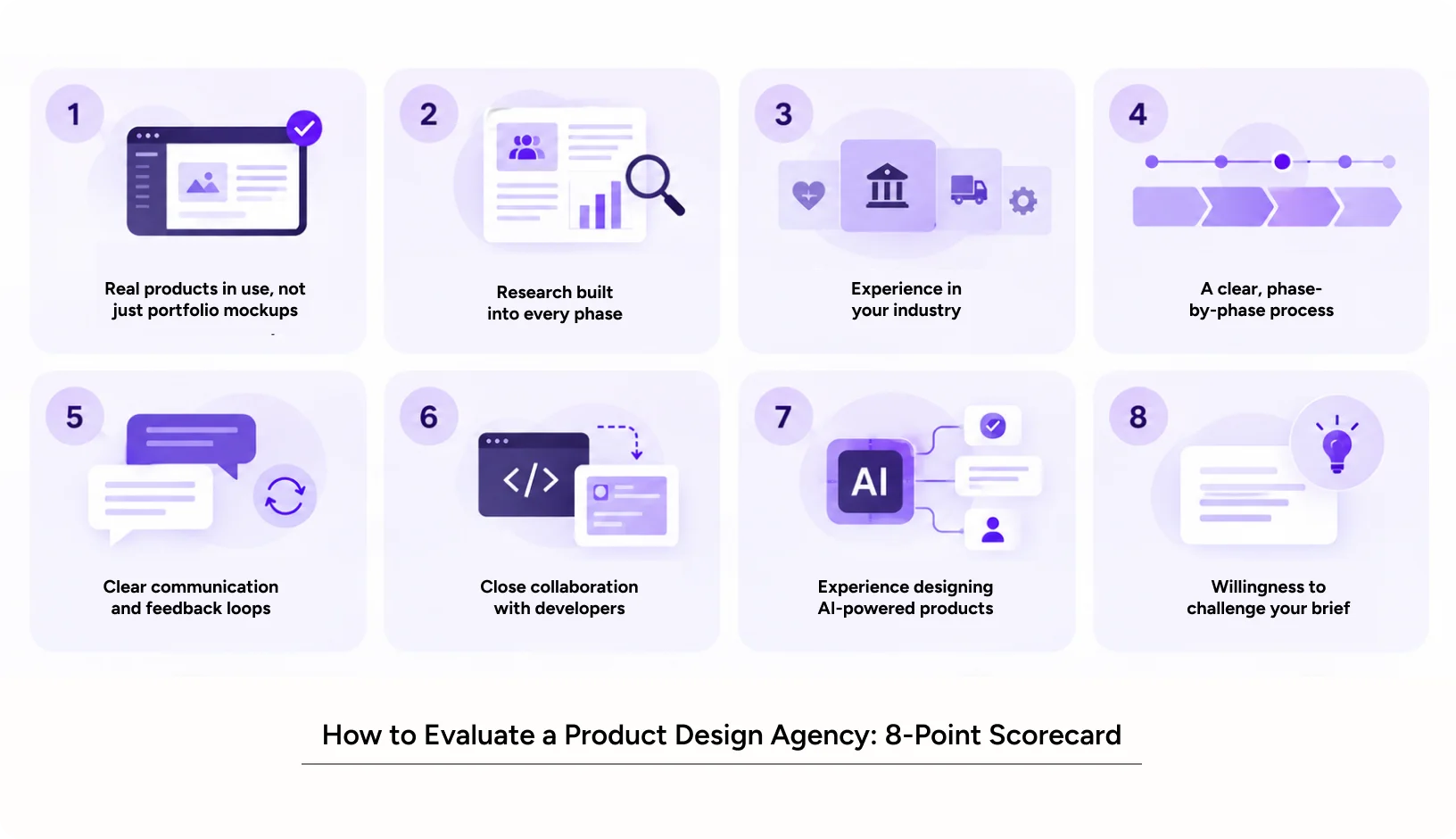
1. Real Products in Use, Not Just Portfolio Mockups
Concept shots are easy to make. Products that real people use every day are not. Ask which projects are live, who uses them, and what happened after launch. Even a specialist user interface design agency should be able to point to shipped work, not only polished mockups.
Then ask for case studies that state the problem, the method, and the result. A strong UX design services company can explain why a design decision was made, not only what it looks like. Look for a starting point, such as a drop-off rate, a support ticket volume, or a task time, and then for what changed. Even directional outcomes, like higher adoption or fewer support calls, show the team thinks in results.
2. Research Built Into Every Phase
Research should shape the work from week one. Ask how many users they usually speak to, which methods they use, and how findings changed a past design. Teams that treat research as optional end up designing for their own assumptions. A mature experience design agency builds it into every phase.
At Yuj Designs, research comes before any screen is drawn. Qualitative interviews, quantitative analysis, and user testing shape the first decisions, not just the final polish.
Ask to see a research plan or findings deck from a past project, with client details removed. You’ll learn how they recruit participants, how they make sense of what they hear, and how quickly insights turn into design decisions.
3. Experience in Your Industry
Fintech, healthcare, logistics, and industrial software each come with their own rules and user habits. A digital product design agency that has worked in your space asks sharper questions from day one. It also spends less of your budget learning the basics.
Domain experience matters most in regulated or high-stakes products. A banking app has compliance rules. A healthcare tool has clinical workflows. An industrial dashboard has operators who can’t afford a wrong click. Ask which past project looks most like yours, and what the team learned from it.
4. A Clear, Phase-by-Phase Process
You should know what happens in weeks one, four, and 12. Look for clear phases: discovery, definition, design, validation, and handoff. A good product experience agency will show you a sample plan and point out where you review and approve work.
Pay attention to how they handle change. Research often reshapes the plan. A well-run team builds review points into the schedule, so new findings can adjust scope without derailing the timeline.
5. Clear Communication and Feedback Loops
Good design work depends on fast, honest feedback in both directions. Ask how often they’ll check in, who your main point of contact is, and which tools they use to share work in progress. Weekly reviews and a shared workspace beat a big reveal at the end of each phase.
Also ask how they report progress and raise problems. A partner who flags a risk early, with a plan to handle it, is far more valuable than one who says everything is on track until it isn’t. If your team and theirs sit in different time zones, ask how they make sure decisions don’t stall overnight.
6. Close Collaboration With Developers
Designs that can’t be built are expensive. Ask how they hand off to developers, whether they build design language systems, and how they handle pushback from engineers. A dependable UX design services company will show you a real handoff file, not just final mockups.
The best partners invite engineers into design reviews early. That catches technical limits before they turn into rework. It also helps your developers understand the reasoning behind each decision.
7. Experience Designing AI-Powered Products
Many products now include recommendations, copilots, or autonomous agents. Users need to understand what the system is doing and when to trust it. Ask whether the product experience agency you’re considering has designed explainability, oversight controls, or human-in-the-loop flows for agentic AI.
AI features often fail quietly when users don’t trust them. People ignore recommendations they can’t explain and override automation they can’t monitor. Ask how the team designs confidence indicators, error recovery, and clear moments where a human approves or corrects the system.
Yuj Designs runs a dedicated agentic AI design practice for exactly this reason. The team designs trust interfaces, oversight dashboards, and human-AI collaboration patterns for autonomous enterprise systems.
8. Willingness to Challenge Your Brief
The right partner will question your brief when the evidence points elsewhere. That isn’t friction. It’s the value you’re paying for.
Ask for an example of a time they disagreed with a client. Listen for how they made the case: with user evidence, data, or a quick test. A partner who always agrees is easier to work with, but rarely improves the product.
Firms describe themselves in many ways. You’ll see “UI UX design services company,” “studio,” or “consultancy.” The label matters less than the work behind it.
6 Questions to Ask a Design Agency Before You Hire
Use these to see how an agency thinks once the sales pitch ends.
What problem did your last three clients hire you to solve?
This shows whether they think in problems or deliverables. Follow up with a simple question: What changed after launch?
Who from your team will actually work on our product?
Ask for names, roles, and experience. The people you meet in the pitch should be the people you work with.
How many users will we hear from?
A clear answer, with methods and participant numbers, shows the research is real. A vague one suggests research gets cut the moment budgets tighten.
Which metrics will you track with us?
Good partners agree on success measures upfront. Examples include task completion, feature adoption, time on task, and support volume.
What happens if research shows our roadmap is wrong?
This tests honesty. You want a team that will tell you, show the evidence, and propose a better path.
Do you stay involved during the build?
Handoff isn’t the finish line. Ongoing design support during development protects the quality of what ships.
A confident experience design agency will answer these directly, with examples. Vague answers about “best practices” usually mean there’s no repeatable method behind the work.
Also Read – Agentic AI UX: How to Design Interfaces for Autonomous AI Agents
5 Warning Signs When Hiring a UX Design Agency
They Quote Before They Understand
A fixed price after one call means they’re pricing screens, not outcomes. Good partners ask for discovery time before they commit to a scope.
No Research in the Proposal
Skipping research saves money upfront. It costs far more after launch, when every fix means reworking a live feature.
Senior People Appear Only at the Pitch
Ask who runs the work day to day. Request a meeting with that person before you sign.
Every Project Looks the Same
A house style suits a brand studio. For a UI UX design services company, it often means the user’s context wasn’t the starting point.
No Measurable Results
If an agency can’t name a single metric it moved, it probably didn’t track any.
Case Study: How Yuj Designs Redesigned Resilinc’s EventWatch App
StubHub, the largest online secondary ticket marketplace in the US, had a conversion problem. Its buying flow was packed with features, yet conversion had stalled.
User research showed why. Event schedules and seat maps were hard to read, labels were confusing, search made new events hard to find, and checkout took too many steps.
Yuj Designs regrouped information, redesigned micro-interactions, cut unnecessary steps, and kept key details visible at every stage. With a third-party partner, the team also designed a dynamic seat map showing row layout, seat number, price, and the view from each seat. The tested design was then extended to the native app.
The results:
- 4.4% increase in overall conversion rate
- 10.6% increase in overall sales
- USD 117 million ROI from the redesigned seat selection flow
This is what to look for when you hire: a clearly defined problem, research-led changes, and results you can measure.
Read More: StubHub case study.
Common Mistakes When Hiring a Product Design Agency
Even careful teams fall into a few predictable traps when they hire a design partner. Most of them come from judging the agency on the wrong signals, or setting up the engagement in a way that makes good work hard.
Hiring for Visual Polish When You Have a Research Problem
If users don’t understand your product, a fresh coat of paint won’t fix it. Hiring a user interface design agency to solve what is really a research or strategy problem is one of the most common ways to waste a design budget. Diagnose first, then hire for the problem you actually have.
Choosing on Price Alone
The lowest quote usually gets there by cutting research, testing, or senior time. Those cuts show up later as rework and low adoption. When comparing proposals, ask what each UX design services company left out to reach its number, not just what it included.
Treating Handoff as the Finish Line
A strong design can still fail in build when specs are unclear or developers join too late. Choose an experience design agency that stays close during development and reviews what ships, not one that disappears after the final file.
Skipping Usability Testing to Save Time
Teams under deadline pressure often drop testing first. They end up designing for an ideal user who doesn’t exist, or copying consumer patterns into enterprise tools where they don’t fit. A capable UI UX design services company will push back on this, because untested designs are the most expensive ones to fix after launch.
Measuring Success by Launch Date
Shipping on time matters, but it isn’t the goal. If nobody agrees on user and business outcomes before the work starts, nobody can tell whether it worked. A good product experience agency will set those measures with you upfront, such as task completion, adoption, or support volume, and track them after release.
How to Hire a Digital Product Design Agency in 5 Steps
Step 1: Define the Problem, Not the Deliverable
Write down what’s going wrong and how you’ll know it’s fixed. “Redesign the dashboard” is a deliverable. “Analysts take 20 minutes to find a report” is a problem a partner can solve.
Step 2: Shortlist 3–5 Agencies and Run Discovery Calls
Look for relevant case studies, verified client reviews, and published thinking. Don’t dismiss a specialist user interface design agency if your problem is purely visual. Then run discovery calls using the questions above. Pay attention to who asks better questions back, because that’s a preview of how they’ll work with you.
Step 3: Request a Scoped Proposal
It should list research activities, milestones, named team members, and success metrics. Compare proposals on what they include, not just the price.
Step 4: Check References
Don’t just ask about the final product. Ask past clients how the team handled deadlines, feedback, problems, and what happened after launch.
Step 5: Start With a Paid Pilot or Discovery Sprint
A short expert review or discovery sprint shows how an agency works before you commit to a long engagement. It gives both sides a low-risk way to test the fit. Yuj Designs offers expert reviews and user testing as standalone engagements for teams that want to start this way.
Conclusion
Hiring a digital product design agency is a product decision, not a procurement task. The right partner changes how your users work and how your business grows. The wrong one leaves you with attractive screens and the same old problems.
Judge evidence over aesthetics. Ask how they research, how they measure, and how they work with engineers. Start small, check references, and pick the team that asks the hardest questions.
Whether you need a product experience agency for a new launch, an experience design agency to fix adoption, or a UI UX design services company to rethink a legacy platform, the same test applies: can they show what changed for users?
Yuj Designs has spent 25+ years designing complex enterprise products for clients across the US, Europe, and India. If you’re evaluating design partners for your next product, let’s talk about what your users need next.

FAQs