
Agentic AI design is the discipline of shaping how autonomous AI agents reason, decide, communicate, and earn trust inside a real product. It combines AI UX design, behavioral logic, governance, and human-AI collaboration patterns to turn raw model capability into adoption and to make any AI implementation strategy actually deliver business outcomes.
Why Most AI Agent Use Cases Stall Before They Scale
Most leaders today are not short on AI ambition. They have models, pilots, vendors, a board slide, and a growing pile of proofs of concept. What they are short on is something far less glamorous: a clear approach to designing for AI as a human experience.
Pause for a moment and look honestly at the AI agents inside your organization. Do people actually use them? Or do those agents sit in a corner of your product, ignored, second-guessed, or quietly creating cleanup work for the team downstream? If any of that sounds familiar, you are not alone. It is the single biggest reason why AI projects fail after a confident launch, and it is rarely talked about in vendor pitches.
Across industries, the same pattern repeats: strong models, weak experiences, abandoned AI agent use cases, and a leadership team quietly wondering why AI projects fail to deliver the ROI promised in the business case.
The missing piece is rarely the model. It is agentic AI design, the craft of shaping how an autonomous agent thinks, acts, communicates, and earns trust within a real workflow. Without it, even the most capable model becomes another disappointing tool. With it, the same model becomes a teammate.
In this guide, we will walk you through what agentic AI design actually means, why AI UX design is no longer optional, the principles behind AI agent design that scale, a practical AI implementation roadmap you can use this quarter, and a real client story showing what changes when AI product design is treated as a strategic discipline rather than a finishing layer.
What Is Agentic AI Design and How Is It Different?
Agentic AI design is the practice of crafting how autonomous AI agents perceive context, plan actions, interact with users and recover gracefully when things go wrong. It is the bridge between a raw language model and a product people actually trust to act on their behalf.
Traditional automation follows fixed rules. An agentic system reasons, takes initiative, and adapts to changing conditions. That power cuts both ways. A well-designed agent feels like an experienced colleague who knows when to ask, when to act, and when to hand back control. A poorly designed one feels like an overconfident intern with the keys to your business. The difference comes down to deliberate AI agent design, which means treating the agent as a product rather than a feature.
AI Agent Use Cases That Drive Business Value
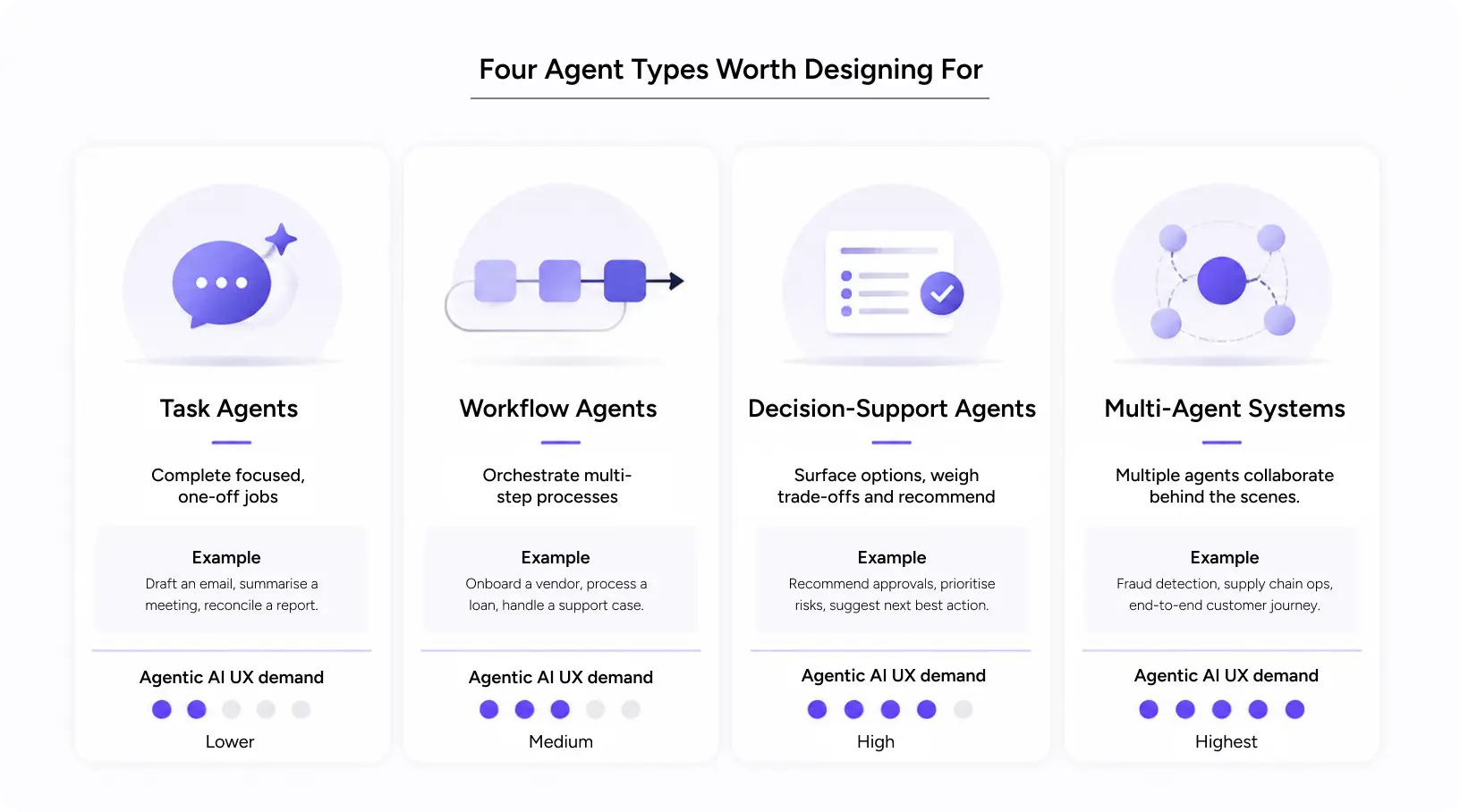
Not every AI agent use case needs the same approach. The most common categories include:
- Task agents that complete focused jobs like drafting an email, summarizing a meeting, or reconciling a report.
- Workflow agents that orchestrate multi-step processes across systems and people, often the heart of a modern process automation strategy.
- Decision-support agents that surface options, weigh trade-offs, and recommend, while leaving the final call to a human.
- Multi-agent systems where several specialized agents collaborate behind the scenes, requiring particularly strong agentic AI UX to keep humans informed without overwhelming them.
- Matching the agent type to the AI agent use case is the first design decision that quietly determines whether the project succeeds or stalls. Get this wrong, and no amount of polish later will save the experience.
Core Principles of Agentic AI Design and AI UX Design
Strong AI product design rests on a few principles that, in practice, separate the agents people love from the ones they tolerate:
- Transparency over magic. Show reasoning, sources, and confidence. Hidden logic erodes trust faster than any single failure.
- Boundaries before brilliance. Define what the agent can do, must not do, and should escalate. Good AI agent planning writes these rules before a single screen is sketched.
- Reversibility. Every consequential action needs an obvious undo. People take risks with agents only when they know they can step back.
- Graceful degradation. When the agent is uncertain, it says so. When it fails, the handoff to a human is smooth, not jarring.
These principles are not philosophy. They are the spine of any serious agentic AI design practice, and the difference between a demo that wows and a product that lasts.
Why Agentic AI Design Matters
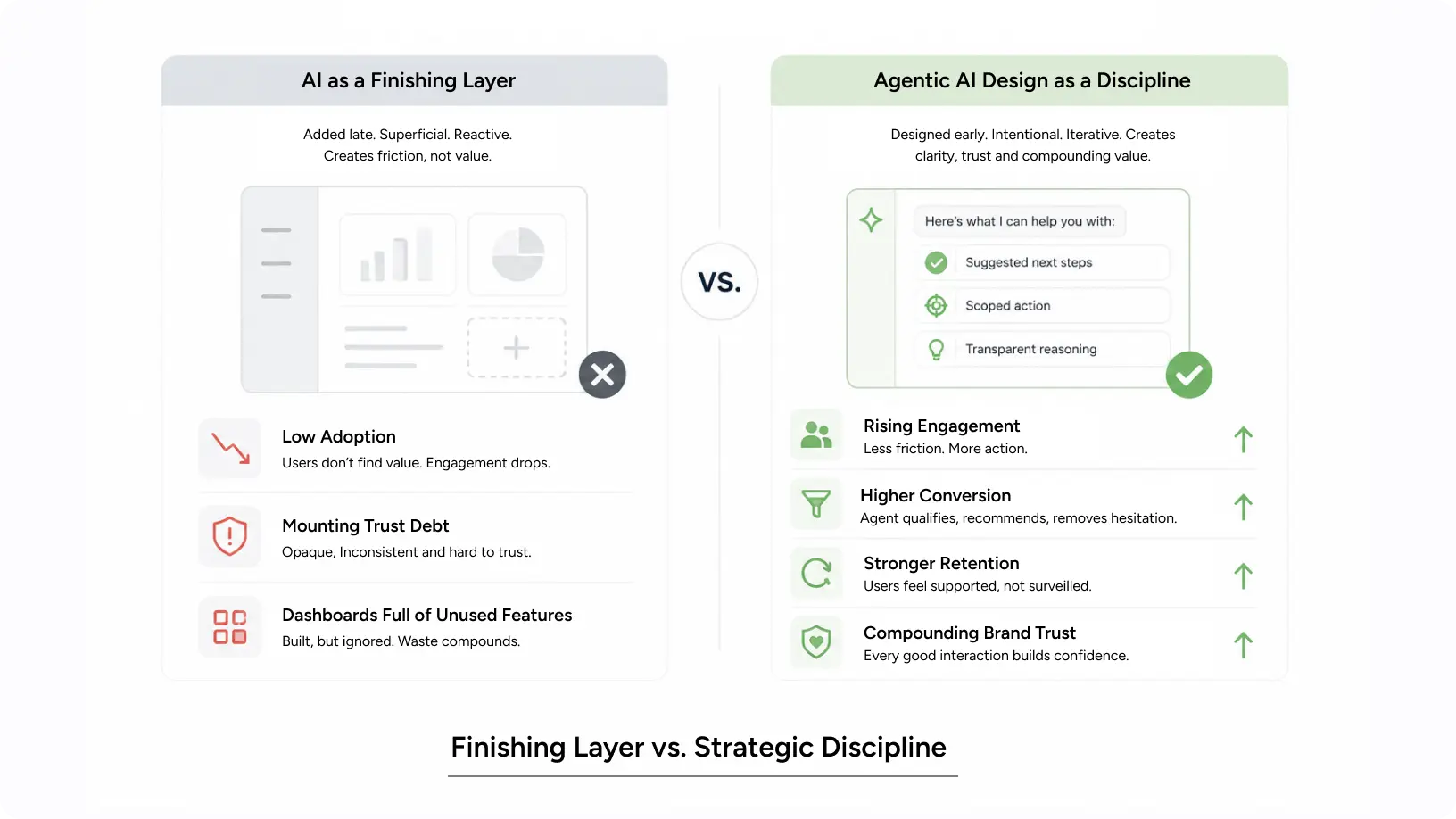
Treat designing for AI as a finishing layer, and you will keep paying the same painful tax: low adoption, mounting trust debt, and dashboards full of unused features. Treat it as a strategic discipline, and the math flips entirely.
Impact on User Experience
Good AI UX design reduces cognitive load. Instead of staring at a blank prompt, the user sees suggested next steps, scoped actions, and transparent reasoning. The strongest AI agent use cases are those where this clarity replaces ambiguity in a real workflow.
Accessibility improves as well. Agentic interfaces enable users to complete complex tasks through natural language, making workflows that once required specialized expertise accessible to a wider audience. The result is a sense of calm confidence, with users feeling in control while the system manages the complexity behind the scenes.
Impact on Business Metrics
When AI products are done well, the numbers move. Engagement climbs because the agent reduces friction at the exact moments users used to drop off. Conversion improves because the agent qualifies, recommends, and removes hesitation. Retention rises because users feel supported, not surveilled. And brand trust, the metric most teams forget to track, compounds with every interaction that goes the way the user expected.
There is a quieter benefit too. A well-designed agent generates better data about user intent than any survey ever will. That data, fed back into your AI implementation strategy, makes the next iteration sharper, not noisier. Teams designing AI products with this feedback loop in mind compound their advantage over time, while teams that treat agentic AI UX as a one-off project stay stuck rebuilding the same agent every quarter.
Common Mistakes to Avoid
Most failed AI rollouts trace back to a short list of avoidable choices, and they explain why AI projects fail with uncomfortable consistency:
- Shipping an agent without clearly defined fallback states.
- Treating prompts as the product instead of as the interface.
- Skipping research on the actual workflow the agent will live inside.
- Confusing model capability with product value.
- Forgetting that agentic AI UX must teach the user what the agent can and cannot do in the flow, without a manual.
- Underinvesting in AI agent planning, the upfront work of defining roles, decision rights, and escalation paths before any code is written.
Avoid those mistakes, and you have already outperformed the majority of enterprise AI launches we see in the wild.
Agentic AI Design in Practice: Your AI Implementation Roadmap
This is where strategy becomes craft. A practical AI implementation roadmap for designing AI products moves through five stages, each grounded in real user evidence rather than assumptions. Skip any of these, and the AI implementation roadmap becomes a wish list. Move through all five with discipline, and AI agent planning stops being an art and starts behaving like a repeatable process.
Step-by-Step Workflow
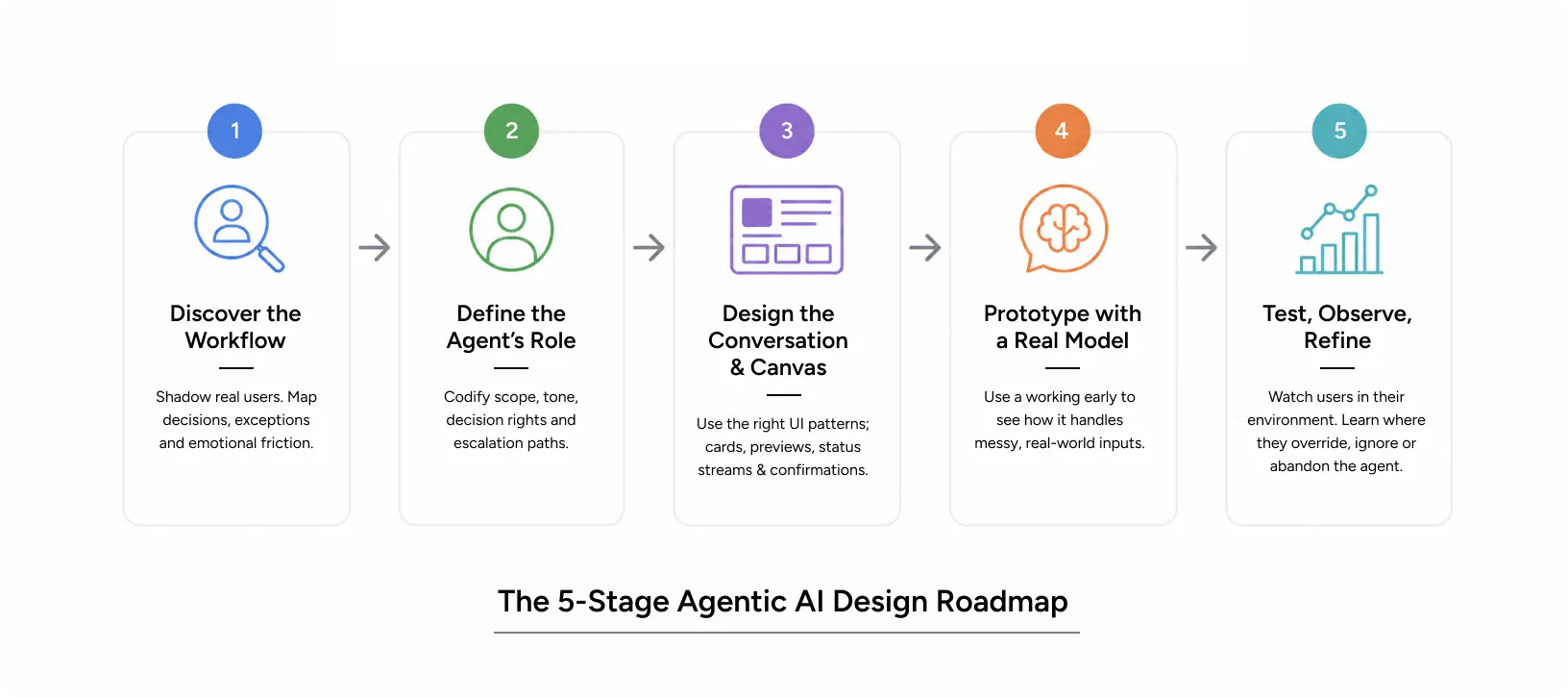
Across AI agent use cases ranging from internal copilots to customer-facing assistants, the same five-stage flow tends to win. Strong AI UX design and disciplined AI agent design sit at the heart of it, and a coherent process automation strategy decides where the agent fits in the bigger system of work.
- Discover the workflow. Shadow real users. Map decisions, exceptions, and emotional friction. Without this, your AI implementation strategy is guesswork delivered in a confident voice.
- Define the agent’s role. Is it advisor, executor, or coordinator? Codify scope, tone, decision rights, and escalation paths. This is the heart of AI agent planning, and the step most teams skip.
- Design the conversation and the canvas. Most agents need more than a chat box. Tables, cards, previews, status streams, and confirmation patterns all belong in the modern AI agent design toolkit.
- Prototype with a real model. Static mockups lie about agent behavior. Use a working model early, even a small one, to discover how it actually responds to messy real-world inputs.
- Test, observe, refine. Watch users in their environment. Note where they override, ignore, or abandon the agent. Those moments are the highest-value design briefs you will ever get.
Pro Tips from the Business Team
The business team working on AI product design consistently shares a few hard-won lessons:
- Write the agent’s “job description” before writing any prompts.
- Design the failure states first; the happy path is the easy part.
- Treat memory and context as design materials, not engineering details.
- Always show the seams. Users trust agents that admit their limits far more than agents that bluff.
- Build a small evaluation set early and re-run it after every change. This is what separates teams designing AI products for the long haul from teams chasing a demo.
Tools and Resources
Modern workflows for designing for AI blend familiar tools with newer ones: Figma for interface and flow design, Miro or FigJam for journey and decision mapping, LangChain or similar frameworks for prototyping agent logic, Dovetail for synthesizing user research, and lightweight evaluation harnesses for tracking behavior over time. The toolset matters less than the discipline of using them in concert across your AI implementation roadmap. Tools do not produce strategy; teams do. And great AI product design depends on people who understand both the model and the human on the other side of the screen.
Hitachi Vantara: Reimagining Enterprise Data Experience
The Problem: Hitachi Vantara, a USA-headquartered enterprise data and digital infrastructure leader, needed to transform how their teams and customers interacted with complex data and analytics platforms. The existing experience was dense, fragmented, and difficult to navigate, especially for non-technical decision-makers who increasingly needed direct access to insights.
The YUJ Designs Approach: Our team partnered with Hitachi Vantara to rebuild the experience from the ground up using a user-first design framework. We mapped intent across multiple stakeholder personas, simplified information architecture, and introduced guided workflows that reduced cognitive load while preserving analytical power. The same principles apply directly to AI agent design, surfacing intent, layering autonomy, and designing for trust at every interaction.
The Outcome: Hitachi Vantara saw faster user onboarding, stronger engagement across their enterprise platforms, and a foundation ready to layer agentic capabilities on top. The case validates a core lesson: a thoughtful AI implementation strategy is built on the bedrock of strong UX foundations, not bolted on after the fact.
Read the full case study: Hitachi Case Study
Conclusion
The next wave of competitive advantage will not be won by whoever buys the powerful model. It will be won by whoever takes agentic AI design seriously as a strategic discipline. Models are becoming a commodity. Trust, clarity, and a well-designed agency are not.
A clear AI implementation strategy answers three questions out loud: which decisions are we delegating, how will users stay in control, and how will we measure trust over time? A thoughtful process automation strategy then turns those answers into agents that do real work without creating new problems downstream. And a deliberate focus on designing for AI ensures every layer of the product, from prompts to dashboards to escalation flows, reinforces the same promise to the user.
If your team has invested in AI but adoption is flat, the gap is rarely the model. It is the design layer between the model and the human, the agentic AI UX that decides whether your agent feels like a colleague or a liability. Close that gap, and your AI strategy finally compounds instead of stalling. Ignore it, and you will keep adding to the long, public list of reasons why AI projects fail even when the underlying technology is sound.
At Yuj Designs, we treat agentic AI design as the missing link most strategies overlook, and the one most worth getting right.

FAQs