UX consulting brings in an external firm to solve a specific design problem with senior expertise, while an embedded design team is hired in-house to own the product day-to-day. In 2026, consulting wins for strategy, audits, and complex product decisions. Embedded teams win for ongoing iteration. Most mature companies run both.
Introduction
A product manager I spoke with last month had a familiar problem. Her engineering team had shipped an AI feature that, by every technical measure, worked. Users still weren’t touching it. She had two budget lines open on her desk: hire two more in-house designers, or bring in a UX consulting partner for a quarter. She couldn’t decide which one would actually fix the problem.
That decision, whether to invest in user experience design consulting or grow a team in-house, is harder in 2026 than it was even two years ago. AI has made design execution remarkably inexpensive. Enterprise teams are hiring designers in-house faster than they can onboard them. And honestly, the line between “hire a firm” and “hire a team” has gotten blurry enough that the question itself needs unpacking before you can answer it.
So which model actually wins? This piece breaks down both. You’ll learn what each model is good at, where each one quietly fails, what it costs, and how to tell which one your product needs right now. By the end, you’ll know which line item to sign.
What UX Consulting and Embedded Design Teams Actually Are
Before delving into the comparison, let’s understand what each term means. People use these terms loosely, and the confusion costs companies real money.
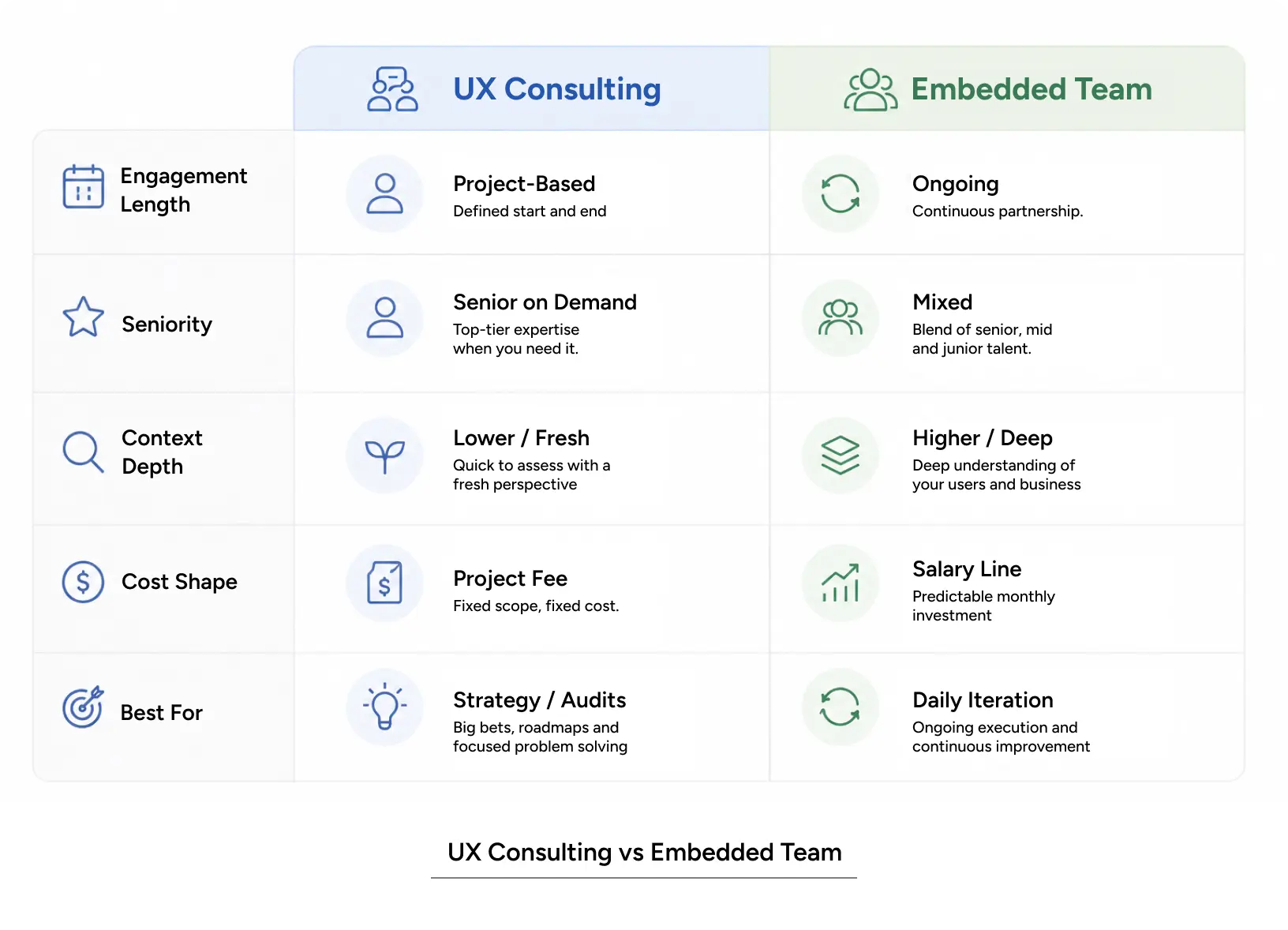
UX consulting is when an external agency is brought in to solve a defined design problem. A UX design consultant or a team audits your product, runs research, sets strategy, or redesigns a critical flow. The engagement has a start and an end. You’re paying for judgement, not hours at a desk. Most UX consulting firms work this way: scoped and outcome-focused.
An embedded design team is the opposite shape. These are designers who sit inside your organization, show up to your standups, and live with the product over months and years. They build deep context. They know why the checkout flow looks the way it does, because they were in the room when somebody made that call, probably reluctantly, under a deadline.
Three Models of UX Consulting and Embedded Design
There isn’t one version of each. In practice, you’ll see a few Engagement Models:
- Project-based consulting. A fixed engagement: a redesign, a research sprint, a UX audit. This is the core of most UX consulting services.
- Staff augmentation. A firm embeds experienced designers within your team, combining external expertise with close day-to-day collaboration to support your product goals.
- Fully in-house. You hire designers as full-time employees. Maximum context, maximum overhead.
Knowing which one you’re actually buying matters. A lot of teams ask UX consulting companies for a quote, then expect embedded-team availability. That mismatch sours engagements before they start.
Core Principles That Do Not Change Across Either Model
Whatever the model, good UX rests on the same foundations. Research before design. Test before shipping. Reduce the load on the user’s brain, not increase it. A model is only as good as how well it lets these principles operate. Consulting can deliver them in a burst. Embedded teams sustain them over time.
This is the part most buyers skip. They debate the model before they’ve agreed on the standard. A great UX design consultant and a great in-house lead will both fight for the same things: evidence over opinion, the real user over the imagined one. If a firm or a hire can’t do that, the delivery model won’t save you.
Also read: 2026: Agentic AI Moves from Experimentation to Enterprise
Why Choosing Between UX Consulting Services and In-House Design Matters
This isn’t an abstract org-chart debate. The model you pick shapes how users experience your product and how your business performs. Here’s where it lands.
The Impact on User Experience
A UX design consultant brought in for an audit will catch things your team has gone blind to. Strong user experience design consulting starts here, with someone who can see what familiarity has hidden. After a year on the same product, everyone stops Seeing the friction. Fresh perspectives from experienced product strategists uncover broken onboarding flows, cognitive overload on the dashboard, and the trust signals missing from your AI feature. That’s the consulting advantage: perspective.
But perspective fades. The consultant leaves, and the product keeps evolving. New features ship. Edge cases pile up. An embedded team catches the slow drift that an outside firm, gone for six months, never sees. They protect accessibility and consistency over time, not just in one sprint.
The Impact on Business Metrics
Engagement, conversion, retention, and trust all move with design quality. Product design consulting tends to produce sharp, measurable jumps. A redesigned flow lifts conversion in a single quarter. Embedded teams produce compounding gains: small, steady improvements that add up over the years.
Neither is automatically better, and anyone who tells you otherwise is selling something. A startup chasing a funding milestone needs a sharp jump. A platform with millions of users needs the slow compounding kind. Figure out which number you’re actually on the hook for, then pick the model that moves it.
One more thing worth noting: trust is a metric too, especially for AI products. Users abandon AI features not because the model is wrong, but because they can’t tell when it’s wrong. Designing those trust signals, like explainability, clear states, and honest error handling, is exactly the kind of work strong UX consulting services are built for. It’s hard to do well in passing, and it’s where good firms earn their fee.
Common Mistakes to Avoid
Three traps catch teams repeatedly.
The first is hiring a fully embedded team to solve a one-time problem. A company that needs a single onboarding flow rebuilt doesn’t need four designers on payroll for a year. That’s expensive, slow, and overkill.
The second is using a UX consulting firm for work that needs daily presence. If a product ships weekly and design decisions surface in every standup, a firm that checks in fortnightly will always be a step behind. Then teams wonder why the firm can’t keep pace.
The third is the costliest: treating UX consulting as a logo-polishing exercise instead of a strategic one. When YUJ worked with StubHub, the largest secondary ticketing marketplace in the US, the brief could have been read as “make the booking screens look better.”
The real problem was deeper. Rich event content wasn’t converting, seat selection confused people, and the purchase flow was tangled. YUJ rebuilt the experience around how people actually choose and buy: a simplified task flow, a dynamic seat map showing the view and price for each seat, and a cleaner information architecture.
Conversion rose 4.4%, sales rose 10.6%, and the work added $117M in revenue. None of it came from prettier screens. UX is not UI. Hiring a consultant to make screens prettier means the problem has already been misdiagnosed.
How to Choose Between UX Consulting Services and an Embedded Team
There’s no universal winner here. There’s only what fits where your product sits right now. So before you sign anything, walk through these.
A Step-by-Step Way to Decide
Work through these in order:
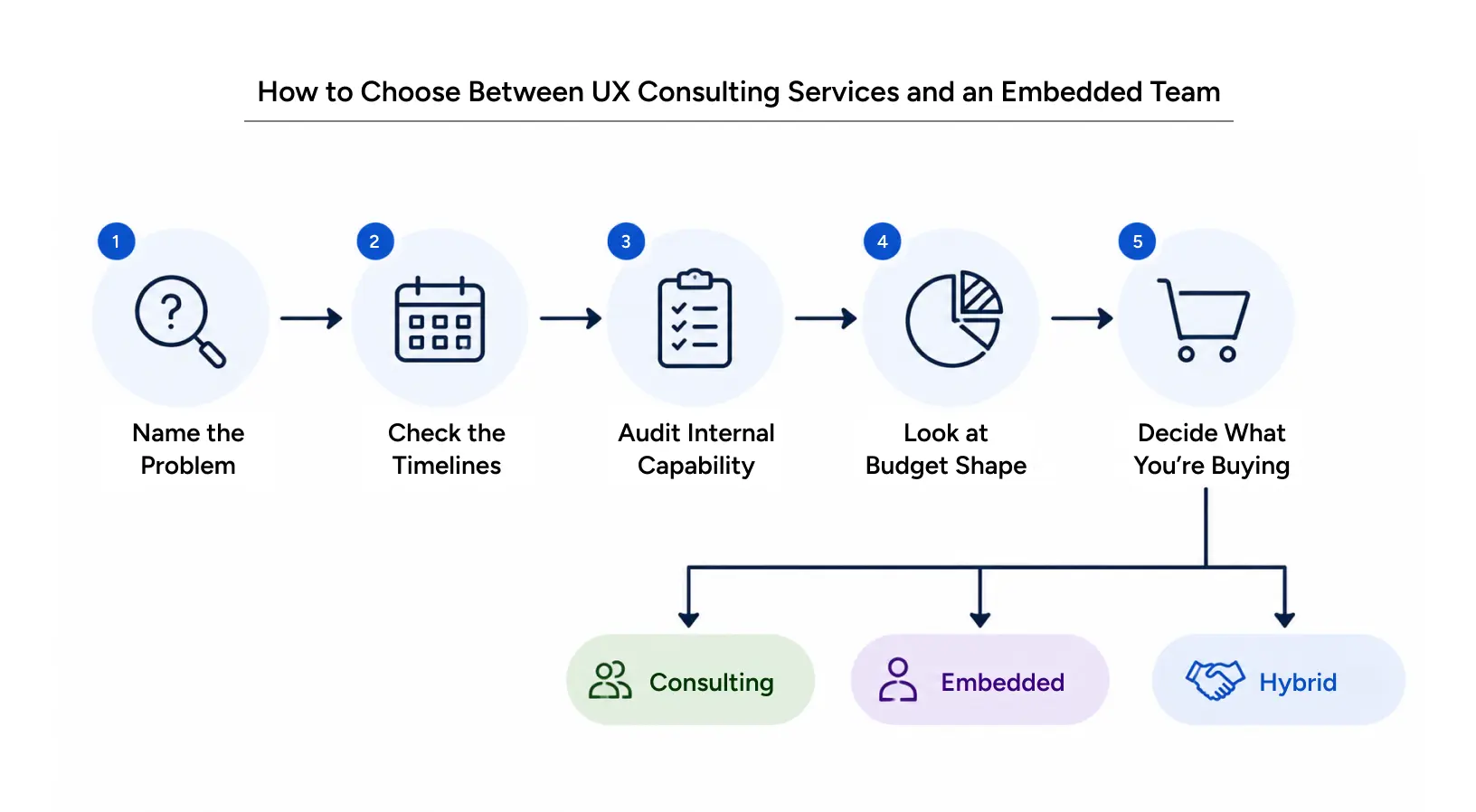
- Frame the problem. Is it a specific, bounded issue like low conversion or a failing feature, or an ongoing need like a product that ships weekly? Bounded problems point to consulting.
- Check the timeline. A 90-day fix favors UX consulting services. A multi-year product roadmap favors an embedded team.
- Audit your internal capability. Do you have design leadership in-house already? If not, a consultant can set direction before you hire.
- Look at the budget shape. Consulting is a project cost, and user experience design consulting engagements are scoped and bounded. An embedded team is a salary line: recruiting, onboarding, retention, the works.
- First, figure out what you’re really after. Need outside judgment and strategy? Go consulting. Need someone who holds context over time? Go embedded.
Most teams land on a hybrid. They bring in UX consulting companies for strategy and audits, then keep a lean in-house team for execution. That combination beats either model alone for most mature products.
Pro Tips From Designers Who’ve Done Both
A few things I’ve learned watching these engagements play out:
- Bring in consultants before you hire, not after. They’ll tell you what kind of team to build.
- Don’t measure a consultant by deliverables. Measure them by the decisions or mistakes that they helped you avoid.
- An embedded team without experienced design leadership drifts. Design generalists keep the product moving. Product design specialists help it move in the right direction. Combining both often delivers the strongest outcomes.
Tools and Resources
The tooling is mostly the same across both models. Figma for design and prototyping. Maze or UserTesting for research. Dovetail and Miro for synthesizing what you learn. What changes isn’t the tool. It’s who’s holding it, for how long, and what they’re trying to do with it.
A consultant brings a design thinking lens to the tools. They use Figma to frame the problem, not just push pixels. They run research in Maze to test a hypothesis, not to tick a box. The work is outcome-driven: the question isn’t “did we ship the screen,” it’s “did the screen move the metric?” An embedded designer uses the same stack, but their advantage is repetition. They watch the same Dovetail insights show up across releases, so they connect patterns a consultant parachuting in for one project would miss.
The newer shift is in how both approach AI. The tools now generate flows, copies, and variations faster than any team can review them. So the skill isn’t producing more. It’s deciding what’s worth keeping. The mindset moves from creation to consumption: reading AI output critically, catching where it breaks user trust, and shaping it into something a real person can actually use. That judgment doesn’t live in the tool. It lives in whoever is holding it.
Also Read: Navigating the Agentic Era: Redefining UX for Real-World Impact
A Real Example: Honeywell and the Plant Productivity Tool
Theory is easy. Here’s one that actually happened.
Honeywell Technology Solutions, a US enterprise, needed a tool that let process plant engineers track configurations, catch engineering anomalies, and plan maintenance without triggering unplanned shutdowns. Dense, high-stakes B2B work. The kind of product where a wrong design decision doesn’t just annoy someone, it costs real money and sometimes real downtime.
What made it work wasn’t that Yuj Designs showed up as a polished outside partner. It was the opposite. The team got close enough to Honeywell’s internal UX processes to operate like part of the team, not a contractor parachuting in. The result was Uniformance Trace, a tool that cut management effort and documentation by up to 80%.
The Honeywell UX Design stakeholder/leader put it plainly: Yuj’s understanding of their internal processes let the firm work as an integral team, not an external consultant. That’s the hybrid model working at its best, with outside expertise and inside context together.
Read More: Honeywell Case Study
Conclusion
So which model wins in 2026? The real advantage comes from choosing the right model for the challenge at hand. UX consulting and embedded design teams aren’t competing approaches; they’re complementary tools that deliver value under different circumstances.
Consulting wins when you need strategy, a fresh audit, or a hard product decision made well, which is the heart of user experience design consulting. Embedded teams win on a different axis. They win when a company needs someone who will still be there in two years, holding context across releases and protecting the experience as the product grows. The same tools sit on both desks: Figma, Maze, Dovetail. What differs is who holds them, for how long, and what they are trying to do with them.
The newer test applies to both models. As AI generates flows, copy, and variations faster than any team can review, the winning team is the one that knows what to keep and what to throw away. The companies that struggle are the ones that force one model to do the other’s job.
What doesn’t change, no matter which one you pick, is the discipline underneath. Research before you design. Test before you ship. Design for the person actually using the product at 11 pm on a bad connection, not the idealized user in the pitch deck. Get that part right, and the delivery model stops being a gamble. It’s just logistics.
If you’re staring at two budget lines like that product manager was, start with the problem, not the model. The right structure usually reveals itself once you’re honest about what you’re actually trying to fix.

FAQs