
Healthcare UX design is the practice of designing digital health products, EHRs, patient portals, clinical tools, and medical apps around how clinicians and patients actually think and behave. Done well, it reduces medication errors, improves patient adherence, and cuts documentation burden for clinical staff. Done poorly, it contributes directly to adverse events and physician burnout.
When a UI Failure Becomes a Clinical Incident
A nurse in a busy ICU reaches for a medication dosing interface. The input fields are tiny. The units milligrams versus micrograms look identical on screen. She makes an error. The patient is harmed.
This isn’t a hypothetical. A 2022 ECRI Institute report identified user interface failures in health IT systems as a top patient safety concern. The design of that screen wasn’t just a product problem. It was a clinical one.
Healthcare UX design sits at an uncomfortable intersection: the stakes are as high as they get, the users are often exhausted and time-pressed, and the technical constraints are significant. Most digital health products fail not because the underlying technology doesn’t work, but because the experience built around it doesn’t account for how doctors, nurses, and patients actually operate.
This blog breaks down what healthcare UX gets wrong, what it gets right when done well, and what a rigorous design process looks like in practice with real examples from US-based health systems and digital health companies.
What Is Healthcare UX Design?
Healthcare UX design is the discipline of designing digital health products, electronic health records (EHRs), patient portals, clinical decision support tools, telehealth platforms, and medical devices around how actual users behave under real clinical conditions.
It covers three core user groups:
- Clinicians (physicians, nurses, pharmacists): time-constrained, high-cognitive-load, working in multi-screen environments
- Patients: varying health literacy, often anxious, accessing systems from home on mobile
- Administrative staff: repetitive workflows, data entry-heavy, error-prone tasks
Medical UX design isn’t just about making interfaces look cleaner. It is about structuring information hierarchies, reducing cognitive friction, preventing input errors, and designing for the specific mental models of clinical users.
A good healthcare ux designer understands both the design standards that reduce error and the clinical context that shapes how a user actually reads a screen at 2 am during a night shift.
Also Read: 2026: Agentic AI Moves from Experimentation to Enterprise
Why Healthcare UX Is Different and Harder
Every UX problem has context. Healthcare UX has context that can injure or kill.
Three things make medical UX design uniquely difficult:
1. The Cost of Error Is Not a Bounce Rate
In e-commerce UX, a poorly designed checkout costs you a conversion. In healthcare product design, a poorly designed medication confirmation flow can cost a patient’s life. The FDA has received thousands of reports linking EHR usability issues to medication errors and diagnostic delays.
This changes the design calculus entirely. Standard UX heuristics still apply. But every decision must be stress-tested against failure modes that extend well beyond user frustration.
2. Your Users Are Cognitively Exhausted
The emergency physician seeing your interface at hour 10 of a shift is not the same user who participated in your usability study at 10 am. Healthcare UX design must account for fatigue-induced attention degradation. That means: critical actions need visual separation, destructive actions need friction, and confirmation dialogs need to be genuinely scannable, not just legal-box checkboxes.
3. Regulatory Constraints Are Real, but Not an Excuse for Bad UX
HIPAA, FDA 510(k) for SaMD, and HL7/FHIR interoperability requirements all constrain what a medical ux design team can do. But they don’t dictate that forms must be unusable or that navigation must be labyrinthine. Compliance and usability are not opposites. The most common mistake healthcare product design teams make is treating regulation as the ceiling, not the floor.
Also Read: Gamifying AI with Octalysis: Designing Motivation in Intelligent Systems
The Business Case: What Bad Medical UX Costs
Healthcare UX failures don’t just produce clinical incidents. They have measurable financial consequences.
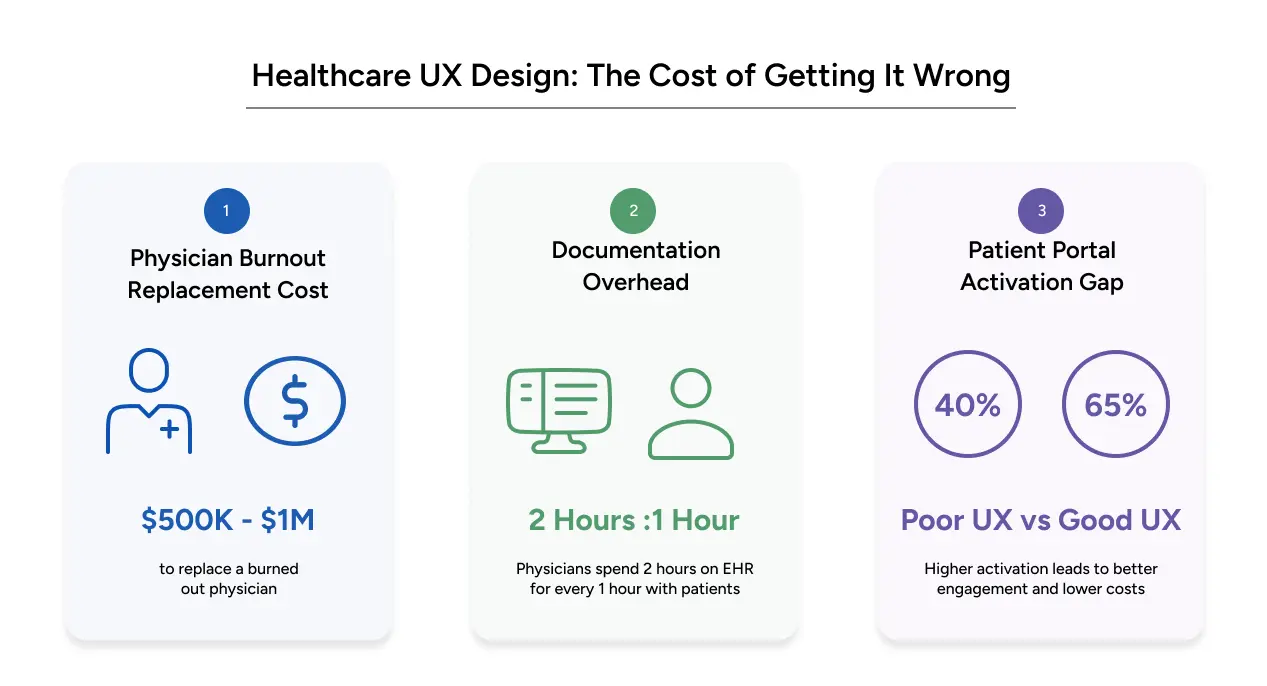
Physician burnout and EHR dissatisfaction are directly linked. A 2023 study in Mayo Clinic Proceedings found that EHR usability scores were among the strongest predictors of burnout. Replacing a physician costs a health system between $500,000 and $1 million in recruiting and productivity loss. That’s not a soft cost.
Documentation burden drives overtime. Physicians in US health systems spend an average of two hours on EHR documentation for every one hour of direct patient care (AMA, 2023). Redesigning documentation workflows, a core healthcare ux design intervention, directly reduces this ratio.
Poorly designed patient portals suppress activation. Health systems spend considerable sums on patient portal technology, yet activation rates often stagnate below 40%. A healthcare UX agency that rebuilds portal onboarding and notification design consistently moves that number above 65%. The downstream effect: fewer call center contacts, better medication adherence, and improved chronic disease management metrics.
Core Principles of Effective Healthcare UX Design
These aren’t generic UX principles. They are the ones that actually move the needle in clinical environments.
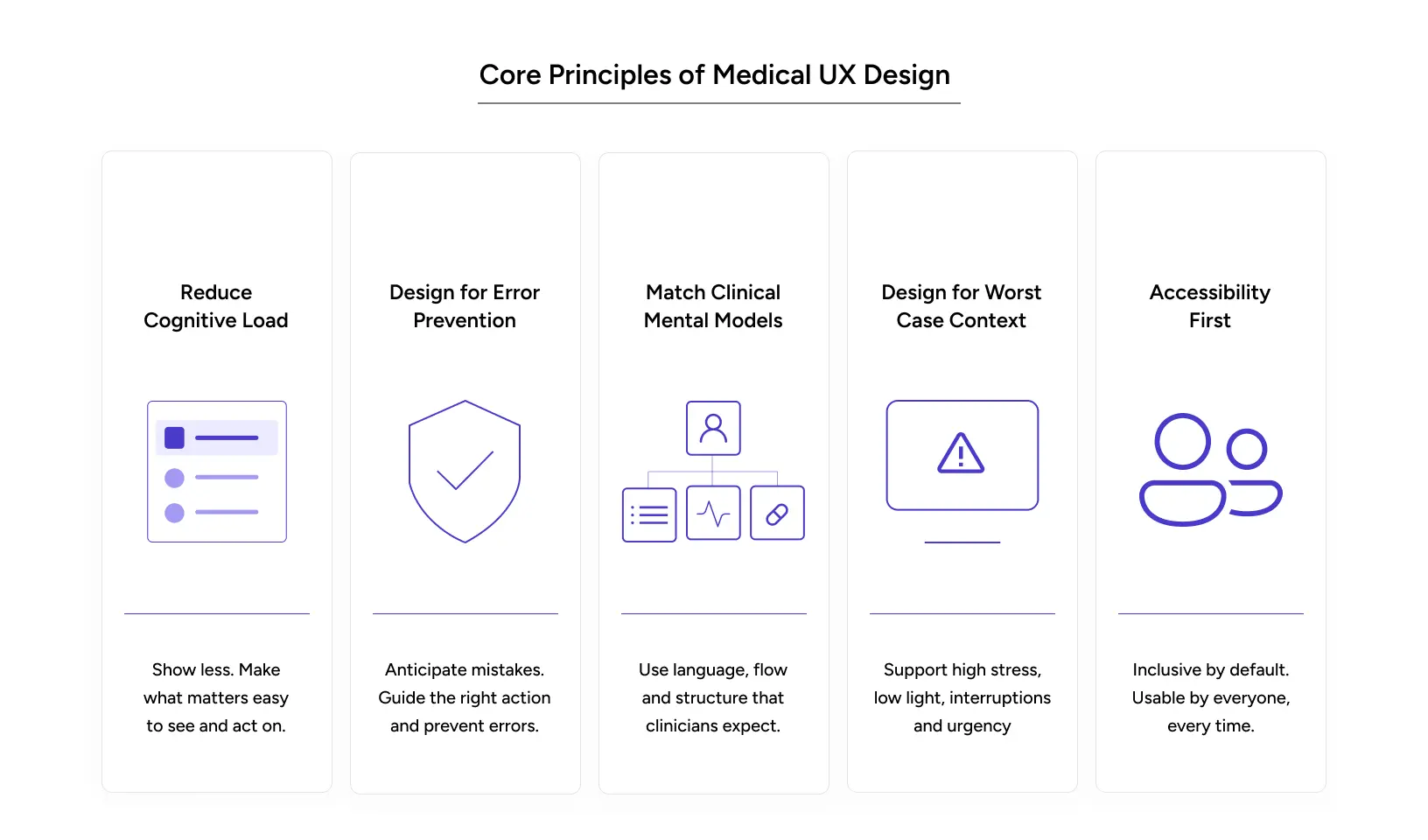
1. Reduce Cognitive Load at the Point of Decision
Critical decisions prescribing, ordering, and confirming need to happen in an environment stripped of irrelevant information. A healthcare UX designer should audit every decision screen for the number of competing visual elements. If a physician must mentally filter out six non-essential elements to find the one they need, the design has failed.
2. Design for Error Prevention, Not Error Recovery
Standard UX allows users to make mistakes and provides clear recovery paths. Medical UX design goes further: it designs the environment so certain errors cannot be made. Default units, smart dosing ranges with visual alerts, and confirmation flows that surface the key information in a scannable format all prevent errors before they happen.
3. Match the Mental Model of Clinical Workflows
Clinicians don’t think in database tables. They think about problems, assessments, and plans. Healthcare product design that maps information architecture to clinical reasoning frameworks rather than system data structures reduces search time and cognitive translation effort. This is where most EHR systems fail: they’re built around data storage, not clinical thought.
4. Design for the Worst-Case Context
Your patient portal user may be checking results while simultaneously managing children, in a noisy environment, on a cracked phone screen. Your ICU nurse may be responding to three alarms while accessing a dosing tool. Healthcare UX design must be tested in degraded contexts, not just in ideal usability lab conditions.
5. Accessibility Is Not Optional
WCAG 2.1 compliance is the baseline. But healthcare ux must go further: high-contrast modes for clinical environments with variable lighting, screen-reader support for visually impaired patients, and readable font sizes that work for an aging patient population.
How to Apply Healthcare UX: A Practical Workflow
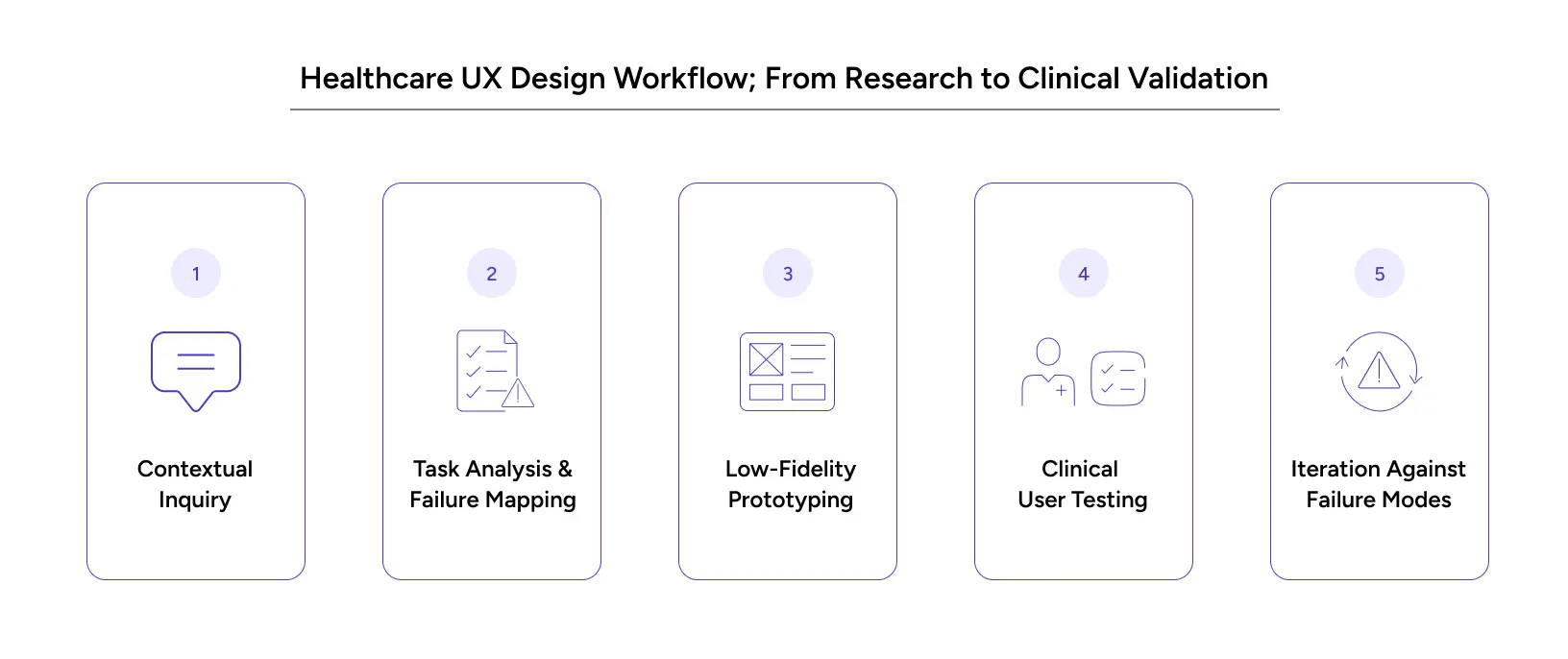
Here’s how a rigorous healthcare UX design process works in practice:
Step 1: Contextual Inquiry- In the Clinical Environment, observation-based research in the actual clinical setting. Not surveys. Not focus groups. Watch a nurse complete a medication administration workflow. Count the clicks. Note the workarounds. This is where the real medical UX problems surface.
Step 2: Task Analysis and Failure Mode Mapping. Map every critical task to its current interaction path. Identify where errors can occur and where they have already occurred. Cross-reference with incident reporting data if available.
Step 3: Prototype with Low Fidelity, Test with High Realism. Paper prototypes work. What matters is that testing simulates actual clinical pressure, including distraction, time pressure, and fatigue, where possible.
Step 4: Validate with Real Clinical Users, not proxy users. Not “healthcare-adjacent” participants. Actual physicians, nurses, pharmacists, or patients who match the real user profile. Five to eight participants per user group reveal the majority of critical issues.
Step 5: Iterate Against Failure Modes, Not Just Preferences. In healthcare product design, user preference data is not enough. A user may prefer a familiar bad design. Validation must test against error prevention, task completion accuracy, and cognitive load, not just satisfaction scores.
Real-World Applications
Clinical Field Teams, Global Life Sciences Organization
A global life sciences organization had 15+ digital platforms for clinical field staff, all built around database logic, not clinical workflows. Teams were navigating fragmented interfaces during time-pressed physician visits with no design consistency and no UX research behind any decision.
YUJ embedded a healthcare UX design team, conducted 150,000+ hours of user research, built a unified Design Language System, and redesigned AI decision support interfaces around how field clinicians actually work. Over ten years: zero escalations, first-time iPad support for field teams, and design maturity transformed from unrecognized to a core strategic function.
Read More: Global Life Sciences-Case study
Conclusion
Healthcare UX design isn’t simply a variation of standard UX; it operates in a high-stakes environment where errors carry clinical consequences, not just usability issues. The real cost of poor medical UX design is seen in physician burnout and documentation burden, both measurable problems that can be addressed through thoughtful design.
Effective healthcare UX requires contextual research within clinical settings, along with failure mode mapping and validation under realistic conditions. It must go beyond compliance, as regulatory constraints only set the minimum standard, not the benchmark for excellence.
The most impactful healthcare UX designers are those who understand clinical workflows deeply enough to challenge and redesign them based on how clinicians and patients actually think and behave.
Working with a specialized healthcare UX agency adds this domain knowledge into the process, accelerating research, reducing iteration cycles, and delivering solutions that perform reliably in real clinical environments, not just controlled testing scenarios.
FAQs