
What Is UX Research?
UX research is the systematic study of users’ behaviors, needs, and pain points to inform and improve product design. The UX research process includes planning, data collection, analysis, and synthesis using both qualitative and quantitative methods. It is the evidence-based backbone of every successful UX design and research project, helping teams build experiences users love.
Why Most Products Fail Without Research
Imagine spending six months building a feature your users never asked for. The interface looks polished. The engineering is solid. But adoption is flat. Users churn. The team is confused.
This is not a hypothetical. It happens every week across product teams worldwide, and almost always, the root cause is the same: decisions made without user insight.
That’s where UX research changes the game.
Whether you’re a startup validating your first MVP or an enterprise refining a complex product, user research is what separates guesswork from clarity. It tells you who your users are, what they’re trying to accomplish, where they get stuck, and why they leave.
In this guide, you’ll learn:
- What UX research is and how it fits into the design lifecycle
- The most impactful UX research methodologies (and when to use each)
- A clear, actionable UX research process you can apply immediately
- Tools trusted by leading UX research companies
- Real-world examples that connect research to outcomes
Whether you’re new to the field or looking to sharpen your practice, this is your definitive resource.
Understanding UX Research: Definition, Types & Core Principles
What Is UX Research?
UX research (User Experience Research) is the discipline of studying your target users to understand their behaviors, motivations, mental models, and needs. Unlike assumptions-based design, user research replaces gut instinct with grounded evidence.
It answers questions like:
- Who are our users, and what are their goals?
- Where do they struggle in the current experience?
- What do they expect from a product like ours?
- How do they make decisions?
At its core, UX design and research are inseparable. Design without research is art. Research without design is academia. Together, they become a product people actually want to use.
Types of UX Research
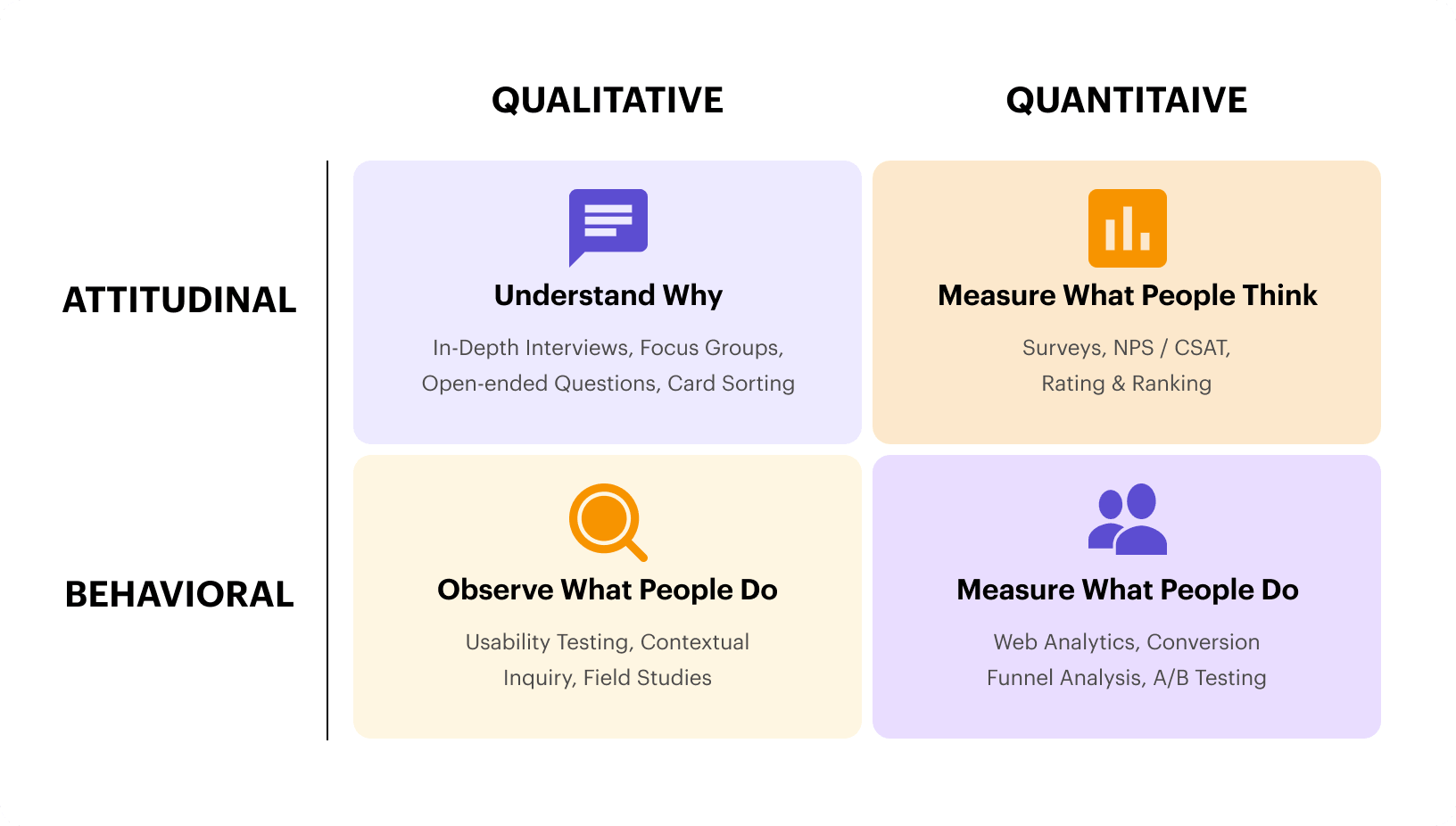
UX research broadly falls into two categories:
1. Qualitative Research Captures the “why” behind behavior. Involves interviews, usability tests, and ethnographic observation. Rich in context, harder to scale.
2. Quantitative Research Captures the “what” numbers, patterns, frequencies. Involves surveys, analytics, and A/B testing. Easy to scale, lighter on context.
3. Attitudinal Research Measures what users say they think or feel (surveys, interviews).
4. Behavioral Research Measures what users actually do (heatmaps, session recordings, usability tests).
The best user research programs combine all four, using qualitative data to explain quantitative patterns.
Core Principles of UX Research
- Empathy First: Research starts with genuine curiosity about people, not just products.
- Context Matters: Users behave differently in lab settings vs. real-life environments.
- Reduce Bias: Good researchers design studies to minimize confirmation bias.
- Iterate Continuously: Research is not a one-time event; it informs every sprint.
- Synthesize, don’t Just Collect: Raw data has no value until it’s interpreted.
Also Read: Gamifying AI with Octalysis: Designing Motivation in Intelligent Systems
Why UX Research Matters: Impact on Design and Business
Impact on User Experience
When research guides design, usability improves directly. Users complete tasks faster and with fewer errors. Accessibility gaps and diverse user needs surface early, not after launch. Cognitive load decreases because designers understand how users actually think. Products feel intuitive because they reflect real user mental models rather than internal assumptions.
Impact on Business Metrics
Forrester Research found that a well-designed user interface can improve conversion rates by up to 200%. Combined with an optimised user experience, that figure rises to 400%. The driver in both cases is the same: a design that reflects how users actually behave, not how product teams assumed they would.
The counterargument to investing in research is always time. Teams under deadline pressure treat it as a luxury rather than a safeguard. Product teams that skip discovery and move straight to Figma are not saving time. They are pushing their problems six months down the road, at considerably higher cost.
The UX Research Process: Step by Step
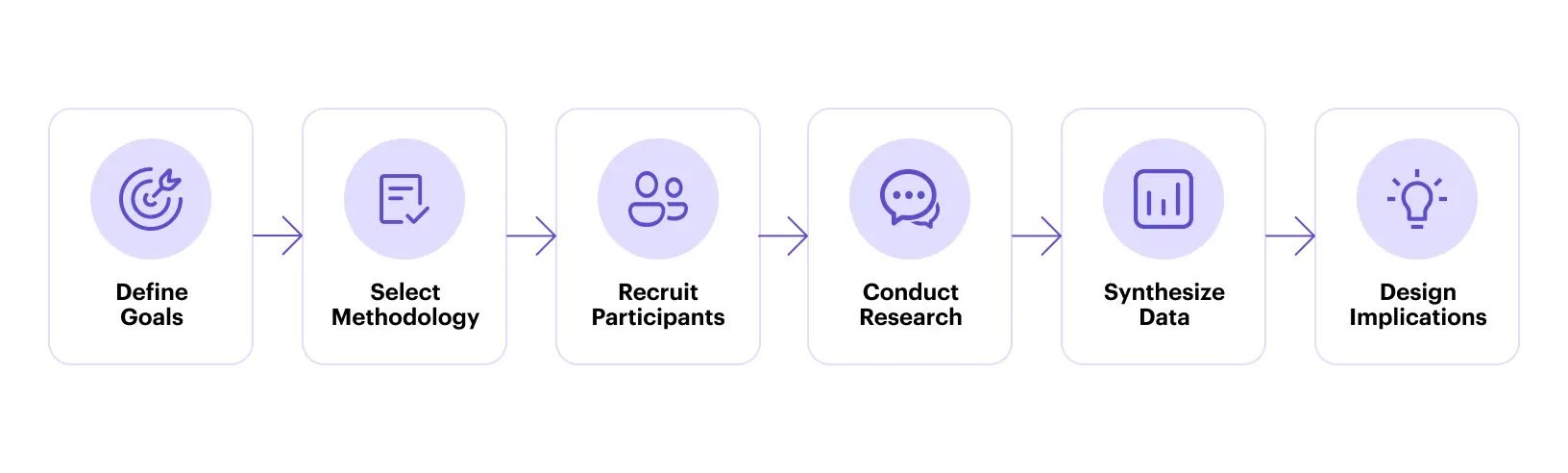
A structured UX research process transforms raw curiosity into actionable design direction. Here’s how leading design teams approach it:
Step 1: Define Research Goals.
Before selecting any method, establish what decision the research will inform. What do you already know? Where are the gaps? What would change in your roadmap if you discovered X? Write a one-paragraph research brief. It keeps the entire team aligned and stops research from becoming unfocused data collection.
Step 2: Choose the Right Method.
Different questions require different approaches. If you need to understand what users are doing, analytics, heatmaps, and session recordings are the right starting point. If you need to understand why they are struggling, usability tests and interviews are more appropriate. Surveys and card sorting help map user mental models. Contextual inquiry reveals behaviour that never surfaces in lab conditions.
Step 3: Recruit Representative Participants.
Target users who represent your actual audience, not colleagues, not your most vocal customers, not whoever is easiest to reach. Use screener surveys to qualify participants. For qualitative studies, five to eight participants consistently surface the patterns that matter most, according to Nielsen Norman Group research. Quantitative studies need 100 or more for reliable results.
Step 4: Conduct the Research.
Run sessions consistently. Use neutral, open-ended questions. Record every session with participant consent. The biggest risk in research is the researcher influencing the outcome, steering participants toward the answer the team wants to see, rather than listening to what they actually reveal.
Step 5: Synthesise and Analyse.
Raw data has no design value. Cluster findings through affinity mapping. Tag recurring themes. Identify patterns by frequency and impact severity. The difference between useful research and wasted research is almost always in this step. Teams that skip synthesis and jump straight to sharing findings present observations without insight.
Step 6: Share and Act on Insights.
Present findings as design recommendations, not just observations. Use personas, journey maps, and “How Might We” statements to connect research to the next design decision. Research that goes into a shared folder and is never referenced again has cost time without producing any return.
Also Read: The Future of Intelligence: Designing Systems That Think with Purpose
UX Research Methodologies: The Full Toolkit
There is no single best methodology. The right one depends on your research question, timeline, and the specific decision you are trying to inform.
1. User Interviews.
One-on-one conversations exploring attitudes, behaviours, and motivations. They belong in discovery, when you are still defining the problem. Rich in context, hard to scale. Five to eight participants typically surface the most important patterns.
2. Usability Testing.
Participants complete specific tasks while researchers observe. Reveals exactly where users struggle and why. Moderated testing allows probing; unmoderated testing gives scale. Nielsen Norman Group research demonstrates that five users surface 85% of critical usability issues.
3. Contextual Inquiry.
Researchers observe users in their actual environment, their desk, their workflow, and their constraints. For enterprise tools and complex SaaS products, this is often the only method that captures how the product is really used, as opposed to how teams assume it is used.
4. Diary Studies.
Participants document experiences over a defined period. Captures longitudinal behaviour and emotional states that do not surface in lab conditions. Especially useful for habit-forming products and daily-use apps.
5. Surveys.
Structured questionnaires distributed at scale. Most effective for validating a hypothesis or measuring sentiment across a broad user base — not for generating the nuanced insight that comes from direct conversation.
6. A/B Testing.
Compares two design variants on a specific metric. Requires sufficient traffic to reach statistical significance. Works best when you already know what variable you are testing, not when you are diagnosing an unfamiliar problem.
7. Analytics Review.
Deep analysis of click paths, funnel data, and session duration. Surface patterns at a scale no research session can match. Tells you where users are going and where they leave. Rarely tells you why.
8. Card Sorting and Tree Testing.
Card sorting reveals how users naturally organise information. Tree testing validates a proposed navigation structure before development touches it. Both are critical for information architecture decisions.
Tools That Power Effective UX Research
| Tool | Category | Best Used For |
|---|---|---|
| Maze | Unmoderated testing | Remote usability tests, rapid prototype validation |
| UserZoom | Full-suite research | Enterprise-grade research programmes |
| Dovetail | Synthesis & analysis | Tagging interviews, building searchable insight libraries |
| Lookback | Moderated testing | Live user interviews with screen sharing |
| Hotjar | Behavioural analytics | Heatmaps, session recordings, and on-site polls |
| Optimal Workshop | IA research | Card sorting, tree testing, navigation validation |
| Typeform | Surveys | Screeners, feedback collection, and hypothesis testing |
| Figma | Prototyping | Testable high-fidelity prototypes for usability studies |
| Miro | IA research | Affinity mapping, journey mapping, cross-team analysis |
Real-World UX Research in Action
The true value of ux research is realized when insights begin to shape real product experiences. Across industries, the ux research process plays a critical role in helping teams reduce friction, improve usability, and align digital products with actual user behavior rather than assumptions.
1. Improving Onboarding Experiences
One of the most common applications of user research is in optimizing onboarding flows. The first interaction a user has with a product often determines whether they stay or leave. When onboarding feels overwhelming, unclear, or unnecessarily long, users tend to drop off early.
Through carefully chosen ux research methodologies, such as usability testing and behavioral observation, teams can identify where users hesitate, what confuses them, and how they interpret initial interactions. These insights help refine onboarding into a more guided and intuitive experience, where users feel a sense of progress and clarity from the very beginning.
2. Simplifying Complex Workflows
In many digital products, especially in SaaS and fintech environments, users are required to complete multi-step tasks that can quickly become mentally exhausting. This is where the ux research process becomes essential in identifying friction points within workflows.
By applying structured user research methodologies, teams can observe how users approach tasks, where they get stuck, and which steps feel redundant. These insights allow designers to restructure workflows into simpler, more intuitive flows. This is a clear example of how ux design and research work together to transform complexity into clarity.
3. Enhancing Navigation and Information Architecture
Navigation is one of the most critical aspects of user experience, yet it is often designed based on internal assumptions rather than user expectations. ux research helps bridge this gap by uncovering how users naturally think about information and where they expect to find it.
Using methods like card sorting and behavioral analysis within the ux research process, teams can organize content in a way that aligns with user mental models. This improves discoverability, reduces confusion, and creates a more seamless interaction with the product.
4. Optimizing Conversion Paths
Every product has key actions it wants users to take, whether it is signing up, making a purchase, or completing a booking. User research plays a crucial role in understanding why users drop off before completing these actions.
By combining different ux research methodologies, teams can uncover both behavioral and psychological barriers. Sometimes the issue lies in unclear messaging, while other times it is due to a lack of trust or excessive cognitive effort. Addressing these issues leads to smoother conversion paths and more confident user decisions.
5. Designing for Accessibility and Inclusivity
Modern digital products must serve a wide range of users with varying abilities, devices, and contexts. The ux research process ensures that accessibility is not treated as an afterthought but as a core part of the design strategy.
Through inclusive user research methodologies, teams can identify barriers that may not be visible during internal reviews. This leads to more accessible interfaces, better readability, and improved usability across diverse user groups, making the product more inclusive and effective.
Visual Suggestion: Alt text: A clean, modern visual showing how ux research transforms confusing interfaces into intuitive experiences. Use a before–after layout with a central “research process” layer (insights, testing, iteration). Highlight onboarding, workflows, navigation, and conversion improvements. Keep the design minimal, structured, and UI-focused, with subtle labels like reduced friction, improved flow, and better usability.
Also Read: Behavioural Systems: The Next Evolution of Design
Conclusion
UX research is not a phase; it’s a practice. The teams and companies that treat it as such consistently build products that users choose, return to, and recommend.
Here’s what to remember:
- UX research answers the most important design question: Who are we really building for?
- The UX research process works best when it’s embedded throughout the product lifecycle, not front-loaded into a single discovery phase.
- UX research methodologies are a toolkit match the method to the question.
- Both qualitative and quantitative user research are essential; neither alone is sufficient.
- User research methodologies like usability testing, interviews, and analytics each reveal different layers of truth about your users.
- Leading UX design and research firms use synthesis tools and structured insight repositories to make research a living, searchable organizational asset.
Research doesn’t slow products down. It stops teams from building the wrong thing fast.
At YUJ Designs, we’ve helped product teams across the USA, India, Southeast Asia, and beyond transform user insights into experiences that perform. Whether you’re starting from scratch or scaling an existing design practice, we bring the methodological rigor and strategic instinct your product deserves.
FAQs