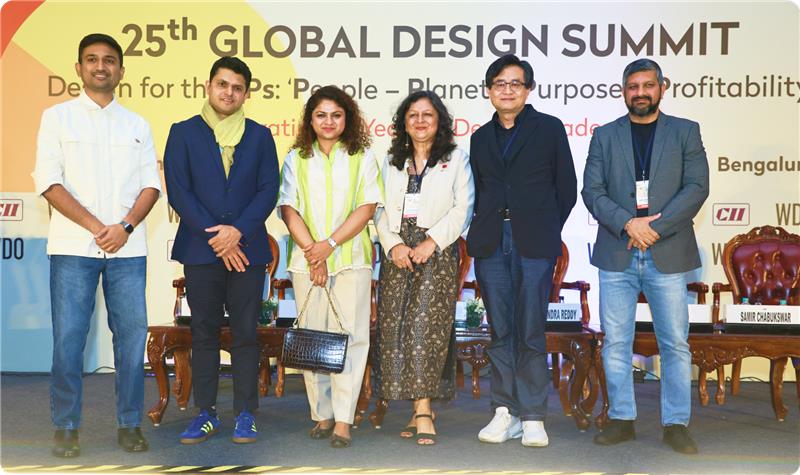
Samir Chabukswar, our Founder, recently shared critical insights at the CII Global Summit on the state of India’s urban future. His core message is unequivocal: The global megacity model is broken, and its symptoms—from water scarcity (Day Zero) to crippling pollution—are a direct result of ignoring basic systemic boundaries.
The time for conventional planning is over. We must abandon the illusion of cities as collections of inert objects and embrace the reality: Cities are intricate, interconnected systems.
Here are the five non-negotiable systemic shifts required to build resilient, human-centric urban futures in India:
1. Cities are Systems of Systems
We see buildings and roads; we must think interdependency. A city is a complex ecosystem where transportation, public health, water, waste, and the economy are inextricably linked. A failure in one – like a local flood disrupting roads-cascades across supply chains, impacting livelihoods and schools.
The Insight: No subsystem exists in isolation. Effective urban design must orchestrate the interactions between these systems, understanding that every part influences the whole. Patchwork fixes will always fail; only holistic, systemic design can prevent widespread collapse.
2. Design Must Respect System Boundaries and Limits
Modern cities behave as if resources are infinite, yet nature imposes non-negotiable boundaries – limits on water replenishment, air dispersal, and ecological carrying capacity (land).
- If a city of 10 million needs 1,500 million litres of water per day, but its watershed only replenishes 700 million litres, the design is fundamentally unsustainable.
- When density exceeds the ecological capacity (e.g., 700–1,200 people/hectare vs. a sustainable 300–350), we exceed the land’s carrying capacity.
The Insight: Sustainable city planning begins by answering a brutal question:
How much can this land, this water, this air actually support without collapse? Ignoring these natural limits guarantees future scarcity.
3. Design for Emergence, Not Events
We often treat urban problems as episodic events – traffic today, pollution tomorrow. But cities are emergent systems. Traffic is not just “too many cars”; it emerges from the complex interaction of road layout, land use, economic hotspots, and mobility culture.
The Insight: We must stop episodic firefighting and focus on changing the underlying conditions from which problems emerge. If the system’s incentives, flows, and constraints are designed correctly, positive outcomes – cleaner air, smoother mobility, better quality of life – will naturally emerge at scale.
4. The Sustainability Equation: Consumption < Replenishment
The math of long-term urban life is simple and absolute: Consumption cannot exceed the rate of natural replenishment.
- Water: Extracting 25–30 TMC/year when groundwater only replenishes 15 TMC/year, as seen in parts of Bengaluru, guarantees a Day Zero scenario.
- Land: Removing green cover faster than it’s replaced creates debilitating urban heat islands, trapping heat 8–10°C hotter than surrounding areas.
The Insight: Resilience is achieved when city planning is aligned to natural replenishment cycles. Unsustainable consumption guarantees a future that is unpredictable, resource-starved, and unliveable.
5. The Universal ‘Mega City’ Model is Failing
From Delhi to Lagos, the global model of outward growth, more cars, and reactive infrastructure is yielding the same crisis symptoms everywhere: scarcity, heat, and gridlock. With over 30 struggling megacities globally, the universal expansion model is structurally flawed.
The Insight: India needs a unique, systemic model – one that designs cities as ecological systems, not real-estate projects. It must respect local climate, cultural behaviours, and water cycles, using systems thinking to balance density with liveability. By grounding our planning in these principles, India can move beyond repeating global mistakes and set a new benchmark for truly resilient urban futures.
Would you be interested in exploring a case study where systems design principles were applied to solve a complex urban water or waste challenge?