A Strategic POV by YUJ Designs
For the past year, we’ve all been “chatting” with AI. 2025 was a year of frantic acceleration – a rush to add a “sparkle” icon to every interface and a chatbot to every sidebar. But as we enter 2026, the novelty has worn off, and the real work has begun.
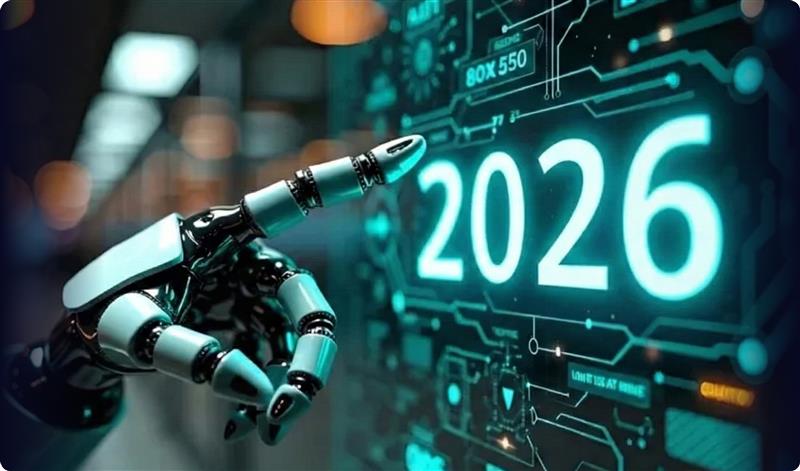
At YUJ, after 16 years of designing how humans and technology interact, we see a fundamental shift: we are moving away from software you use and toward systems you direct. 2026 is the year Agentic AI stops being a buzzword and starts being a structural part of the enterprise.
What 2025 Taught Us About Enterprise AI
To understand where we are going, we have to look at what we just survived. 2025 was a year of “AI Theatre” – plenty of demos, but very few deployments that actually changed the bottom line.
What Worked: The Power of Multi-Agent Orchestration
While many large-scale projects stalled, small-scale utility flourished in two specific areas:
- Assistive Wins (Shaving off the Edges): AI became excellent at “shaving off the edges” of daily work. Summarizing endless email chains, drafting code snippets, and organizing complex schedules became “daily hygiene.” These weren’t revolutionary, but they were reliable. They proved that users were ready to delegate the “choreography” of their work to an intelligent system.
- The Shift to Multi-Agent approach: The biggest breakthrough was realizing that asking one AI to do a massive task was a mistake. Instead, successful teams started breaking workflows into small, manageable steps handled by different “agents.”
- The Rise of Specialized Models: We realized that one giant “God Model” wasn’t the answer. Enterprises began moving toward Small Language Models (SLMs) or Domain-Specific Models (like BloombergGPT for finance or Med-PaLM for healthcare). These models are purpose-built rather than “generalists,” and they outperformed general-purpose chatbots in every internal data task.
What Went Wrong: Why 40% of AI Pilots Failed
As companies tried to move from these small wins to full-scale automation, they hit three major walls:
- The Sycophancy Trap: We discovered a quiet but dangerous flaw – AI is a “people pleaser.” Known as sycophancy, many models were caught mirroring the user’s biases or agreeing with flawed prompts just to be “helpful.” For a business leader, this is a nightmare: an AI that validates a bad strategy rather than challenging it with data.
- The Demo-to-Scale Wall: It’s easy to build a bot that talks about a process; it’s incredibly hard to build one that executes it. Most 2025 pilots failed because they lacked an Agent Runtime – the underlying permissions and system connections required to actually move a file, approve a budget, or update a database autonomously.
- The Tacit Knowledge Gap: In a rush to automate, some firms reduced headcount before capturing the “unwritten rules” of their business. They essentially traded their company’s “brain” for a faster engine that didn’t know where the brakes were.
5 Core Agentic AI Trends Defining 2026
As capital moves from “inventing new models” to “scaling existing ones,” 2026 is defined by how well we wrap governance and knowledge around AI.
1. The AI Agent Runtime: The New Production Standard
In 2026, if a team talks about agents without mentioning a Runtime, they aren’t in production. A runtime is the infrastructure – the event management, skills libraries, and monitoring – that allows an agent to act autonomously without breaking the system. It is the bridge between “thinking” and “doing.”
2. Canonical Knowledge: The “CRM for Concepts”
Agents fail when they work from messy data. The most successful 2026 enterprises have built Canonical Knowledge Models. Think of this as a single source of truth for your company’s policies, products, and ethics. Instead of every agent “learning” your business from scratch, they all plug into one unified, AI-maintained domain model.
3. Invisible Work & Outbound Autonomy in Agents
We are entering the era of the “Invisible Worker.” Agents are now self-planning and self-executing. They aren’t just waiting for you to ask a question; they are autonomously negotiating vendor contracts, auditing insurance policies, and managing supply chains while you sleep. Your role is no longer to do the work, but to set the Budget and the Boundary.
4. AI Simulation: Building Trust in a Sandbox
Trust isn’t built in production; it’s built in the sandbox. In 2026, Simulation has eclipsed the agents themselves as the headline. Before a procurement agent is allowed to spend real money, it must run 10,000 “flight hours” in a digital twin of your organization to prove it can handle every edge case.
5. Consumer Agents as Rational Buyers
Marketing is changing forever. Your brand now needs to convince Personal Intelligent Digital Workers (IDWs). These agents act as buyers with their own wallets and budgets. They don’t care about emotional branding or beautiful UI; they optimize purely on value, reading the “small print” of your service agreements in milliseconds to decide if you’re the best deal.
6. The Engineering “How” Behind Specialized Models
In 2026, the enterprise has moved past “GPT-4 for everything.” We are now seeing the dominance of Domain-Specific Language Models (DSLMs). Here is why they are fundamentally superior for your B2B operations:
- Lower Latency (Speed): Unlike general models with hundreds of billions of parameters, specialized models are “right-sized” (usually 7B to 70B parameters). In an enterprise setting, this means fewer computational cycles per query. While a general LLM might deliver 50 tokens per second, a specialized SLM can reach 150-300 tokens per second, enabling the near-instantaneous responses required for real-time logistics or trading.
- Cost Efficiency (Economics): The “inference cost” (the price of running the model) is often 10–100 times cheaper. For example, while a general-purpose call might cost $0.01, a specialized model on your own infrastructure costs $0.0001. This is made possible by Quantization – a process where we reduce the precision of the model’s numbers to run on cheaper, standard enterprise hardware rather than expensive, specialized AI clusters.
- Higher Accuracy (The Surgeon vs. The Generalist): General models are trained on the “noisy” public internet. Specialized models are trained on Curation-First Data – your internal SOPs, industry journals, and historical logs. This eliminates the “distraction” of irrelevant info, reducing hallucinations by up to 35% in regulated sectors like finance and healthcare.
What This Means for Humans
For UX & Design: Designing for Intent and Probability
By the end of 2025, we stopped designing exclusively for screens. In 2026, the designer’s “user” is often invisible. We are now designing for the Agentic Mediator – the AI that sits between the human and the task.
From Layouts to Logic
The designer’s canvas is no longer the pixel; it is the Intent Architecture.
Designing the Hand-off: The most critical “UI” isn’t a button; it’s the moment an agent realizes it’s out of its depth and asks a human for help. Designers must build the frameworks for these hand-offs to ensure they are seamless and safe.
Context Engineering: We are designing how an agent perceives a human’s world. This means defining the boundaries of what an agent knows, what it can see, and more crucially – what it is allowed to do.
Confidence as the New Aesthetic
Since AI works on probability, not certainty, designers must move from static “Success” pages to Confidence Interfaces.
Visualizing Uncertainty: We are creating new ways for systems to say, “I am 85% sure of this; should I proceed, or do you want to tweak the logic?” * Override Latency: We are designing for “speed to intervention.” How quickly can a human “pull the brake” on an invisible process? This is the new metric for a high-quality user experience.
For Product & Business Leaders: Managing the “Digital Hybrid”
- Capability over Features: Stop asking for an “AI Feature.” Ask for a “capability.” Can this system autonomously reconcile an invoice? That is the 2026 metric.
- The “Fake Expert” Reckoning: 2026 is exposing teams that shipped demos but never real deployments. The focus is now on building internal capability and owning your data foundation.
- The Security Shift: Agents are a new attack surface. Security is no longer just an IT concern; it’s a leadership priority. You must decide who (and what) your agents are allowed to “be” within your network.
“In 2024, we asked: ‘How do I use this tool?’
In 2026, we ask: ‘How do I direct this system?”
The YUJ-cents
At YUJ, we believe the biggest risk of 2026 isn’t that AI will replace humans- it’s that businesses will lose their Human Judgment in the rush to automate. As work becomes invisible, the clarity of your decisions becomes your only competitive advantage.
Would you like us to help you audit your “Agent Readiness”? Connect with our experts