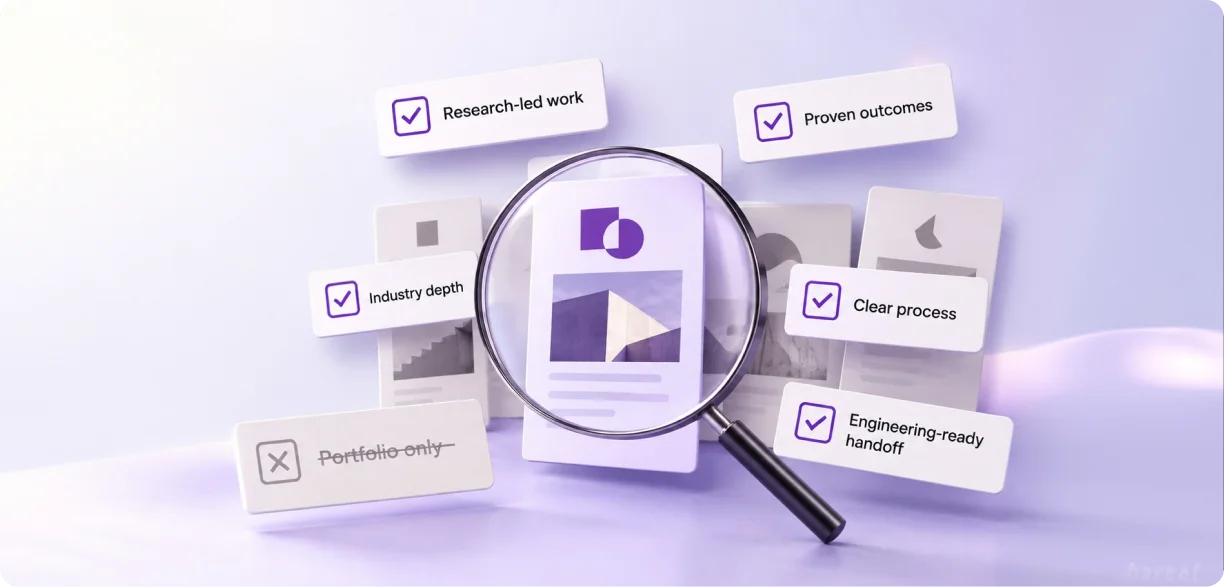
An in-house research team works best when you need continuous, product-embedded insight and can fund full-time researchers. A user research agency fits better for specialized studies, fast ramp-up, and neutral findings. It also suits research you run only a few times a year. Most mature enterprises combine both.
Introduction
Imagine this. People sign up for your product, but many leave before they actually use it. Your team wants to find out why by talking to real users. But first, you need to decide who will do that research.
That’s usually when the real question surfaces. Do you build research capability inside the company, or bring in a partner?
Both paths work. Both can also fail, and expensively. The right answer depends on how often you need research and how complex your product is. It also depends on how honest your company is about its blind spots.
At Yuj Designs, we’ve run user research for UX design on enterprise products for more than 25 years. Our teams work from studios in India and the USA. We’ve been the outside partner. We’ve also helped clients build their own teams. This guide covers what we’ve seen work, where each model breaks, and how to decide.
What Does User Research Services Actually Involve?
User research services help product teams understand how real people think, behave, and decide when they use a product. The goal is simple: replace assumptions with evidence before those assumptions turn into code.
A typical engagement mixes several kinds of work:
- Generative research: interviews, contextual inquiry, and diary studies that uncover unmet needs.
- Evaluative research: usability tests, heuristic reviews, and expert audits of existing flows.
- Quantitative research: surveys, analytics reviews, and experiment design.
- Synthesis: personas, journey maps, and a ranked list of opportunities.
Good user research for UX design doesn’t stop at a report. It shapes what gets designed next, what gets cut, and what gets tested again.
How an In-House User Research Team Works
An in-house team is made up of full-time researchers inside your product organization. In a smaller company, that might be one researcher supporting several squads. In a large enterprise, it’s often a research operations function with its own tools, participant panels, and insight repository.
The biggest strength is context. In-house researchers know the roadmap, the internal dynamics, and the history behind every odd design decision. They can run quick studies between sprints and stay with a problem for years.
The trade-offs are real, though. Hiring senior researchers takes months. A small team can only cover so many methods well. And people who live inside a product slowly start seeing it the way the company wants it to be seen. That isn’t a flaw in the people; it’s a human tendency.
What a UX Research Agency Does Differently
A user research agency is an external partner that plans, runs, and synthesizes studies for you. A strong UX research agency brings researchers who have seen the same problem across dozens of products and industries.
That pattern recognition is the main thing you pay for. By week two, an agency may recognise patterns in your onboarding flow based on similar challenges it has encountered across other projects. It also brings methods you may need only once a year, like accessibility studies, multi-country fieldwork, or AI trust testing.
Neutrality matters too. When findings challenge a senior leader’s favorite feature, an outside voice often lands better. It’s easier to hear “this isn’t working” from someone with no internal stake.
The downside? Ramp-up time, steep-feeling project fees, and the risk of losing access to valuable research insights once the engagement ends.
Also Read – UX Consulting vs Embedded Design Teams: Which Model Wins in 2026?
UX Research Agency vs In-House Team: Cost, Speed and Quality
| Factor | In-House Team | External Agency |
|---|---|---|
| Setup time | Months to hire and onboard | Weeks to kick off |
| Cost model | Fixed salaries, tools, and panels | Project or retainer fees |
| Product context | Deep and continuous | Built during discovery |
| Method range | Limited by team size | Broad specialist bench |
| Objectivity | Prone to insider bias | Fresh outside perspective |
| Scalability | Slow to flex | Scales up or down per project |
| Knowledge retention | Stays in the company | Needs a deliberate handover |
| Best for | Continuous, embedded research | Specialized, high-stakes, or occasional studies |
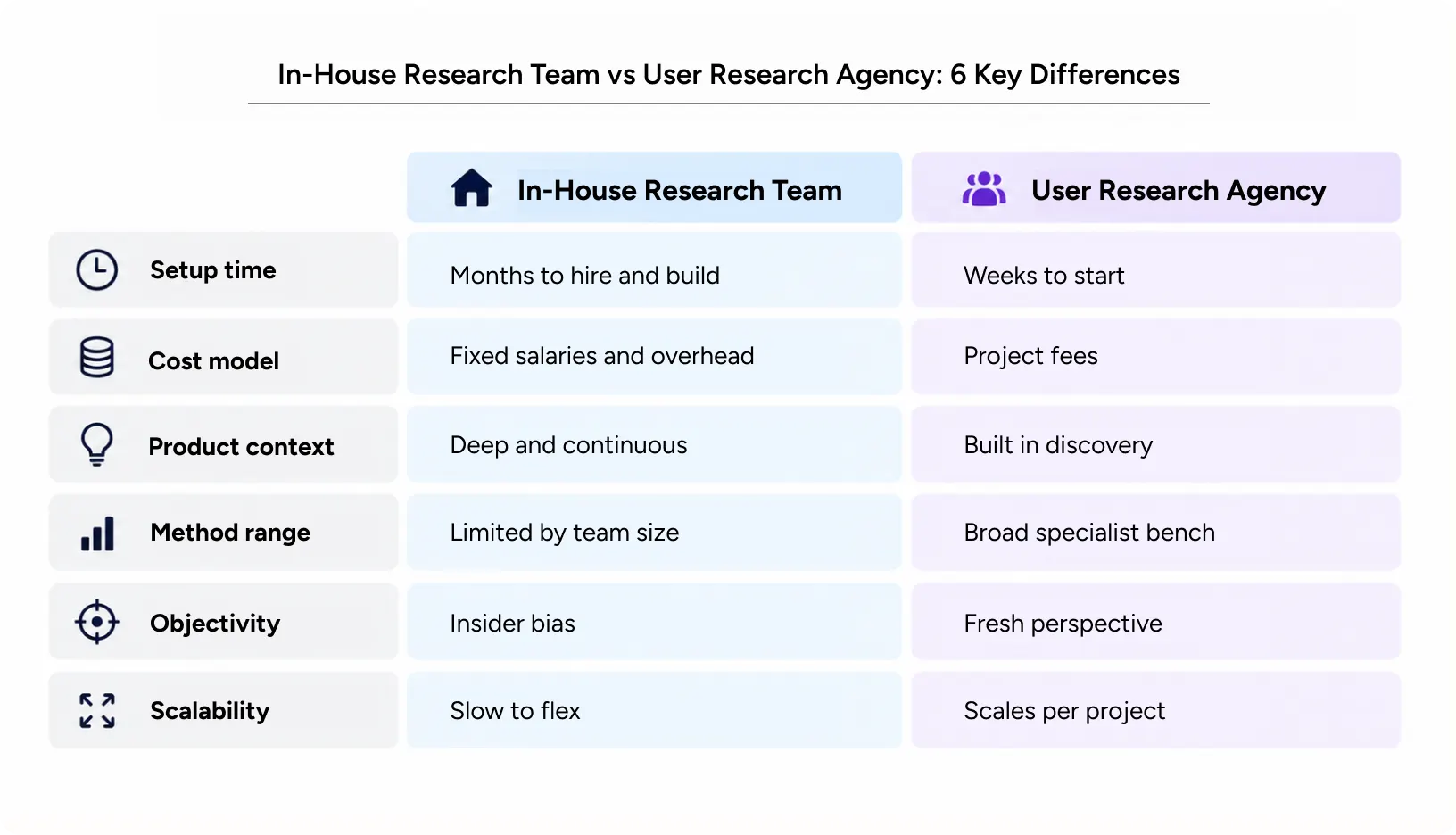
As a rule of thumb, if your product team needs UX research in every sprint to validate design decisions and improve user flows, an in-house research team may be more practical. If you only need occasional usability testing, UX audits, or in-depth user studies, partnering with a UX research agency is often the more efficient option.
Impact on User Experience: How Each UX Research Model Shapes Products
Whichever model you choose, research earns its budget through what it does to the experience. Here’s where the difference shows up.
Usability
Usability testing helps identify problems before they affect the user experience. Watching people try to complete the same task can reveal more than weeks of internal discussions. A dedicated usability testing service brings structure to the process, with clearly defined tasks, relevant participants, and findings prioritised by severity. In-house teams can conduct these tests too, but tight deadlines often lead to shortcuts, including testing with colleagues instead of actual users. The problem is that colleagues already understand the product, while real users may not.
Accessibility
Accessibility research needs specialist knowledge. That means recruiting people who use screen readers, magnification, or voice control. It also means understanding WCAG beyond a checklist. Few in-house teams have that bench, so this is one area where external user research services almost always add value. It matters most for regulated products in banking, healthcare, and government.
Cognitive Load
Enterprise products carry a heavy cognitive load. Dense dashboards, layered permissions, and 20-field forms wear people down. Research reveals where users hesitate, re-read, or give up. In-house researchers are good at tracking this over time. Agencies are good at spotting it fresh, because they haven’t learned to tolerate the clutter.
Emotional Response
People don’t judge a product only on whether it works. They judge how it makes them feel: confident, anxious, rushed, or in control. Moderated sessions and interviews capture that emotional layer. In our experience, it’s often the gap between a tool people tolerate and one they recommend.
Impact on Business Metrics: What Better Ux Research Moves
Research stops looking like a cost center once it’s tied to numbers leadership already tracks.
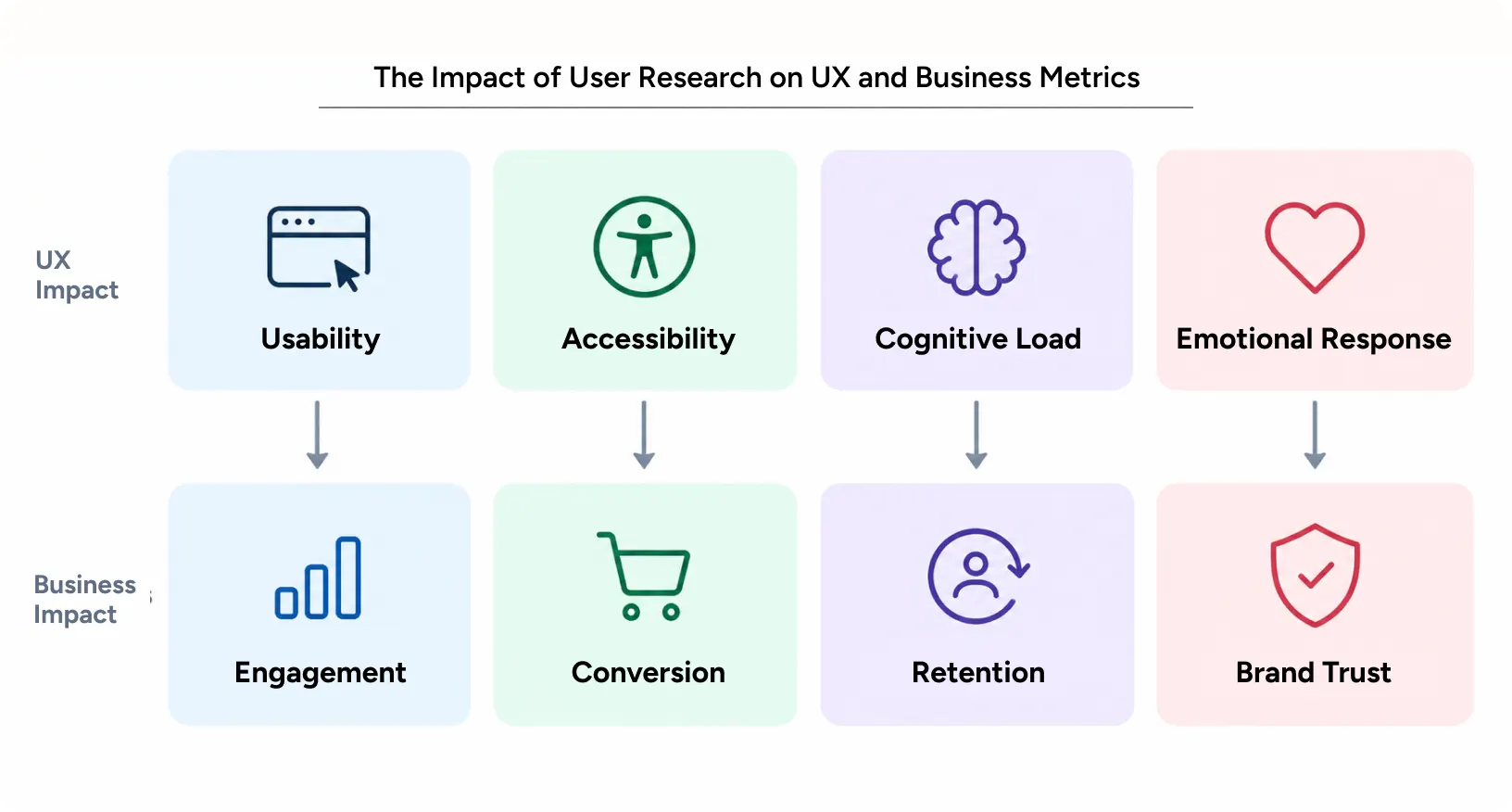
Engagement
Research shows which features people value and which ones they never find. That lets you invest in the right places. Teams that run regular user testing services tend to catch engagement problems before they show up in quarterly dashboards.
Conversion
Every step in a sign-up, checkout, or booking flow is a chance to lose someone. A focused usability testing service pinpoints the exact step, field, or label causing the drop. Fixing one confusing pricing screen can move conversion more than a full visual redesign.
Retention
Users leave quietly. Churn interviews and longitudinal studies explain why. This is where in-house teams shine, because retention research needs patience and continuity. A partner can set up the framework, and your team keeps it running.
Brand Trust
Trust builds when a product behaves the way people expect. It erodes when pricing feels hidden, or errors feel like the user’s fault. Research surfaces these trust gaps early. For AI-powered features, testing how users interpret recommendations is no longer optional.
Which Research Model Fits Your Team: In-House, Agency, or Hybrid?
Build In-House When…
- You ship continuously and need research every sprint.
- Your product needs domain context that takes years to build.
- You can fund senior hires plus research operations, tools, and participant panels.
Hire a User Research Agency When…
- You need specialized methods, like accessibility, international, or AI trust studies.
- A major redesign or launch needs evidence fast.
- You need well-recruited user testing services ahead of a release.
- Internal opinions are deadlocked, and you need neutral findings.
- You want to validate a new product before committing to a full team.
Go Hybrid When…
Most mature enterprises end up here. The internal team owns continuous research and the insight repository. A UX research agency handles big strategic studies, demand surges, or skills the team lacks. Some companies start with a partner, then use that partner to embed design talent and train their first in-house researchers.
Common Mistakes to Avoid When Sourcing User Research
Misuse or Overuse
Research can quietly become a way to delay decisions. If every small copy change needs a formal study, the team stalls. Match the method to the risk. Sometimes five quick remote sessions are enough. Sometimes a decision deserves a multi-week study.
Poor Implementation
The most common failure isn’t bad research. It’s research nobody uses. Reports land in a shared drive and vanish. Effective user research for UX design ends in a decision, not a document. Fix this by bringing designers and product managers into sessions, writing findings as decisions, and tracking which insights actually shipped. When you hire a user research agency, ask how it hands over findings, not just how it gathers them.
Pro Tips from Yuj Designs
- Test with the right people. Recruit people who match your real users. Internal staff, friends, or very tech-savvy panels will skew your results.
- Ask neutral questions. Ask “How did that feel?” instead of “Wasn’t that easy?” Leading questions only confirm what you already believe.
- Revisit your findings regularly. User behavior shifts as markets and technology change. Treat each study as a snapshot, not a permanent truth.
- Look beyond the lowest price. A cheap UX research agency that recruits poorly costs more in wrong decisions.
- Include the quiet middle. Studies often focus on new users and power users. Make room for the majority who simply muddle through.
How to Choose a UX Research Agency: 6 Questions to Ask
If an agency is the right call, vet it like a senior hire. Ask these six questions:
1. Which industries have you researched?
Look for depth in your domain, not just famous logos. A team that has studied banking apps will already understand compliance rules and customer worries. That means less time explaining your world, and sharper insights sooner.
2. How do you recruit participants?
Recruitment quality decides result quality. If the wrong people join your study, the findings will point you in the wrong direction. Ask how the agency screens participants and how it finds niche roles, like hospital staff or fleet managers.
3. Who runs the sessions?
Senior researchers often lead the sales pitch, then hand the work to junior staff. Ask who will plan the study, moderate the sessions, and write the findings. Experienced researchers notice small moments that less experienced eyes can miss.
4. How do findings become design decisions?
A long deck full of user quotes looks impressive but rarely changes anything. Ask for findings ranked by severity and business impact. Each one should come with a clear next step your designers can act on.
5. Can you work alongside our team?
The best partners build your capability, not your dependency. Ask if your team can observe sessions and join analysis workshops. A good agency should also leave behind templates and frameworks you can reuse later.
6. Do you offer research and design together?
Research and design often sit with separate vendors, and insights get lost in the handover. A partner offering both user research services and design can carry insights straight into prototypes. It can then test those prototypes with real users before anything gets built.
Any usability testing service you hire should also define success metrics up front. Common ones include task completion rate, time on task, and System Usability Scale (SUS) scores. Measure them before and after a redesign, and you’ll know exactly how much the experience improved.
Real-World Applications: How Agency-Led Research Reshaped Avis Bookings
Avis, the US-based car rental company, partnered with Yuj Designs to rethink its website booking experience. Booking friction was costing rentals, add-ons, and repeat business. Users faced overwhelming options, unclear pricing, and generic journeys. The mobile flow didn’t match how travelers book on the go.
The Yuj Designs team built the redesign on three priorities: transparency to build trust, mobile-first interactions, and progressive disclosure to simplify complex choices. Smart filters and guided comparisons helped users find the right vehicle faster.
In user evaluations, the new experience scored 9/10 on usability and retention desirability. It also scored 9/10 for time to complete a booking. It scored 10/10 for intuitive navigation and user confidence. Yuj Designs delivered a scalable responsive application in 12 weeks. The work secured executive buy-in for full development and helped set up a Design Center of Excellence.
Read More: The Avis case study
Conclusion
There’s no universal winner in the in-house vs agency debate. In-house teams give you continuity and deep context. A user research agency gives you range, speed, and an honest outside view. The smartest product teams in the US and India use both, each where it’s strongest.
Start with your research cadence, your product’s complexity, and the decisions riding on the next release. Then pick the model, or mix, that gets you trustworthy evidence fastest. Strong user research services pay for themselves in fewer wrong builds and products people trust. At Yuj Designs, we work both ways: as your outside research partner, or alongside your in-house team.

FAQs