A UX audit is a structured review of a product’s experience to identify where users get stuck, become confused, or drop off. Running a UX design audit before a redesign saves money and prevents rebuilding the wrong things. This guide explains what UI and UX audit work covers, what UX audit services include, and how a UX audit company turns findings into priorities.
Why most redesigns fail before they start
Here is a pattern we see constantly. A product team senses something is wrong. Sign-ups are flat. Support tickets keep repeating. So someone says the word every founder eventually says: redesign.
The deck gets built. New screens get shipped. Three months pass by. And the numbers barely move.
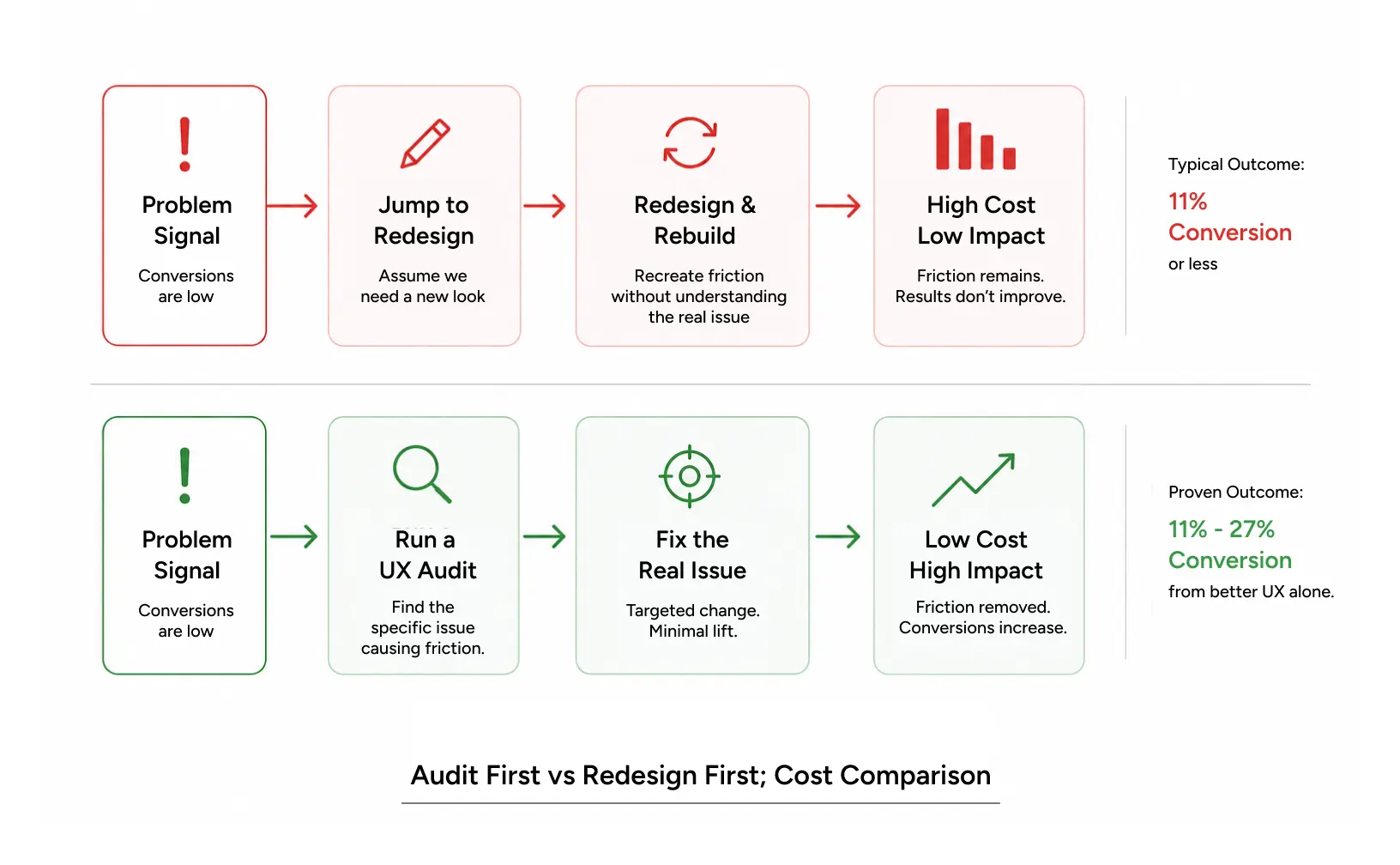
The problem was never the visuals. The problem was that nobody diagnosed the actual issue first. A redesign without a UX audit is surgery without a scan. You are guessing at the cause and hoping the new paint hides it.
We have watched teams spend ₹15-20 lakh rebuilding an interface, only to recreate the same drop-off in a prettier shell. The friction did not live in the colours. It lived in the flow. A UX design audit tells you what needs to change before you write a single line of new code.
What a UX Audit Is and How It Differs From a Redesign
A UX audit is a structured, evidence-based review of how real people experience your product. It is not an opinion about whether a screen looks good. It is a method for finding where users hesitate, misread, abandon, or quietly give up.
Think of it as a health check. A good UI and UX audit combines several lenses. It looks at behavioural data to see where people fall off. It runs heuristic evaluation against established usability principles. And it watches actual users move through the product to catch what the numbers cannot explain.
The output is not “make it cleaner”. The output is specific: users drop at step three of onboarding because the form asks for a PAN number before showing any value. That is a finding you can act on. That is what separates UX audit services from a generic design review.
We have run these evaluations at Yuj Designs for 16 years, across fintech, healthcare, and enterprise SaaS. The thing that holds true everywhere is this. The team is often too immersed in the product to recognize its own challenges; however, an audit provides a fresh perspective through the eyes of experts.
What a UX design audit looks at
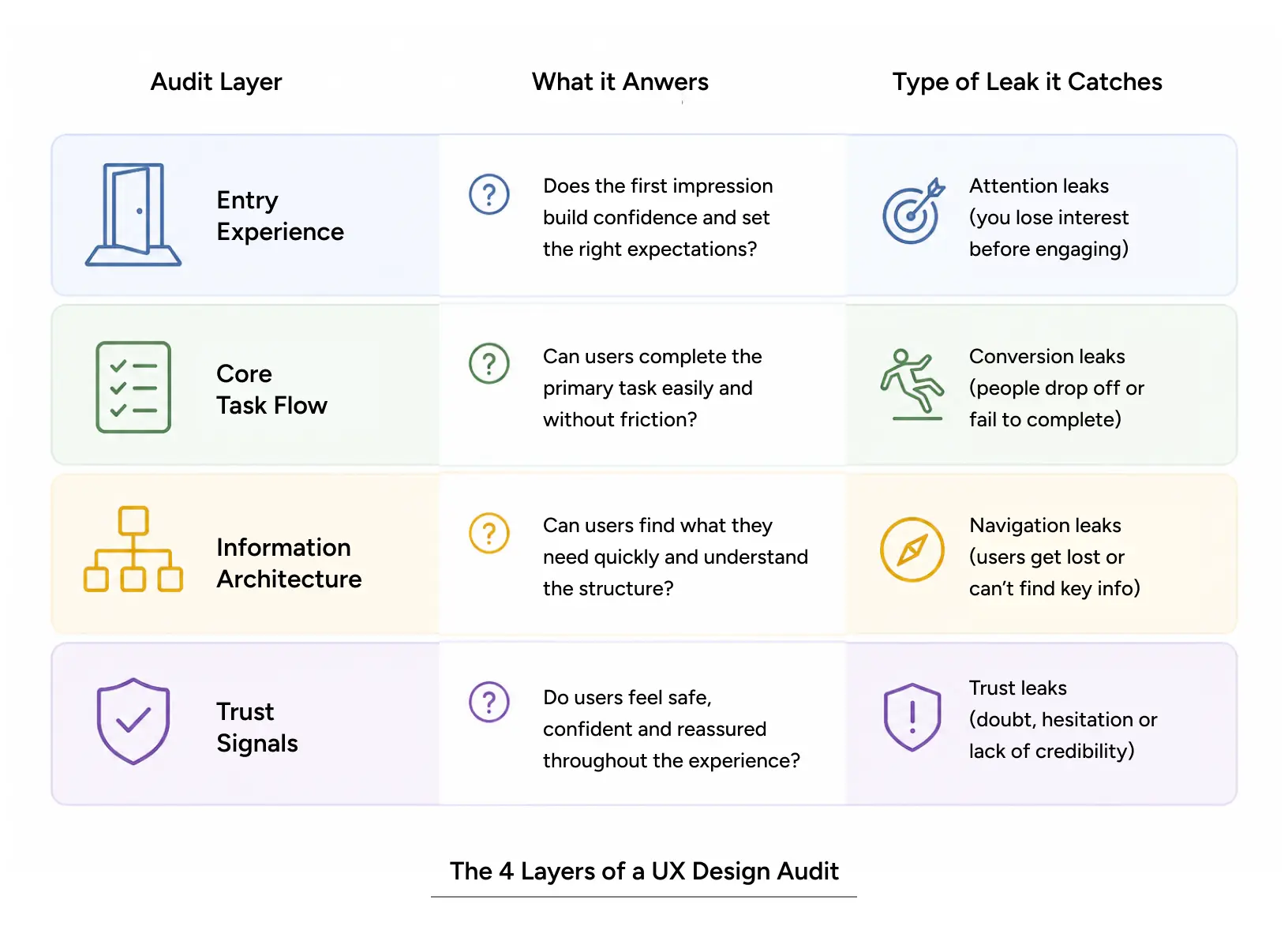
A proper UX design audit does not stop at one layer. It moves through navigation, content, presentation, interaction, and strategy because friction hides in different places depending on the product. By examining each of these dimensions, the audit uncovers issues that might otherwise remain invisible to the team.
First, the entry experience. Where do people land, and does the first screen tell them they are in the right place? Most products lose users in the first session, and usually, it is here. A clear hook beats a clever animation every time.
Second, the core task flows. If your product helps someone do one thing, can they do it without thinking? A UI UX audit maps every step of that flow and marks the moments where the user has to stop and figure something out. Each stop is a leak.
Third, the information architecture. Can people find what they need? Bad navigation is invisible to the team that built it and obvious to everyone else.
Fourth, the trust signals. This matters more than people admit, especially in fintech and AI products. Users do not abandon it because a feature is missing. They abandon because they cannot tell what is happening or whether they can trust it.
A strong UX audit company weighs all four and tells you which one is actually costing you and your users. Not all friction is equal. The job is to find the expensive friction.
B2C Website UX Audit vs. B2B Product UX Audit
People often use these terms loosely, so let me draw the line clearly.
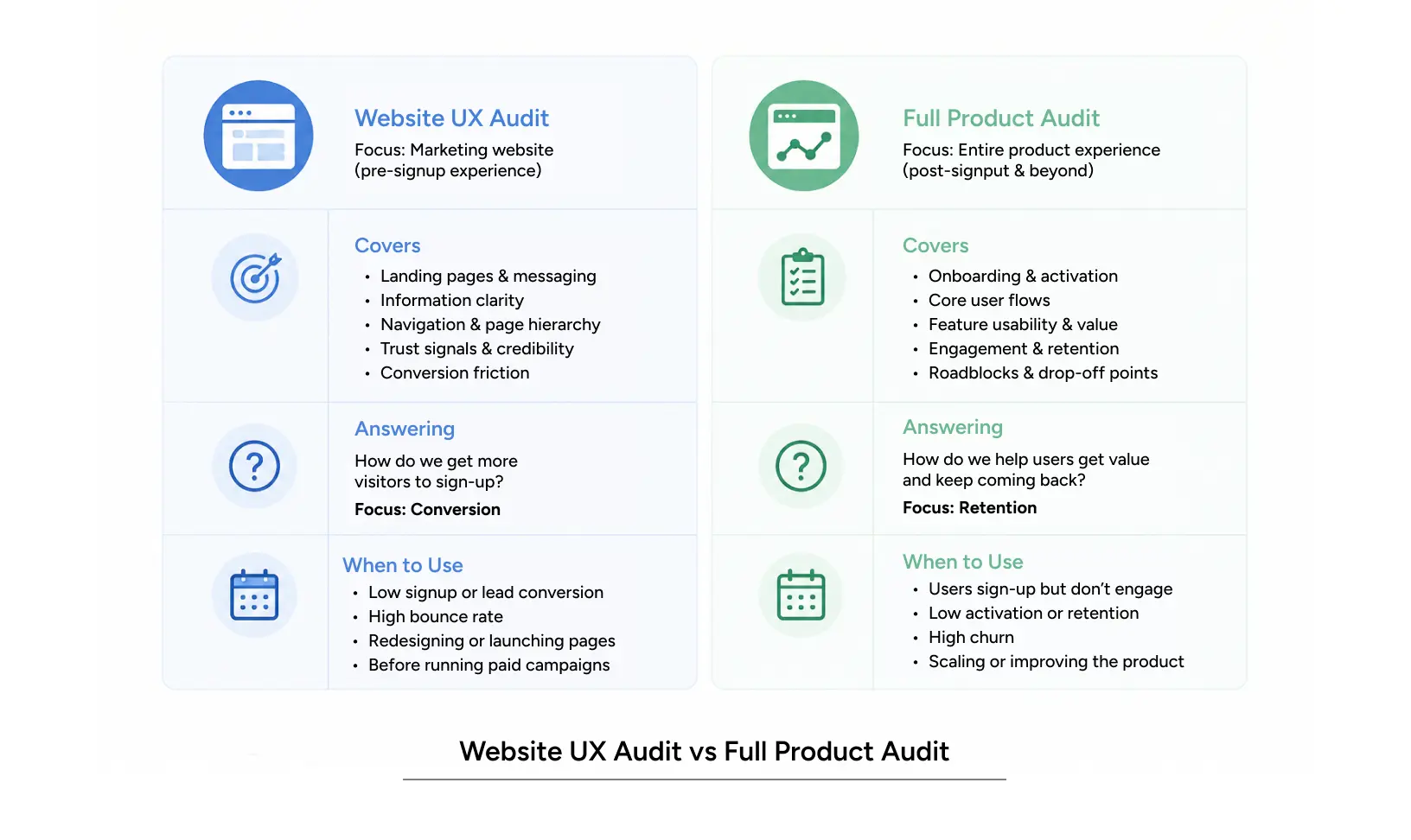
A website UX audit focuses on your marketing and conversion surfaces. The landing pages, the pricing page, the lead form, the checkout. The goal is conversion. A good website UX audit answers one question: why do visitors leave before doing the thing you want them to do?
A full product audit goes deeper into the app itself, where users actually work after they sign up. This is about retention and task success, not first-click conversion.
Both answer different questions but are equally important. If your traffic is fine but sign-ups are weak, you need a website UX audit. If sign-ups are fine but people churn after a week, you need the full product version. A serious UX audit company will ask which problem you are solving before quoting you a scope. Anyone who sells you the same package regardless of the question is selling a template, not a diagnosis.
For mobile-first audiences in India, the website UX audit carries extra weight. Every extra form field, every slow redirect, every unclear button costs conversion at a rate most teams underestimate.
The UX competitive audit nobody runs
Here is the layer most teams skip entirely: the UX competitive audit.
Your product does not exist in a vacuum. Your users have used Razorpay, Swiggy, and Zepto, and those products quietly set their expectations. When your flow asks for three more steps than the app they used this morning, they notice. They may not say it. They just leave.
A UX competitive audit maps your experience against the products your users already trust. Not to copy them, but to understand the baseline. If competitors solved onboarding in two steps and you take six, that gap is your churn.
We at yuj Designs run a UX competitive audit as standard for clients entering crowded categories. It often surfaces the cheapest wins, because matching an expectation users already have is far easier than inventing a new pattern. A focused UX competitive audit has saved our clients months of debate by replacing opinion with evidence about what the market already does well.
How a UX Audit Company Turns UX Audit Findings Into a Ranked Plan
Findings are useless if they sit in a slide deck. The real value of strong UX audit services is prioritisation.
A finished UX audit should hand you a ranked list. Each issue is tagged by impact and effort. High-impact, low-effort fixes go first. The expensive structural problems get flagged but are scheduled. This is what tells you whether you even need a full redesign or whether ten targeted fixes will recover most of the loss.
This is the part that teams value most. A good UX audit company does not just tell you what is broken. It tells you what to fix first, what to fix later, and what to leave alone. That sequencing is the difference between a report and a roadmap.
At Yuj designs, every audit ends with this prioritised plan. The client should walk away knowing exactly where their next dollar of design budget goes and what return to expect from it.
When you need UX audit services and when you don’t
Let me be honest, because not every team needs to pay for UX audit services right now. If you are pre-launch with no users, an audit has nothing to measure. Get the product in front of people first. If you have a tiny, specific bug, fix it. You do not need a full UX design audit to move a button.
But if any of these sound familiar, an audit will likely pay for itself. Your conversion is dropping, and you cannot say exactly why. You are about to spend serious money on a redesign. Your support team keeps answering the same three questions. Or your AI feature works technically, but users do not trust it.
In all of those cases, a UX audit is the cheapest insurance you can buy. It costs a fraction of a redesign and tells you whether the redesign is even the right move. Skipping it is how teams end up rebuilding the same problem twice.
UX Audit in Action: How One Fintech Went From 11% to 27% Conversion
A fintech client came to us convinced they needed a full rebuild. Trial-to-paid conversion sat at 11%. The founder was ready to scrap the whole interface.
We pushed back and ran a UI UX audit first. The model was fine. The product was fine. The problem was that the AI made recommendations without explaining why, so users did not trust it enough to pay.
We did not redesign the product. We rebuilt one layer, the transparency around how the AI reached its conclusions. Conversion moved from 11% to 27% in 90 days. The redesign they wanted would have cost ten times more and missed the actual problem entirely.
That is the case for the audit in one story. The expensive answer is rarely the right one. The right answer is usually specific, small, and invisible until someone trained looks for it.
Conclusion
A redesign is a bet. A UX design audit is how you find out whether it is a smart bet before you place it. It tells you where users actually struggle, ranks the problems by what they cost you, and shows you the cheapest path to recovery.
You can run pieces of it yourself. But a dedicated UX audit company brings the trained eye and the competitive context that internal teams, too close to their own product, rarely have. Whether you need full UX audit services, a focused website UX audit, or a UX competitive audit to understand your market, the principle is the same. Diagnose before you operate.
If your numbers are slipping and a redesign is on the table, talk to our team about a UX audit first. It is the cheapest decision you will make this quarter.

FAQs