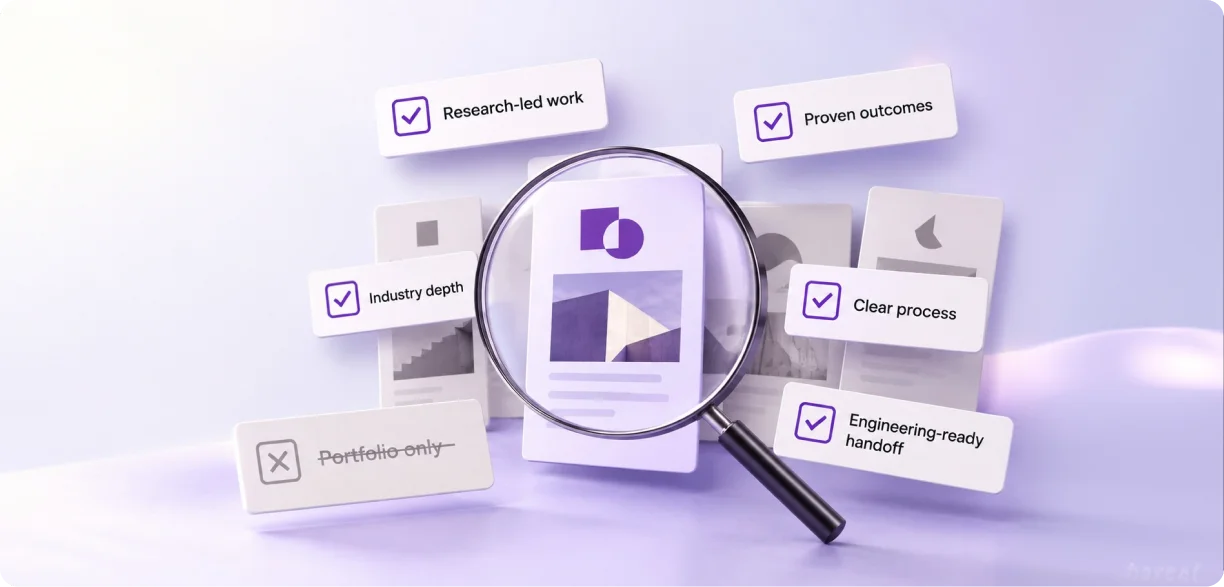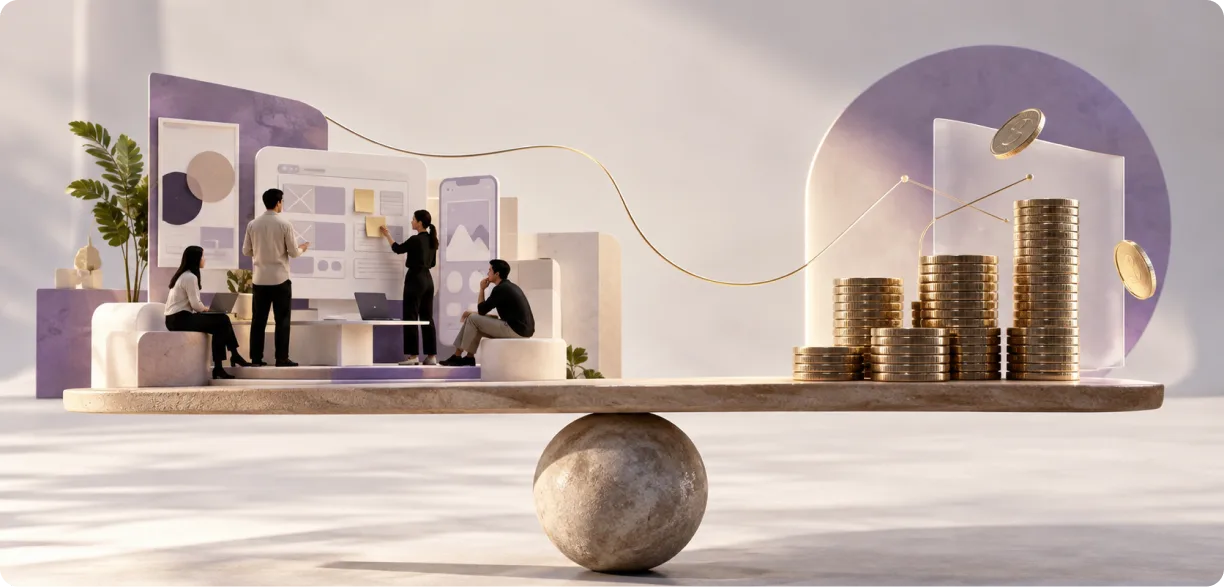
In 2026, UX design costs run from about $10,000 for a focused MVP to $150,000 or more for an enterprise platform. Agencies bill hourly, per project, or on a monthly retainer. The final number follows complexity, research depth, team seniority, and location. This guide explains each factor and how to budget without overpaying.
Why Does Every UX Quote Look Different?
Ask five agencies for a quote, and you will get five numbers that seem unrelated. One says $12,000. Another says $90,000. Neither is necessarily wrong. They are pricing different amounts of risk.
That is the frustrating part of buying design. Product leaders know they need better UX. What they rarely get is a plain explanation of the UX design agency cost before the proposal lands.
Yuj Designs works with Fortune 500 companies in the United States and enterprise teams across India. This guide shows how pricing really works, what you are paying for, and where budgets quietly leak. By the end, you will know what a fair quote looks like for your product and how to spot one.
How Much Does a UX Design Cost in 2026?
The honest answer is that UX design cost depends on how much uncertainty the work must remove. A five-screen signup flow and a multi-role enterprise dashboard both need UX. They are not the same job.
Clutch, which publishes pricing from verified client reviews, reports that UX/UI projects on its platform typically cost more than $10,000. It also notes that most projects average about 10 months. Dribbble’s 2026 pricing guide places agency work between $10,000 and $500,000+, depending on scope and risk.
| Project type | Typical budget (USD) | Typical timeline | What’s usually included |
|---|---|---|---|
| Small app or MVP | 10,000–50,000 | 4–8 weeks | Light research, core journeys, key screens, basic usability checks |
| Mid-size redesign | 50,000–150,000 | 8–16 weeks | Full user research, reworked flows, complete screens, design system, several test rounds |
| Enterprise platform | 150,000–500,000+ | 3–6 months | Discovery workshops, multi-role workflows, advanced testing, documentation |
Source: Dribbble, 2026 agency pricing guide. Treat these as ranges, not price tags. Your number sits wherever your product’s complexity puts it.
What Shapes Your UX Quote? 5 Key Pricing Factors Explained
Five factors move UX design cost more than anything else. Here is how each one shows up in a quote.
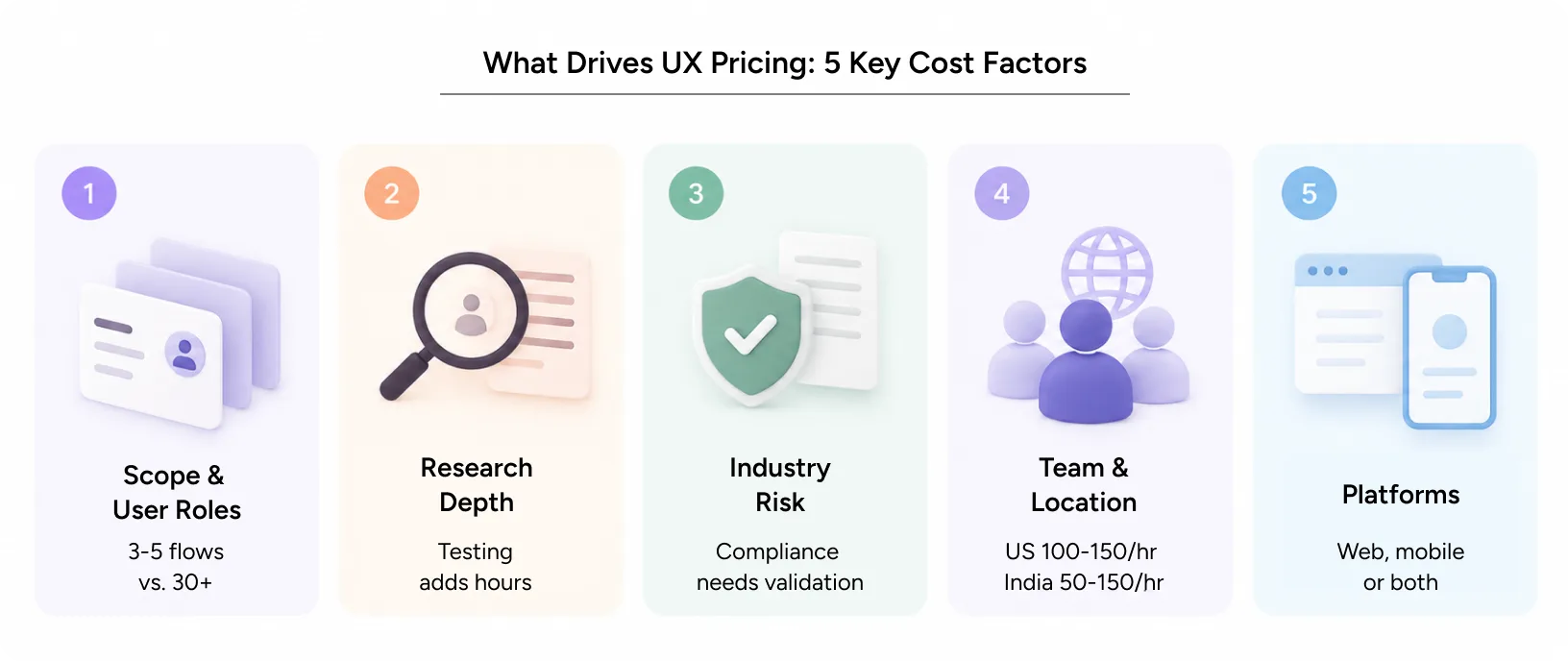
1. Scope and User Roles
Scope is the biggest lever on any quote. An MVP may have 3 to 5 core flows. An enterprise tool can have 30 or more, each with its own edge cases, error states, and permissions. Every extra user role adds scenarios to map and screens to test. Dribbble notes that a simple marketing site might need 10 to 15 screens, while a SaaS product can easily pass 100.
2. Research Depth
Interviews, participant recruitment, and usability testing all add hours to a project. They also remove the guesswork that causes expensive rework later. A light MVP may rely on quick feedback sessions. An enterprise product usually needs structured testing with real users across every role. Skimping here rarely saves money, because problems found after development cost far more to fix.
3. Industry Risk and Compliance
Fintech, healthcare, and automotive products carry compliance, security, and safety demands. Those need extra validation, documentation, and review cycles. Dribbble’s 2026 data shows the gap clearly: a mid-sized SaaS project typically runs $12,000 to $45,000, while healthcare work starts around $40,000. Regulated products cost more because a design error can mean a fine, a lawsuit, or a safety incident.
4. Team Seniority and Location
Rates follow local salaries and market demand. Dribbble lists senior US designers at $100 to $250 an hour. Senior designers in India fall between $50 and $150. Seniority matters as much as geography. A senior team often solves in one round what a junior team needs three rounds to get right.
Location affects price, but it should not decide quality. A UX design services company in India with Fortune 500 delivery experience can offer senior depth on a different rate card than a US studio.
5. Platforms and Devices
Web, iOS, Android, and tablet each need their own interaction patterns. Dribbble estimates web projects at $10,000 to $40,000 and mobile apps at $25,000 to $60,000. Multi-platform products often start around $70,000, because they also need a shared design system. That system costs more upfront but lowers the price of every future redesign.
Also Read – UX Consulting vs Embedded Design Teams: Which Model Wins in 2026?
Which UX Pricing Model Fits Your Scope?
The pricing model shapes your final UX design agency cost as much as the hourly rate does.
| Model | Typical range (USD) | Best for | Watch out for |
|---|---|---|---|
| Hourly | 100–250 per hour (experienced US agencies) | Audits, small fixes, short-term support | Invoices grow when tasks expand |
| Project-based | 15,000–150,000 | MVPs, redesigns, defined feature sets | Scope changes trigger change orders |
| Retainer | 10,000–30,000+ per month | Teams shipping features every sprint | Paying for capacity you don’t use |
Source: Dribbble. A simple rule works well: match the model to how stable your scope is. A six-month hourly engagement for a defined MVP usually costs more than a fixed quote. Picking the right model early can trim your total UX design cost before any design work begins.
Hidden UX Design Costs Most Budgets Miss
The number on the proposal is rarely your final UX design cost. Most quotes cover defined deliverables, not every tool, test, or revision a real product needs. These are the line items that most often surprise buyers.
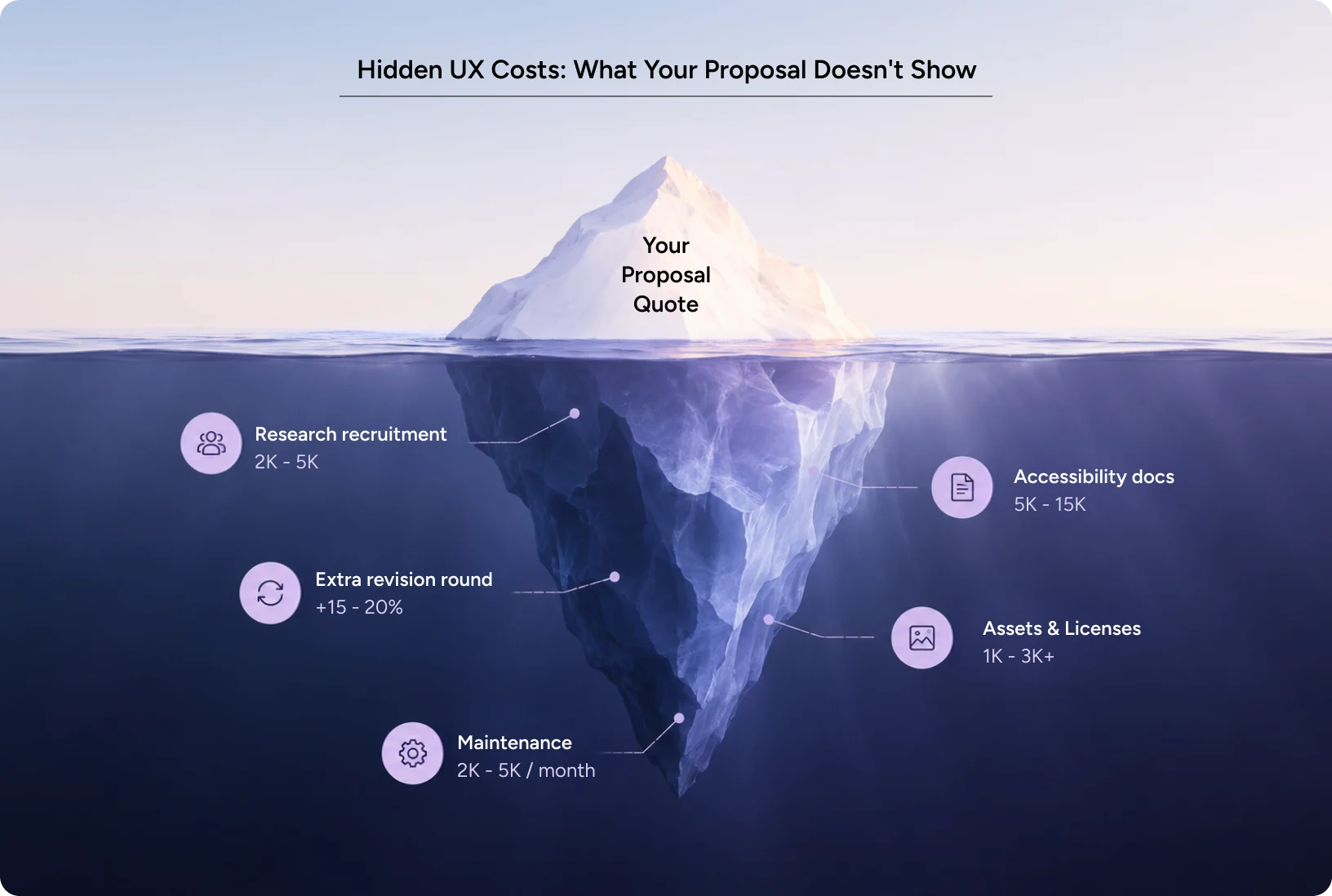
1. Research Recruitment and Testing Tools
Talking to real users is never free. Incentives for niche participants, such as doctors, CFOs, or field engineers, can add $2,000 to $5,000. Remote testing platforms can add another $1,000 or more. Ask whether recruitment and tools sit inside the research fee or outside it.
2. Accessibility and Compliance Documentation
Enterprise and government projects often require formal proof of accessibility compliance. Accessibility audits and VPAT reports can add $5,000 to $15,000 to a project. Addressing accessibility during the design phase can reduce the cost of fixing issues later. If your project involves enterprise or government clients, discuss accessibility requirements with your UX design agency early to avoid unexpected costs.
3. Extra Revision Rounds and Scope Changes
Most contracts include two revision rounds. A third major cycle can add 15% to 20% of the fee. Edge cases, such as error states and empty screens, are sometimes left out of the first scope. Late feedback from senior decision-makers is a common trigger for change orders.
4. Assets, Licenses, and Handoff Support
Fonts, premium icons, and stock visuals all carry license fees. Dribbble estimates fonts at $500 to $2,000+ a year and visual assets at $1,000 to $3,000. Design tools can cost $15 to $75 per user each month. Developer handoff support beyond the agreed hours can run $150 to $200 an hour.
5. Post-Launch Fixes and Maintenance
Design work does not end at launch. Real data often breaks layouts built on placeholder content. Operating system updates can also force interface changes. Many agencies offer maintenance retainers in the $2,000 to $5,000 a month range to cover this.
How to Protect Your Budget?
Hold back a 10% to 15% contingency. It keeps a small scope shift from turning into a budget crisis. Ask any UX design services company you shortlist to list these items in writing.
How Your UX Budget Improves Usability and Accessibility
Paying for UX means paying for how people feel and perform inside your product. Here is where the money shows up for users.
Usability
Usability is whether people can finish the task they came for. Research and testing hours are where it gets built. Cutting them is the fastest way to lower UX design cost, and the fastest way to ship confusion.
Accessibility
Accessible design serves people with visual, motor, hearing, and cognitive differences. It also protects you in markets with legal requirements, such as the ADA in the United States. Building WCAG checks in from day one costs less than retrofitting them. A good UX design consultant flags gaps during wireframes, not after launch.
Cognitive Load
Every extra field, label, and decision taxes attention. Enterprise tools suffer most, because users juggle many tasks at once. Simplifying a dense dashboard takes research and several rounds of iteration. That is a big reason complex products cost more. A seasoned UX design consultant can spot overload quickly during an expert review.
Emotional Response
People decide whether to trust a product within moments. Visual clarity, honest microcopy, and predictable feedback create calm. A skilled UI UX consultant shapes this layer through tone, motion, and system states, not decoration alone. Good UX consulting then ties that feeling back to measurable behavior.
How Good UX Pays Off: The Business Metrics It Moves
A smart UX design agency cost decision is judged by what it moves on your dashboard, not by the size of the invoice. Here are the metrics worth tracking, and what good design does to each one.
Engagement
Clear navigation and useful empty states keep people exploring. When users find value early, session depth and feature adoption tend to rise together. A UI UX consultant can often fix these quick wins in a short sprint.
Metrics to track: daily and monthly active users (DAU/MAU), average session length, and feature adoption rate.
Conversion
Every redundant step in a signup or checkout leaks revenue. Fixing one high-traffic flow can repay the UX design cost of an entire engagement. Ask any partner to model that math with you before you sign.
For Hero MotoCorp, a client review on the Yuj Designs website credits the work with a 25% overall improvement in conversion rates, ratings, and NPS.
Metrics to track: conversion rate, funnel drop-off at each step, form completion rate, and cost per acquisition.
Retention
Users rarely leave because of one bug. They leave because the product keeps making them work harder than it should. Ongoing UX consulting or a design retainer keeps churn in check as new features pile up.
Metrics to track: churn rate, repeat usage, renewal rate, and customer lifetime value (CLV).
Brand Trust
In fintech, healthcare, and enterprise software, the interface is the brand. Predictable flows and transparent AI behavior signal competence. A UX design services company with regulated-industry experience knows which trust signals your buyers look for.
Metrics to track: Net Promoter Score (NPS), customer satisfaction (CSAT), app store ratings, and support ticket volume.
Set a Baseline Before You Start
Record each metric before design work begins. Without a baseline, no team can prove what changed or what the investment returned.
UX Hiring Mistakes That Quietly Drain Your Budget
Misuse or Overuse
Investing in an enterprise-grade process for a startup’s early-stage needs can inflate UX design costs quickly. You rarely need extensive documentation, multi-platform coverage, or a large component library at launch. But scaling back too much can be just as costly. Many teams invest in UI polish when the real problem lies in a broken user flow.
Poor Implementation
Great designs often die in handoff. When developers get static screens without states, specs, or design tokens, they have to guess. Budgeting for handoff support and design QA helps ensure the final product matches the intended design. Without them, your true UX design agency cost includes rework nobody planned.
Pro Tips from Yuj Designs: How to Get More From Your UX Budget
After 25+ years of enterprise projects, these are the habits we see in teams that get the best return on design spend.
1. Start With a Paid Discovery Sprint
A short discovery phase lets you test the partnership before you commit the full budget. Early UX consulting at this stage also sets clear success metrics, such as task completion or drop-off targets, before design starts.
2. Match the Partner to the Problem
A lone UX design consultant works well for a focused audit or a single flow. A multi-role platform rebuild needs a UX design services company with research, design, and testing depth under one roof.
3. Judge Seniority, Not the Hourly Rate
A cheaper UI UX consultant who needs three extra rounds can cost more than a senior one who gets it right the first time. Always ask who will actually do the work, not just who pitches it.
4. Fix Your Highest-Traffic Flow First
Prioritize the journey closest to revenue, such as signup, checkout, or onboarding. An early, measurable win makes it far easier to secure a budget for the next phase.
5. Test Prototypes Before Development
Clickable prototypes let real users validate decisions while changes are still cheap. A fix in a prototype takes hours. The same fix in production can take weeks.
6. Think in Design Systems From Day One
Reusable components and design tokens make every future feature faster to design and build. They also keep your product consistent as more teams start shipping.
Real-World Application: How Wayfair Got More From Its Design Spend
Here’s how research-led UX consulting can help solve complex workflow problems inside a large enterprise. For Wayfair, the challenge was with a tool that marketing teams relied on every day.
Wayfair’s marketing teams build every campaign inside a tool called the Template Manager. As the company grew, the tool started to slow them down. Workflows were scattered, errors were hard to catch, and analysts increasingly turned to support for help.
Yuj Designs spent more than 100 hours watching marketing analysts, operations specialists, and support specialists use the tool day to day. What they saw shaped the redesign: live previews, version history with rollback, role-based access, and AI suggestions for templates and content blocks.
When users tested the new system, they completed 98.24% of tasks successfully and gave it an 88.75% satisfaction score. They rated it 4.2 out of 5 and appreciated all 9 features tested. Most importantly, teams could finally finish their work on their own.
“Huge improvement will save our time!” — Julie, Senior Operations Specialist
Read more: Wayfair case study
The lesson for anyone weighing UX design cost: those research hours were not overhead. They are what made the results possible.
Conclusion
There is no universal price for good UX. There is only the right scope for the risk you carry. Get clear on the decision you need to de-risk, pick a pricing model that fits your scope, and judge every proposal by outcomes. Do that, and UX design cost becomes an investment you can defend in any budget review.
Yuj Designs has spent more than 17 years designing complex enterprise products for teams in the US, Europe, and India. That experience helps us give clients realistic estimates from the very first conversation. We know where complexity hides, and we scope for it before it turns into a surprise invoice. A good partner explains what every dollar of your budget pays for.

FAQs