
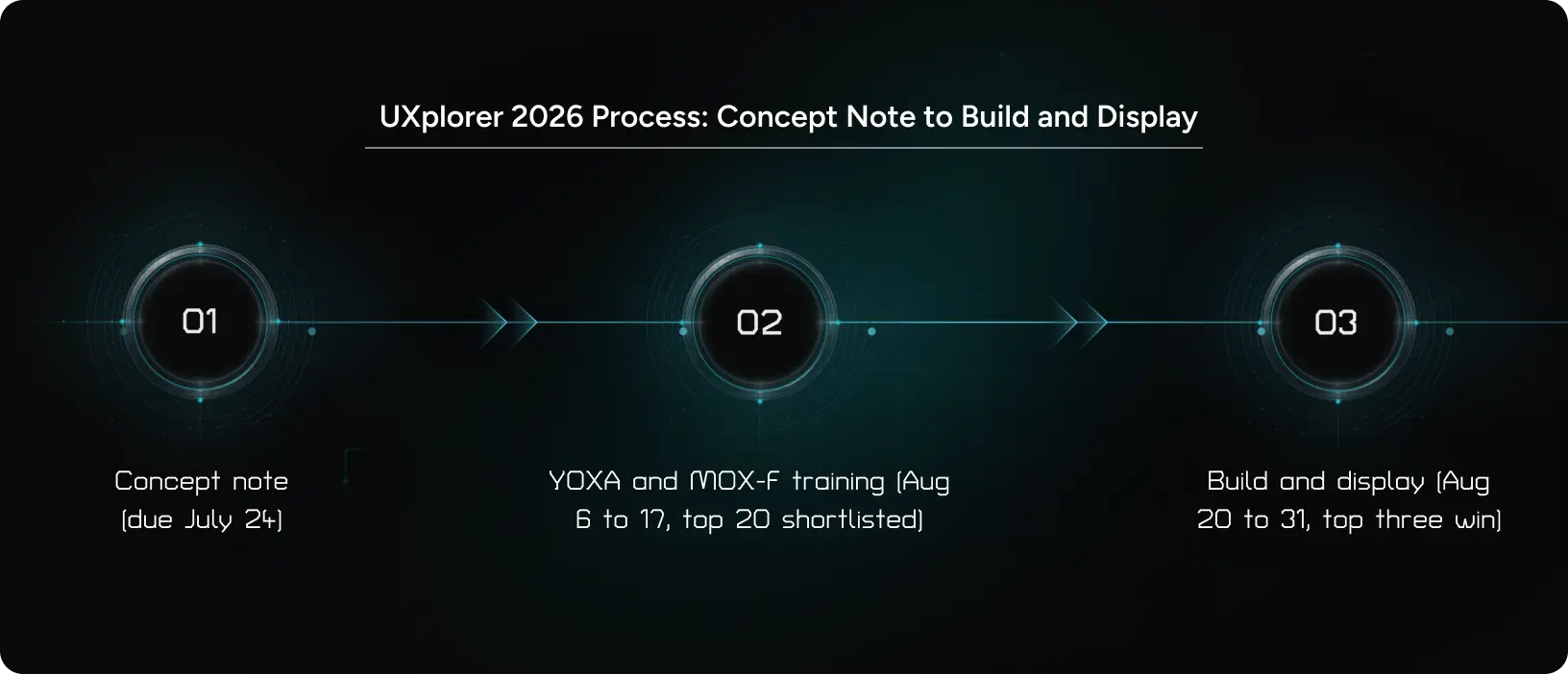
UXplorer 2026 is the world’s first design-led agent design challenge, hosted by Yuj Designs. Instead of automating broken enterprise workflows with AI, it asks people to reimagine those systems from the ground up and design an agent that fits. Entries begin with a one-page concept note by the aspirant (student from any discipline), due July 24, 2026, followed by hands-on YOXA and MOX-F training, culminating in the development and presentation of a working AI agent prototype.
Introduction
The biggest problem with enterprise AI isn’t the technology. It’s how it’s being applied. A company deploys an AI agent, drops it onto a workflow that was already broken, and waits for the magic. The agent runs. It processes requests. It generates outputs. And twelve months later, someone asks why the money vanished and nothing got scaled.
We’ve watched this business scenario before. It was called digital transformation, and most companies got it wrong for the same reason they’re about to get agentic AI wrong: they automated the mess instead of fixing it.
UXplorer 2026 is a call to those who refuse to build around broken systems. The goal isn’t to automate what’s already there, but to reimagine how the system should work before a single agent is deployed.
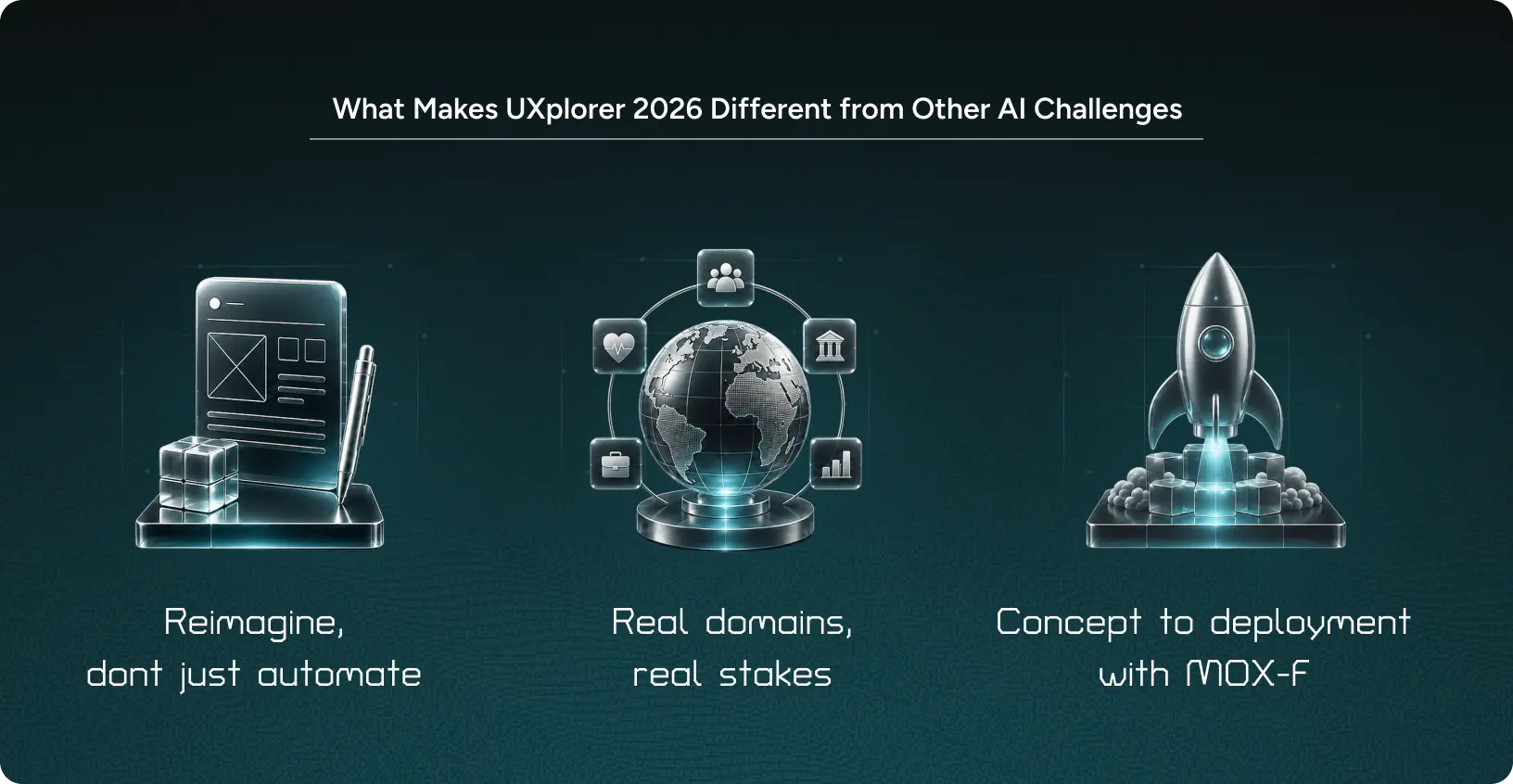
What is UXplorer 2026?
UXplorer 2026 asks one hard question: if you rebuilt this system from scratch, what would it look like?
Most competitions in the AI space reward technical cleverness. This one rewards judgment. Yuj isn’t looking for people who can wire up an agent to replicate an existing workflow. It’s looking for people who’ll throw the workflow out and ask what the system should be in the first place.
That shift may sound subtle, but it’s transformational. It’s the difference between treating AI as a bolt-on for existing workflows versus treating it as a design material that reshapes how work gets done. One approach gives you a faster version of a broken process. The other one creates AI-native creators who can eliminate unnecessary work, scale with the business and deliver measurable outcomes. That’s the mindset UXplorer is designed to cultivate: not just people who build AI agents, but AI-native creators who design systems that enterprises can actually trust, adopt, and scale.
The idea underneath: agentic design
Agentic design is the practice of building systems where AI agents make decisions, take action, and hand work back to humans at the right moments. It’s a step beyond conversational UX or drawing screens for a chatbot. The real work is deciding what the agent does on its own, what it escalates to a person, and which parts of the old workflow should simply disappear.
That last part is where most teams flinch. Deleting steps is harder than automating them. But it’s also where the value lives, and it’s exactly the kind of AI agent design UXplorer 2026 is built to surface.
Yuj frames the whole thing around a single line worth remembering: the question was never, can we build an agent that does this task? The question is, should this task exist at all?
The Real Challenge Isn’t Building AI. It’s Making It Usable.
Here’s the part that should concern anyone shipping AI products: most enterprise AI is being built with little or no UX thinking involved. The technology works, but the user experience doesn’t. As a result, AI agents may be technically capable, yet difficult and frustrating to use in practice.
Think about the auditor who gets an alert saying a payment is “risky” with no reason attached, no severity, and no next step. The model worked. The AI user experience failed. The user opens four other tools, rebuilds the context by hand, and quietly stops trusting the system.
That gap is why agentic design matters. An agent that shows its reasoning lowers cognitive load and earns trust. An opaque one gets abandoned, subscription and all. And trust isn’t a soft metric here. People only use AI when they understand, and usage is where the return actually lives. Adoption, faster decisions, less rework, all of it follows from an agent that people believe.
This is also, honestly, where the future of UX design is heading. As companies pour AI into their operations, someone has to design the human side of autonomous systems. The vocabulary for that work, human-AI interaction design, agentic experiences, is being written right now. UXplorer 2026 is a chance to help reimagine it.
How the UXplorer 2026 Agentic Design Challenge Works
The structure is refreshingly light. You don’t need to be a designer or an engineer. You need system thinking, some design judgment, and genuine curiosity about how work happens.
It runs in three stages:
Concept note. Pick a domain where AI disruption is high, then write one page. Name the broken process, reimagine the system, define the agent, and show the ROI. Entries are judged on problem clarity, system reimagination, market viability, and originality. Individual and group entries are both fine, and it’s open globally.
YOXA and MOX-F training. The top 20 shortlisted participants get hands-on training on YOXA – Yuj’s multi-agent orchestration platform and on MOX-F, its Multi-Agent Orchestration Experience Framework. Yuj built MOX-F while developing its own agentic product, so this is production practice, not classroom theory.
Build and present. Participants can take their reimagined system to a working prototype and present it to a jury of enterprise design leaders and agent architects. The top three win.
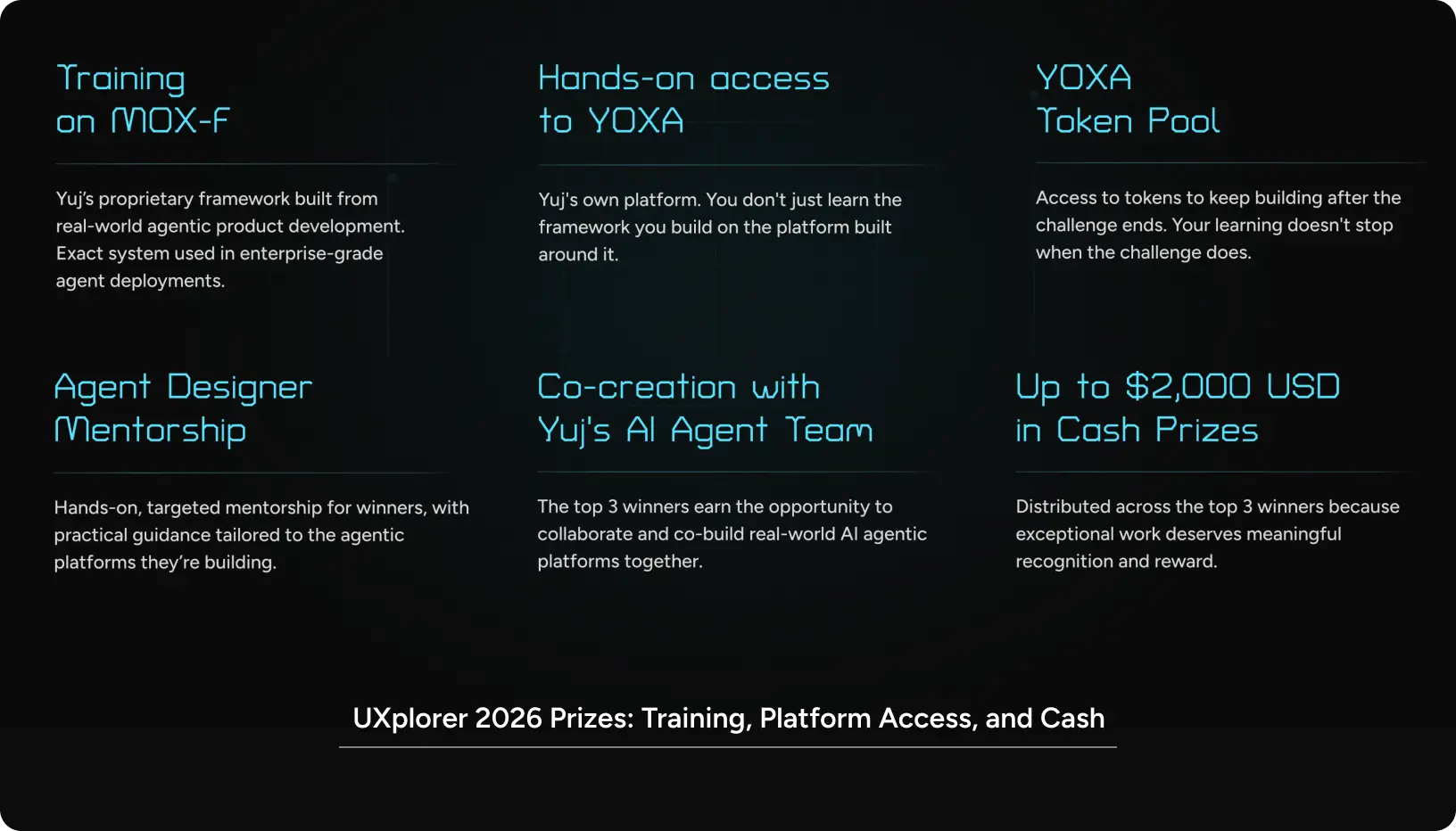
The rewards go far beyond the $2,000 USD cash prize pool. Participants gain training on MOX-F, hands-on access to YOXA with a dedicated token pool to keep building, mentorship from experienced agent designers, and the opportunity to co-create alongside Yuj’s AI agent team. The cash is a bonus, but the real value lies in the skills, framework, and network you leave with.
What does a winning entry look like?
Yuj is blunt about this, and it’s the most useful guidance in the whole brief. Most entries will automate an existing workflow. Winning entries will question whether that workflow should exist at all.
The strongest concept notes tend to do a few things well. They pick a high-impact domain where AI displacement creates a genuine reimagination opportunity. They challenge the current process instead of speeding it up. They show real system thinking: what the agent decides, what it acts on, what it hands back to a human. And they prove the idea is buildable, sellable, and scalable, with a clear understanding of the target audience and the value it delivers.
If your instinct is to make an existing job faster, you’re in the wrong headspace. The instinct that wins here is to ask what the job should even be.
Who Should Enter UXplorer 2026
If you think in systems, care about outcomes more than outputs, and see AI as a design material rather than a shortcut, this challenge is written for you. Yuj has a name for that combination of system thinking, design judgment, and domain curiosity: an AI- Native Creator. Right now, the world doesn’t have nearly enough of them.
The concept note is one page. The deadline is July 24, 2026. There is no registration fee and no prior experience required. Most people will keep building agents on top of broken processes. Some won’t. If you’re in the second group, this is your brief.

FAQs